




Dutch Bombe Desk
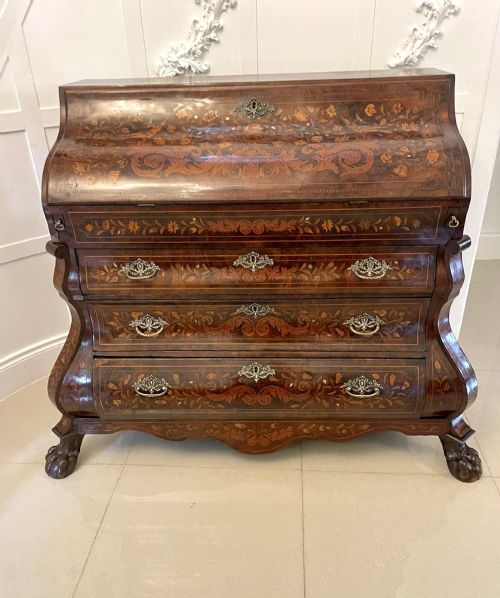
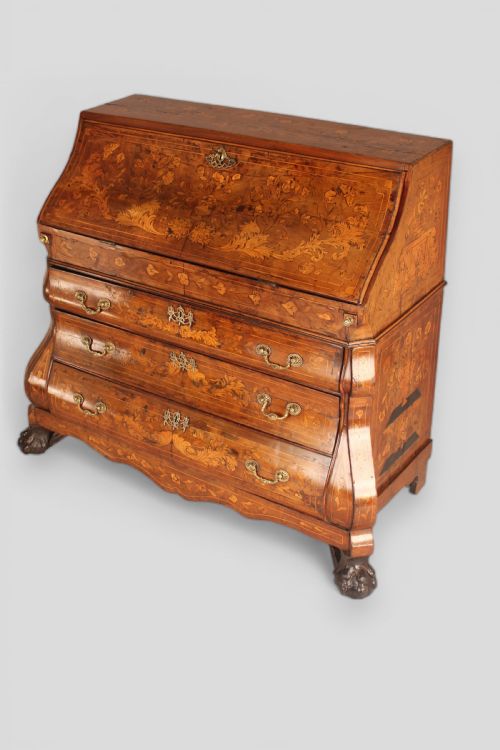
These walnut and mahogany bureau bookcases and writing desks show the swelling lines of a dutch bombe desk.
Dutch Bombe Desk
A dutch bombe desk brings sweeping, convex contours to a working writing cabinet, uniting practical storage with distinct continental character. Pieces appearing here span the eighteenth century, the nineteenth century, and later revivals, offering both compact writing bureaux and towering bureau bookcases.
The form relies on a characteristic outward-swelling front and sides that taper toward the base, creating a substantial silhouette. Walnut, burr walnut, and mahogany provide the primary surfaces, often enriched by elaborate floral marquetry in fruitwood.
Makers working within the Dutch Rococo and Dutch Baroque traditions shaped these writing desks to catch the light across curved panels. Bureau cabinets and cylinder desks appear alongside standard bureaux, each displaying the characteristic bombe profile.
How they were made
Cabinetmakers constructed carcass frames in oak and fruitwood before applying rich veneers of burr walnut and mahogany to the curved surfaces. This multi-layered approach prevented warping while presenting deeply figured grain across the sweeping bombe profile.
Marquetry panels were formed by hand-cutting delicate fruitwood inlays into complex floral and foliate motifs, then fitted directly into the primary timber. Brass hardware, including drop handles and escutcheons, was cast and chased to complement the scrolling drawer fronts.
What varies in quality
The ambition of the marquetry and the choice of veneer set individual pieces apart, separating standard workshop output from exceptional cabinetwork. Highly figured burr walnut and dense, multi-toned fruitwood inlay demand advanced technical skill to execute across curved drawer fronts.
Proportion and the handling of the bombe swell dictate the visual success of the piece, with superior examples maintaining balanced curvature from top to foot. Interior arrangement also marks quality, distinguishing simple pigeonholes from fitted drawers with secret compartments.
Morison of Edinburgh
The Dutch Bombe Desk Glossary
- Bombe
- A bulging, outward-curving profile found on the front and sides of case furniture. This swelling form requires specialist joinery to shape solid timber or apply veneer to curved surfaces.
- Marquetry
- Decorative veneer work formed by fitting together small pieces of tinted wood, fruitwood, and other materials to create pictorial or floral patterns. It differs from inlay by covering the entire surface as a single sheet before application.
- Bureau bookcase
- A dual-purpose piece combining a sloping-lid writing desk below with enclosed shelving above. Upper sections typically feature glazed or panelled doors to display books and porcelain.
- Burr walnut
- Timber taken from the abnormal growth or burl of a walnut tree, yielding complex, swirling grain patterns. Cabinetmakers prize this material for its decorative impact on primary display surfaces.
- Cylinder desk
- A writing cabinet featuring a quarter-circle rolling wooden shutter that conceals the fitted desk interior. When closed, the curved cylinder protects the writing surface and papers.
Dutch Bombe Desk: Frequently Asked Questions
What is a dutch bombe desk?
A dutch bombe desk is a writing cabinet defined by its convex, swelling front and sides, which give the piece a weighty, sculptural presence.
These desks often feature elaborate floral marquetry in fruitwood and come in forms ranging from compact slant-front bureaux to tall bureau bookcases.
How do I date a dutch bombe desk?
Dating relies on examining the secondary timbers, construction methods, and hardware styles alongside the primary veneers and marquetry motifs.
Eighteenth-century examples typically show hand-cut dovetails and native oak linings, while nineteenth-century revivals and later pieces reveal different secondary woods and mechanical precision.
Where were dutch bombe desks used?
These pieces served as private writing and storage cabinets in the principal rooms of wealthy homes, merchants' houses, and town residences.
The sloping lid dropped down to provide a stable surface for correspondence, while internal compartments kept ledgers and writing materials secure.
How do I care for burr walnut veneer?
Burr walnut requires stable indoor humidity and protection from direct sunlight to prevent the thin decorative veneers from drying, fading, or lifting.
Application of traditional wax polish maintains the moisture and natural lustre of the timber without building up synthetic residues.