


Delftware Ceramic Jugs
These delftware ceramic jugs bring tin-glazed earthenware and cobalt pigment into domestic spaces, offering collectors historic forms from Dutch, German and English potteries.
Delftware Ceramic Jugs
When you search for delftware ceramic jugs, you encounter hollow vessels formed primarily from earthenware and finished with a distinctive tin glaze. These pieces span centuries of production, recording shifts from early seventeenth-century models through to nineteenth-century interpretations.
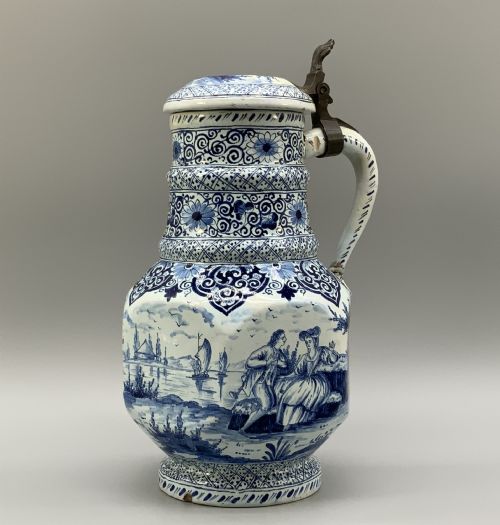
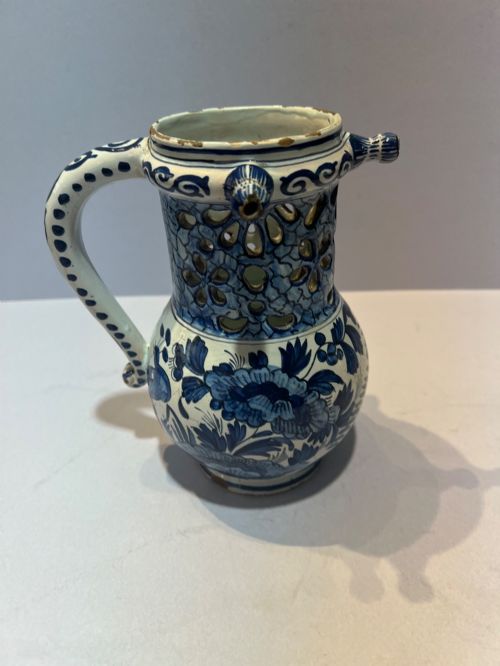
The objects take various functional and decorative shapes, including pitchers, ewers, tankards, coffee pots, puzzle jugs, and figural Toby jugs. Many examples employ blue and white decoration, whilst others utilise polychrome palettes and manganese highlights.
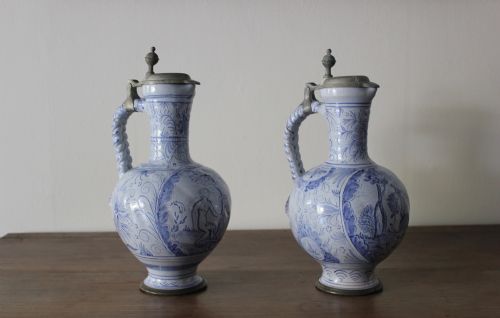
Dutch origins dominate the selection, alongside German faience and English delftware examples. Buyers frequently meet pieces featuring Chinoiserie motifs, floral patterns, and pewter lidded mounts.
Assessing craftsmanship and finish
Quality rests upon the crispness of the painted decoration and the stability of the tin glaze over the earthenware body. Superior examples display controlled brushwork, particularly within Chinoiserie scenes and botanical motifs.
The integration of metal mounts, such as pewter lids on eighteenth-century jugs, influences the overall character of the piece. Well-balanced forms and uniform glaze coverage distinguish finer studio output from standard utilitarian wares.
Listings incorporate earthenware, tin-glazed earthenware, and pewter across periods spanning the seventeenth, eighteenth, and nineteenth centuries.
Pieter Verburg
The Delftware Ceramic Jugs Glossary
- Tin Glaze
- An opaque white ceramic glaze containing tin oxide, which provides the characteristic smooth background for painted decoration on delftware. This coating absorbs pigments readily before firing.
- Cobalt Pigment
- A metallic blue colouring agent used extensively under the glaze to create the deep blue motifs seen on traditional pottery. It reacts with high kiln temperatures to yield rich hues.
- Faience
- European tin-glazed earthenware, particularly that produced in France, Germany, and the Netherlands. The term encompasses various forms of decorated pottery sharing similar glazing techniques.
- Chinoiserie
- European artistic style reflecting Chinese motifs and landscapes, frequently hand-painted onto seventeenth and eighteenth-century ceramics. This aesthetic appears across numerous blue and white vessels.
- Toby Jug
- A pottery jug modelled as a seated figure, usually a robust person holding a mug and jug of beer. These figural pieces emerge in nineteenth-century production.
Delftware Ceramic Jugs: Frequently Asked Questions
What is delftware?
Delftware is tin-glazed earthenware produced primarily in the Netherlands and England, featuring a white opaque glaze painted with mineral pigments.
The tradition evolved over centuries, encompassing domestic vessels, decorative jugs, and figural containers.
How do I date a jug?
Dating relies on stylistic shifts, glaze characteristics, and potting techniques recorded across the seventeenth, eighteenth, and nineteenth centuries.
Early pieces often feature specific Chinoiserie painting styles, whilst later nineteenth-century examples introduce polychrome Toby designs and different baseline clays.
Are pewter lids original?
Many historical jugs feature fitted pewter mounts added by makers to protect rims and seal contents.
These metal additions require careful observation to determine period authenticity relative to the ceramic body.
How were puzzle jugs used?
Puzzle jugs functioned as tavern novelties designed with perforated necks that forced drinkers to solve a riddle to imbibe without spilling.
Potters constructed these vessels using internal channels to challenge guests during social gatherings.