


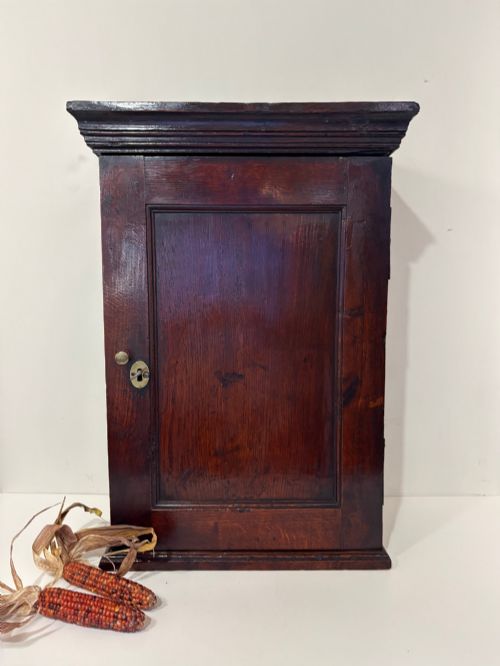
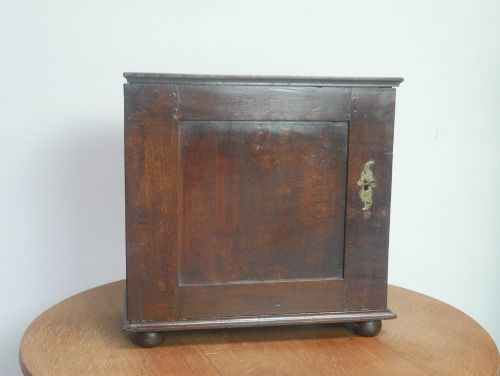
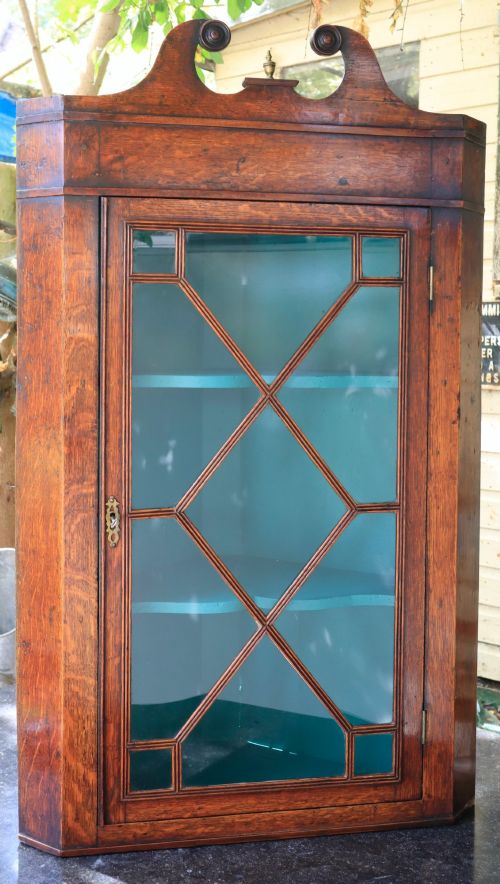
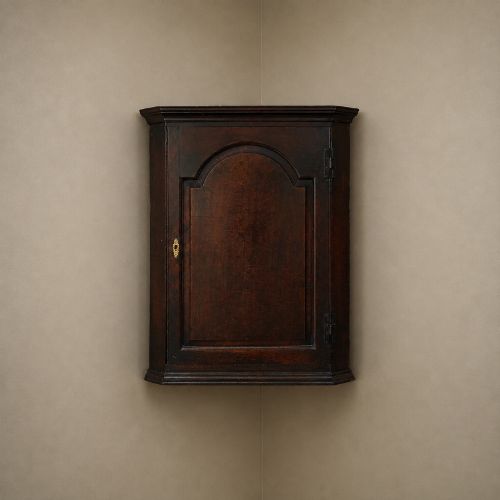
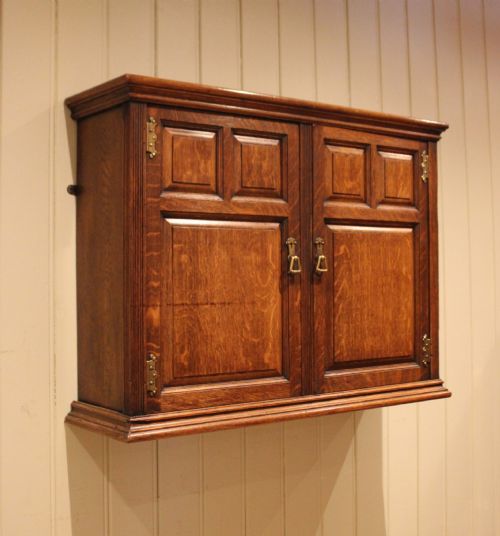
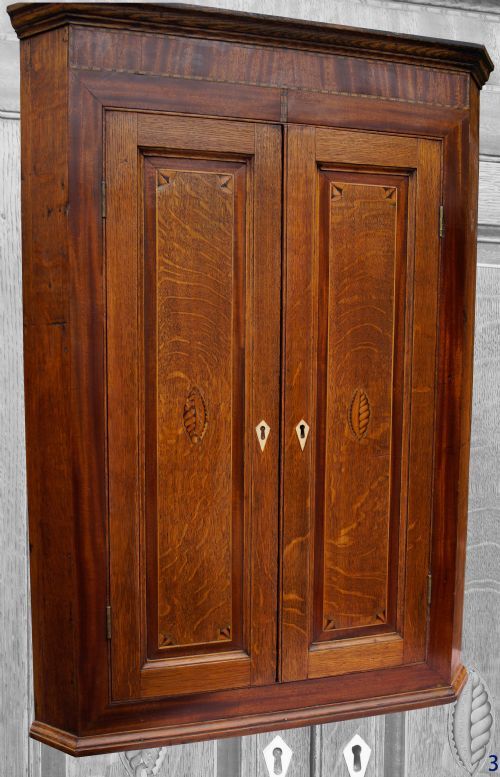
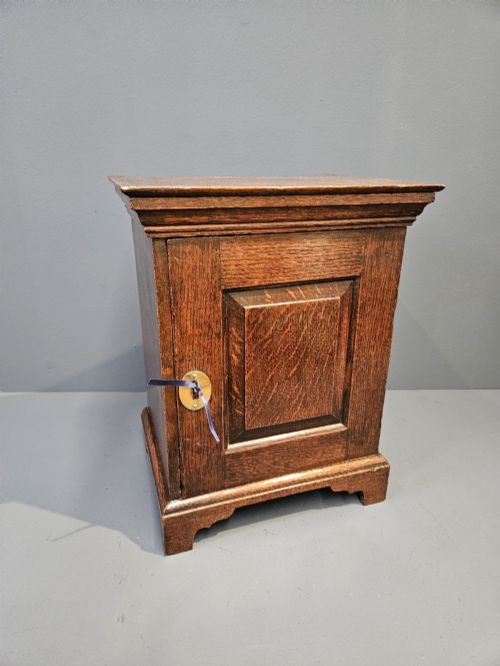
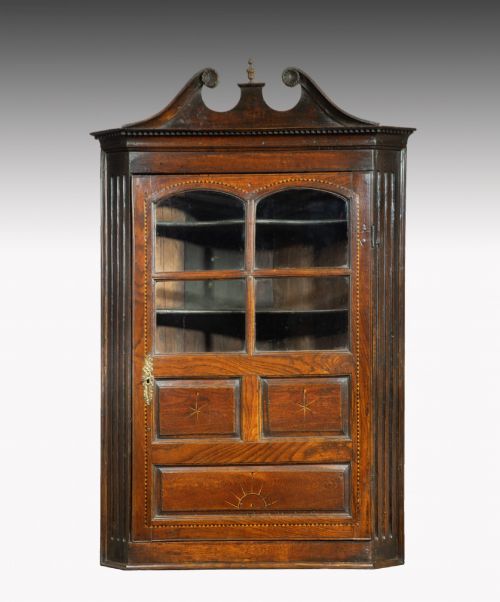


Dark Oak Wall Cupboard
A dark oak wall cupboard brings rich grain and practical storage to any room, holding centuries of craft in a compact, hanging form.
What these pieces are
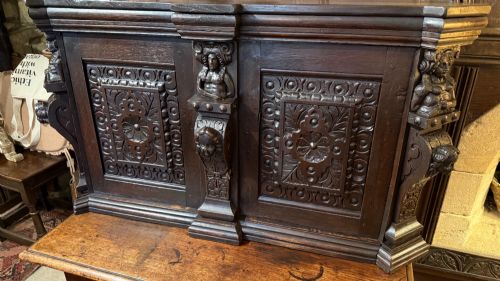
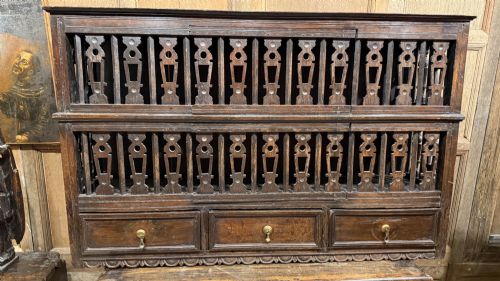
A dark oak wall cupboard is a sturdy hanging cabinet designed to save floor space while keeping household goods secure. The examples seen on this page span several distinct eras, including pieces from the seventeenth, eighteenth, and nineteenth centuries.
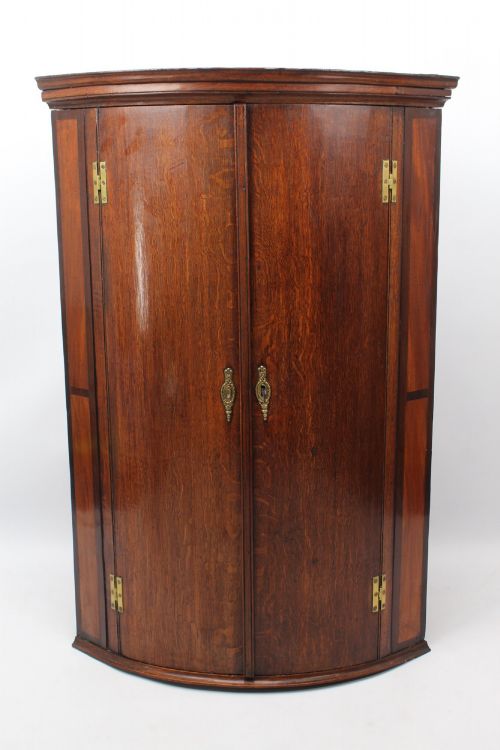
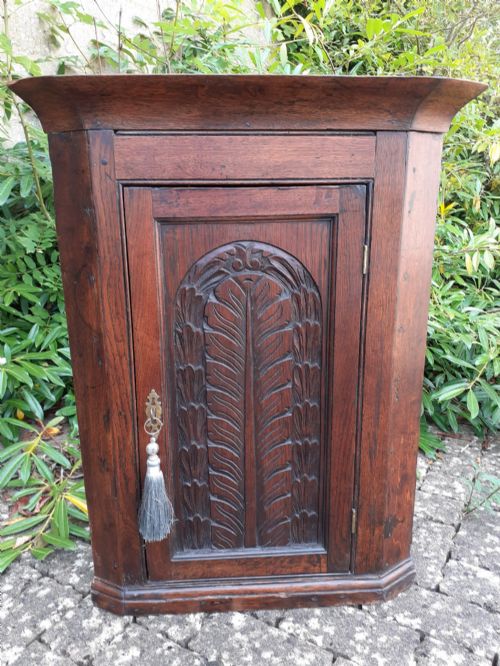
Buyers will encounter forms ranging from traditional rectangular hanging food cupboards to bow-fronted corner cabinets and narrow estate-made pieces. Styles stretch across Georgian, seventeenth century Jacobean, continental Baroque, and Victorian country traditions.
Most items are built to mount directly onto a wall, utilising the natural strength of oak timber. The selection offers various configurations, from simple single-door storage to corner units shaped to fit domestic interiors.
How they were made
The primary material across these listings is solid oak, complemented by secondary details in fruitwood inlay, brass, iron, and various other woods. Joinery relies on traditional methods suited to heavy timber, creating rigid frames capable of supporting heavy loads while hanging.
Metalwork in iron and brass appears on hinges, latches, and escutcheons, providing functional security that contrasts with the dark timber. Certain items incorporate wood inlay or fruitwood details to add subtle contrast across the surface of the doors and panels.
Retail Price Guide 2026
Typical UK retail prices for dark oak wall cupboard, calculated from the Sellingantiques database of over a million retail prices indexed since 2003. This retail price guide relies exclusively on Sellingantiques data; no external sources or auction records are used, so the figures do not describe the wider market.
Materials across this selection include solid oak paired with iron, brass, wood inlay, and fruitwood inlay.
What varies in quality
Quality separates through the crispness of the timber's surface preparation and the finesse of any integrated inlay work. Earlier seventeenth-century pieces display heavier structural joinery, whereas eighteenth-century and Georgian examples often show finer proportions and more refined mouldings.
The presence of original hardware, such as brass or iron hinges and locks, elevates an example above those altered with later replacements. Finer pieces also exhibit well-figured oak boards that have aged uniformly over generations.
The Dark Oak Wall Cupboard Glossary
- Hanging Cupboard
- A wall-mounted cabinet designed to keep provisions or small items off the floor. These units use internal shelves or hooks to organise stored contents.
- Bow Front
- A convex curved cabinet front that softens the linear geometry of a room. This shape requires advanced woodworking skill to bend or shape the solid timber framework.
- Corner Cabinet
- A specialised storage unit built to fit directly into a room angle. These pieces make efficient use of otherwise neglected domestic space.
- Fruitwood Inlay
- Decorative contrasting wood inserted into the primary oak surface. This technique creates geometric or floral patterns across the door panels.
- Estate Made
- Furniture constructed locally on a landed property rather than in a commercial urban workshop. Such pieces often display idiosyncratic regional details and robust utilitarian construction.
Frequently Asked Questions
How do I hang a heavy oak wall cupboard safely?
These cupboards require secure fixing directly into masonry or substantial wall studs to support the weight of solid oak timber.
Professional installation is recommended due to the dense materials and historical nature of the hanging brackets.
What is the difference between a corner cabinet and a standard wall cupboard?
A corner cabinet has an angled back designed to fit snugly into the ninety-degree junction of two walls.
Standard wall cupboards feature flat backs intended for placement on a single flat wall surface.
How do I care for antique oak timber?
Maintain the wood by applying traditional beeswax periodically to nourish the dry surface and preserve the dark finish.
Avoid placing these cupboards near direct heat sources or rapid temperature shifts that might cause the timber to split.
Are all these cupboards from the same period?
The listings include pieces spanning from the seventeenth century through to the nineteenth century.
Stylistic shifts range from early Jacobean and continental Baroque influences to later Georgian and Victorian country designs.