
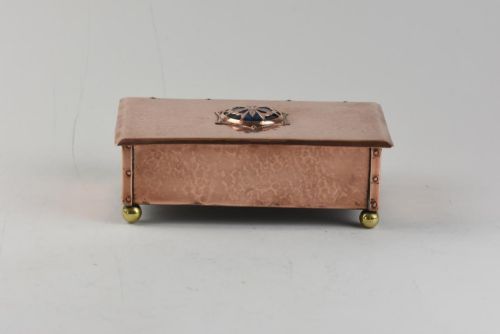
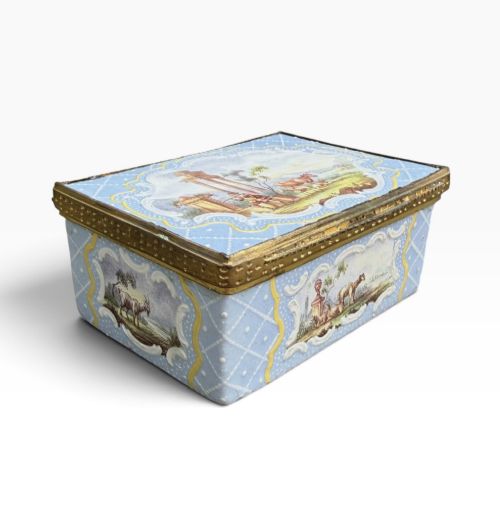
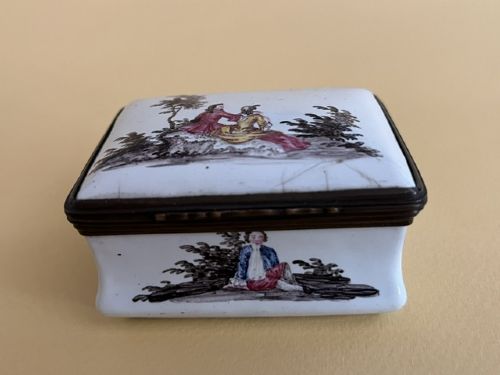


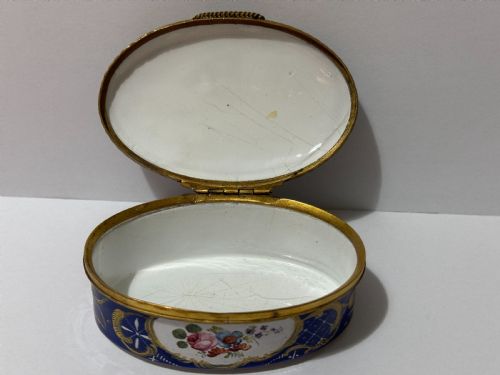


Copper Enamel Trinket Box
These copper enamel trinket box examples offer vibrant portable colour and miniature craftsmanship, bringing eighteenth-century Georgian elegance and Meiji period detail straight to the collector's desk.
What these boxes are
The pieces listed on this page span the Georgian era through to eighteen eighty, encompassing Staffordshire and Bilston workshops alongside Japanese ateliers. These small containers served practical purposes for holding patches, trinkets, or powder while doubling as miniature canvases for enamellers.
Georgian examples often display topographical inscriptions or floral motifs beneath glossy surfaces, while Japanese pieces utilise cloisonné techniques on similar metal foundations. Each object demonstrates how makers applied vitreous enamel directly onto copper substrates to create durable, highly coloured surfaces.
How they were made
Makers formed the structural bodies of these items from sheet copper, shaping them into boxes, jars, and gourd pots before applying powdered glass coats. Fusing the vitreous enamel to the metal required intense kiln heat to melt the minerals into a smooth, colourful glaze.
Mountings and hinges frequently incorporate brass or gilt metal to frame the enamel panels securely. Artisans then painted fine details directly onto the fired surface or laid down thin wire partitions for cloisonné work.
Listings on this page span the eighteenth century, the year eighteen eighty, and the Georgian and Japanese Meiji styles.
What varies in quality
The fineness of the painted detail and the crispness of the metal mounts distinguish standard production from superior examples. Smoothness across the enamelled surface and the precise alignment of hinges indicate the maker's original level of skill.
Complexity of design also dictates the standard of the piece, moving from simple floral fields to detailed topographical scenes or intricate wirework cloisonné. Preserved gloss on the glass surface without extensive chipping shows how well the object survived its centuries of handling.
The Copper Enamel Trinket Box Glossary
- Bilston enamel
- A specific regional designation for enamel boxes produced in the Staffordshire town of Bilston during the Georgian period. These items typically feature hinged copper bodies decorated with colourful painted scenes.
- Cloisonné
- A technique where thin metal wires are soldered to a copper base to form compartments that are subsequently filled with enamel paste and fired. This method creates detailed, compartmentalised patterns across the surface of lidded pots.
- Patch box
- A small eighteenth-century container originally designed to hold cosmetic beauty patches worn on the face. They usually incorporate a mirrored interior lid alongside an enamelled exterior.
- Staffordshire enamel
- A classification covering enamel trinket boxes and patch boxes manufactured within the Staffordshire pottery region. These pieces frequently showcase topographical titles or sentimental inscriptions.
- Vitreous enamel
- A material made by fusing powdered glass to a metallic substrate through high-temperature firing. This process produces a hard, glossy, and chemically resistant decorative coating.
Frequently Asked Questions
What were copper enamel trinket boxes used for?
These small vessels originally held cosmetic patches, small trinkets, or personal items for daily use by Georgian and Meiji society.
Their portable size made them suitable for carrying in pockets or displaying on dressing tables and desks.
How do I identify a Georgian enamel box?
Georgian examples typically feature copper bodies with hand-painted enamel decoration, often showing specific period styles and titles like Cheltenham Wells.
They frequently employ brass mounts and simple hinged lids characteristic of eighteenth-century manufacturing methods.
What is the difference between Staffordshire and Meiji pieces?
Staffordshire items from the eighteenth century rely on painted enamel surfaces on copper bases, often with textual inscriptions. Meiji period Japanese pieces from eighteen eighty utilise cloisonné wirework to create intricate patterns across metal vessel forms.
How should I care for an antique enamel box?
Keep these delicate items away from direct sunlight, moisture, and extreme temperature shifts to protect the glass surface and metal mounts.
Clean them gently with a soft, dry cloth without applying harsh chemical polishes to the enamel.