
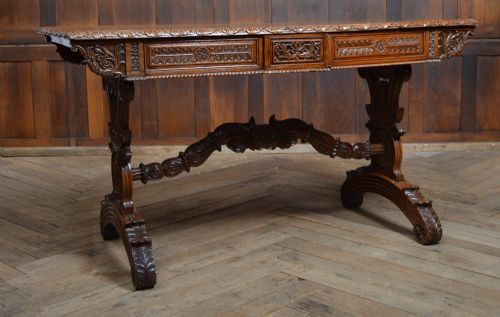


Colonial Hardwood Desk
A colonial hardwood desk brings dense tropical timbers and intricate hand-carved detail into a study.
Colonial Hardwood Desk
A colonial hardwood desk represents the intersection of British nineteenth-century form with skilled craftsmanship from distant territories. When searching for a colonial hardwood desk, buyers encounter heavy writing furniture designed for administrators, merchants, and officers stationed abroad.
The pieces appearing on this page span the Victorian era, utilising dense timbers imported to serve imperial households and offices. Forms range from partners desks and bureau desks to pedestal variants, often carrying the deep relief carving characteristic of Anglo-Indian workshops.
Materials and construction methods
These items rely on heavy exotic timbers such as teak, padauk, and rosewood, selected for their stability and resistance to climate. Artisans worked these dense hardwoods using hand tools to create robust carcases capable of withstanding tropical humidity and heavy use.
Surface enrichment frequently involves intricate chip carving and relief work, complemented by functional brass hardware for campaign transport. Selected pieces incorporate contrasting details like bone inlay or incorporate needlepoint upholstery on associated seating.
An exceptional pair of carved ebony elephants stands ready to guard the desk, proving that nineteenth-century desks rarely travelled alone.
Assessing grade and execution
Quality in these items rests upon the depth, sharpness, and discipline of the hand-carved ornament. Superior examples display crisp foliage and figures carved directly into the structural timber rather than applied as separate decorative mouldings.
Engineering and secondary woods also dictate the tier of a piece, separating utilitarian camp equipment from grand partners desks intended for principal residences. The weight of the timber and the integration of internal fittings demonstrate the original commission's budget.
The Colonial Hardwood Desk Glossary
- Partners desk
- A large double-sided writing table designed for two people to work opposite one another, featuring drawers on both longitudinal faces. This form served government offices and boardrooms.
- Padauk
- A heavy, durable hardwood with a reddish-orange hue that darkens with age to a deep brown. It was favoured for fine cabinetmaking in colonial regions due to its stability.
- Campaign box
- A portable container or desk made in sections with recessed brass handles for military transport. Officers utilised these pieces during British Army deployments.
- Anglo-Indian
- A descriptive term for furniture made in the Indian subcontinent during the British period, combining European forms with local carving traditions. Artisans utilised native timbers for these commissions.
Colonial Hardwood Desk: Frequently Asked Questions
What is a partners desk?
A partners desk is a large double-sided writing table designed with drawers and cupboards accessible from both faces. This configuration allowed two individuals to sit opposite each other and work simultaneously.
Such forms were standard in government offices, banks, and large libraries during the nineteenth century. They require substantial floor space to allow access from all sides.
What woods were used?
Cabinetmakers working in British colonies utilised dense tropical hardwoods such as teak, padauk, and rosewood. These timbers offered exceptional resistance to warping and insect damage in humid climates.
The natural grain and colour of these woods meant they often required little staining. Over time, exposure to light deepens the rich tones of padauk and teak.
Where were these pieces made?
These items were produced in workshops across the Indian subcontinent and other British territories during the nineteenth century. Local craftsmen applied traditional carving techniques to standard British furniture patterns.
This fusion resulted in distinct regional styles often categorised as Anglo-Indian. The workshops combined European utility with intricate botanical and figurative relief carving.