




Antique Colonial Bureau
An antique colonial bureau is a robust writing piece designed for distant postings, offering fitted compartments and fold-down desks in dense timbers.
Antique Colonial Bureau
An antique colonial bureau represents the convergence of British administrative needs and overseas cabinet-making traditions, typically taking the form of a fall-front desk or a secretaire chest. The pieces encountered on this page span several distinct expressions, ranging from campaign furniture intended for travel to heavy Anglo-Indian examples carved from regional hardwoods. Buyers searching for an antique colonial bureau frequently encounter desks and chests of drawers that integrate writing surfaces with secure storage compartments.
The stylistic lineage recorded in these listings includes Anglo-Indian, Victorian military, and Spanish colonial revivals, reflecting global movement and trade. Dating spans from seventeenth-century Spanish vargueno cabinets up to Edwardian interpretations, though the nineteenth century provides the bulk of the utilitarian campaign forms. Elm, teak, padouk, and walnut appear frequently, forming the structural backbone of these travel-ready writing cabinets.
Materials and construction
Makers utilised dense tropical hardwoods such as teak, padouk, and mahogany to withstand harsh climates and frequent transport. These timbers resist warping and wear, providing a stable foundation for intricate carvings or plain, functional surfaces.
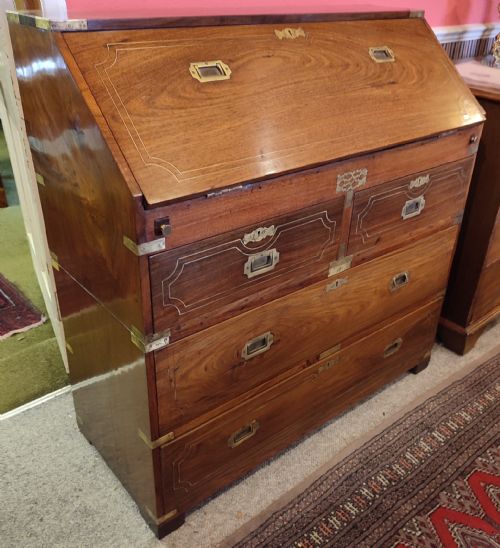
Brass mounts, corner brackets, and flush handles reinforce the construction of campaign-style pieces, protecting vulnerable edges from impact during transit. Secondary elements like leather writing inserts and iron locking mechanisms ensure the desks remain functional administrative tools.
Captain Fairbrother left his name attached to a teak campaign secretaire chest, preserving a personal travel history in brass.
Assessing quality and origin
The refinement of internal drawer configuration and the crispness of regional carving separate standard utilitarian items from exceptional pieces. Superior examples exhibit tightly dovetailed joints in secondary woods and well-integrated secret compartments within the bureau interior.
The integrity of the original brass hardware and the stability of the timber grain dictate the overall standard of the desk. Pieces retaining their original fitted campaign interiors and functioning locks command greater interest from collectors than modified or heavily restored examples.
The Antique Colonial Bureau Glossary
- Campaign chest
- A piece of furniture made in sections with brass corners and recessed handles, designed to be packed down and transported easily.
- Secretaire bureau
- A cabinet featuring a pull-out or drop-front drawer that conceals a writing surface and small pigeonholes.
- Anglo-Indian
- A descriptive term for furniture made in India during the British period, combining European forms with local carving styles and timbers.
- Vargueno
- A type of Spanish cabinet with a drop-front panel that opens to reveal numerous small drawers and compartments.
- Padouk
- A heavy, durable reddish-brown tropical hardwood utilised extensively in colonial cabinet-making.
Antique Colonial Bureau: Frequently Asked Questions
What is an antique colonial bureau?
An antique colonial bureau is a portable or stationary writing cabinet produced in overseas territories or influenced by global trade.
These pieces often feature fold-down desks and internal compartments designed for administrative work away from home.
How do I date a campaign bureau?
Dating relies on timber selection, brass hardware design, and construction methods like dovetailing.
Nineteenth-century examples frequently utilise teak or padouk with recessed brass handles for military transport.
Where were these bureaus made?
Production occurred across British colonies, particularly India, as well as Spanish territories influenced by European trade.
Local artisans adapted domestic forms using regional hardwoods like elm and teak.
How do I care for tropical hardwood?
Maintain stable indoor humidity levels to prevent the dense timber from splitting.
Apply occasional appropriate wax to nourish the grain without sealing the surface unnaturally.