
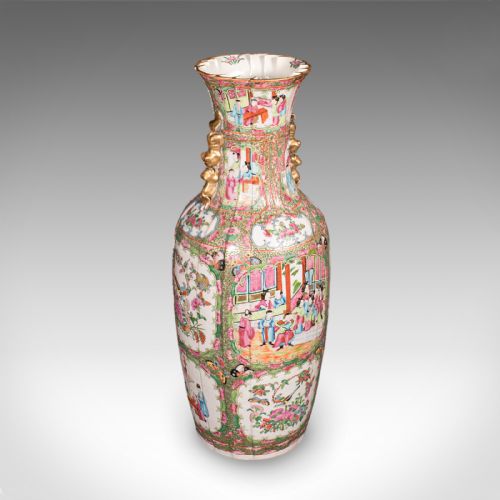


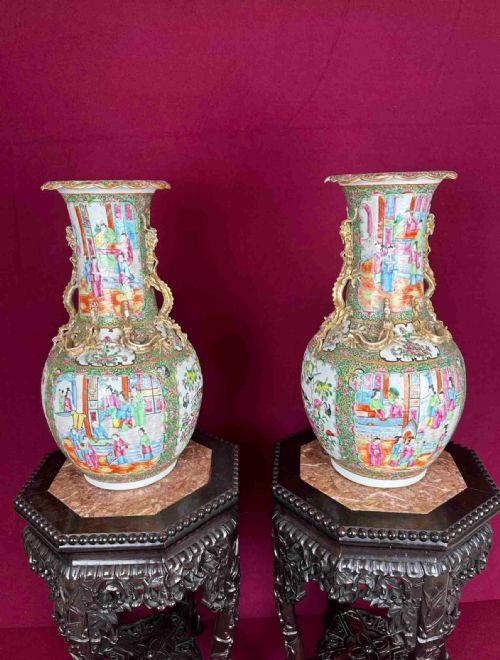


Chinese Court Scene Vases
Chinese court scene vases bring vibrant narrative scenes into a room, offering a rich glimpse into nineteenth-century export art.
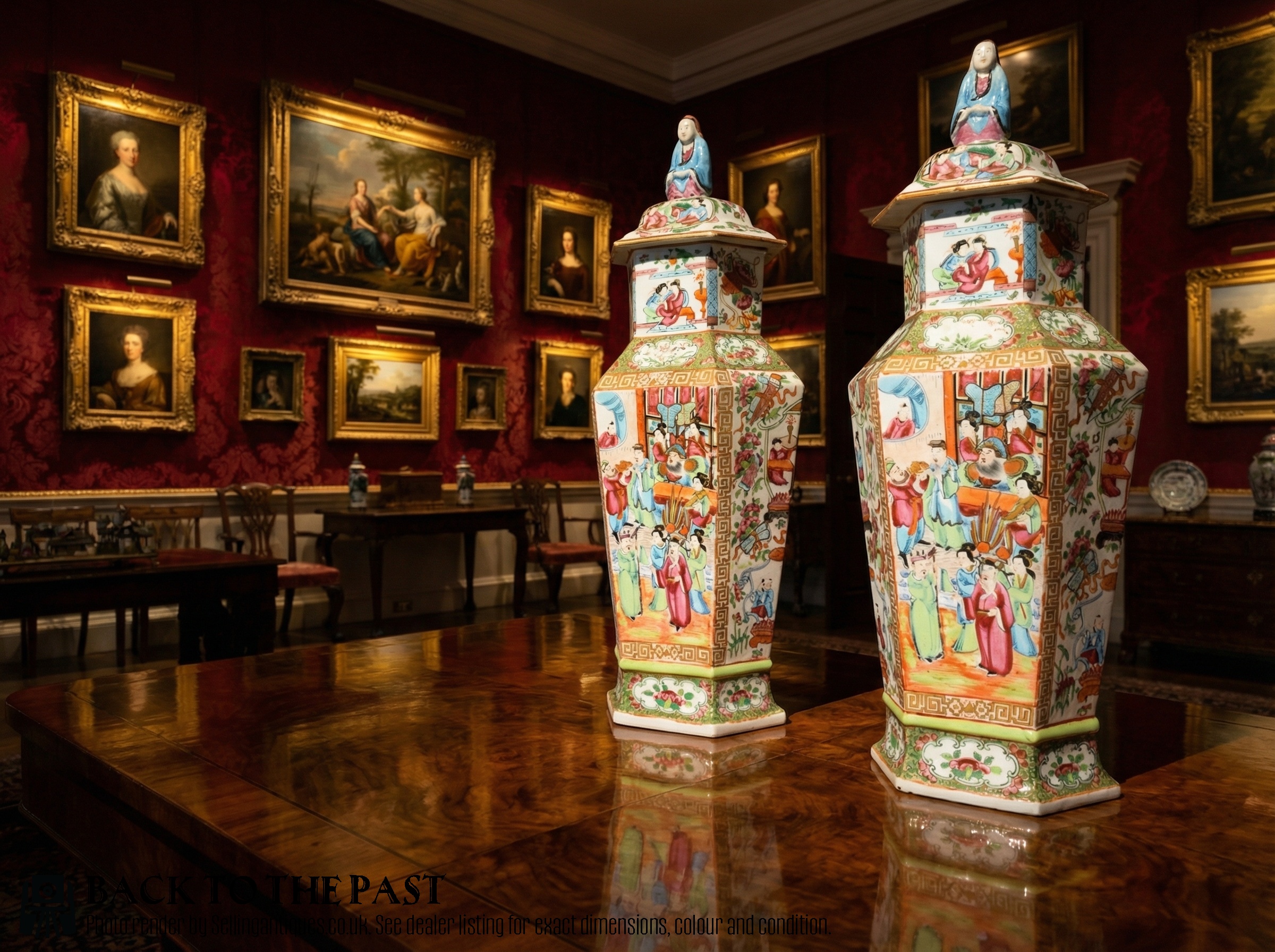
What Chinese court scenes vases are
The dominant aesthetic draws upon Chinese Export and Canton traditions, showcasing ornate figural narratives alongside botanical motifs. You most frequently meet Cantonese and Rose Medallion designs on this page, reflecting the specific decorative output of the period.

How they were made
The foundation of each piece is porcelain, shaped into substantial vessel forms and fired before decoration is applied. Artisans then employed detailed enamel work to build up the complex multi-figure narratives and floral borders.
Surface enrichment often includes gold leaf or gold gilt highlights, adding a luminous quality to the painted panels. Selected pieces also incorporate carved wood elements, such as fitted bases or lids, completing the traditional construction.
Retail Price Guide 2026
Typical UK retail prices for chinese court scene vases, calculated from the Sellingantiques database of over a million retail prices indexed since 2003. This retail price guide relies exclusively on Sellingantiques data; no external sources or auction records are used, so the figures do not describe the wider market.
Listings on this page span the nineteenth century, uniting Victorian tastes with Qing dynasty porcelain and enamel traditions.
What varies in quality
Quality reveals itself in the precision and density of the hand-painted court scenes, where master painters achieved greater expressiveness in the figures and crispness in the surrounding geometric borders. The application of gold leaf shows clear gradation, with finer examples retaining richer, more meticulous gilding across the panels.
The overall scale and proportion of the porcelain body also distinguish the work, as larger pairs demand superior potting skill to prevent distortion during high-temperature firing. Finally, the harmony between the famille rose palette and the subsidiary floral elements separates standard commercial export ware from the most ambitious studio output.
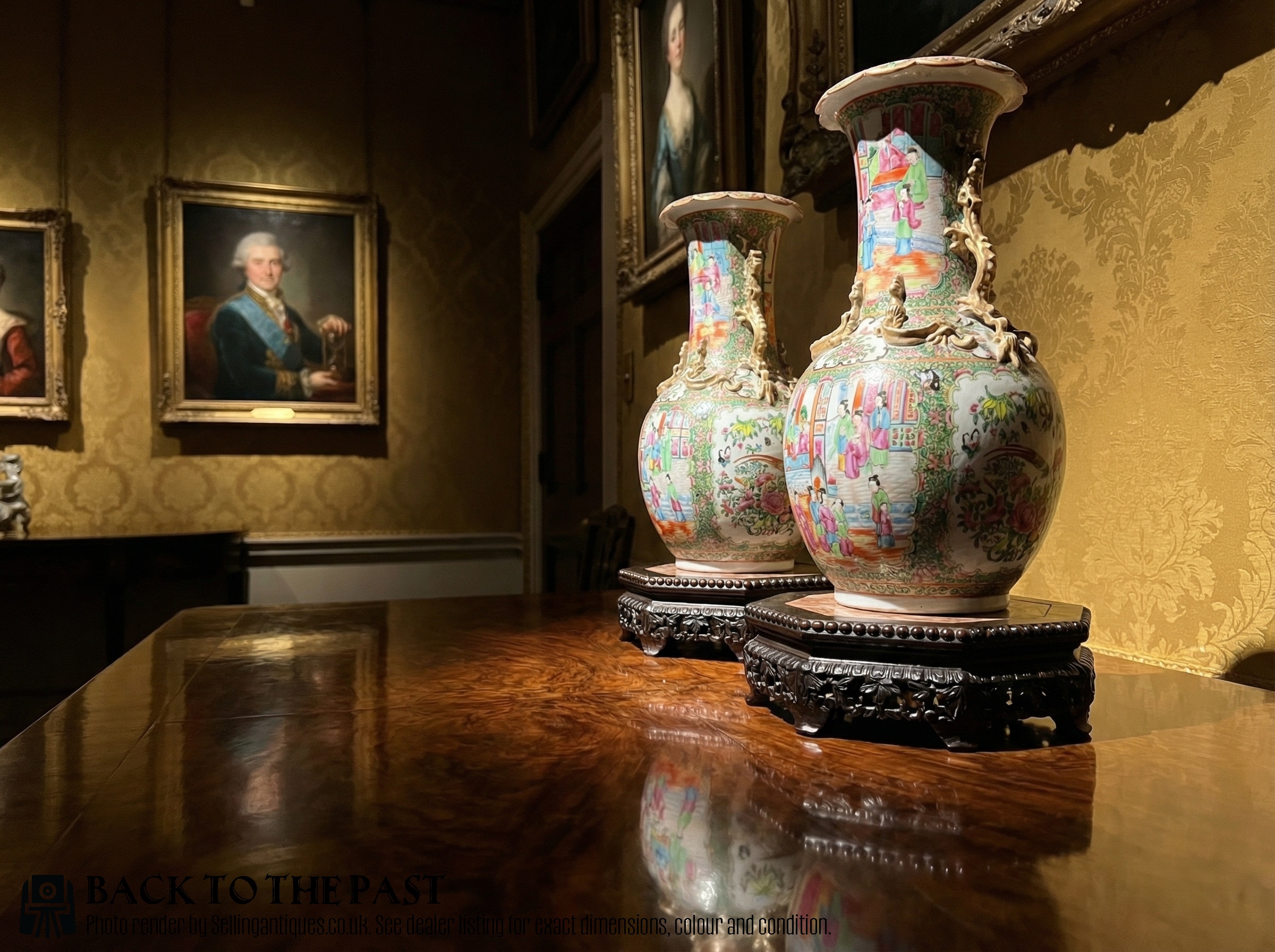
The Chinese Court Scene Vases Glossary
- Canton
- A term denoting porcelain decorated in the southern Chinese port city specifically for export to Western markets. These items are celebrated for their crowded panels of figures, birds, and butterflies.
- Famille Rose
- A major palette of Chinese ceramic enamels introduced in the Qing dynasty, dominated by opaque pink or rose colours derived from colloidal gold. This palette allowed for subtle tonal gradations in painted robes and blossoms.
- Rose Medallion
- A distinct pattern style featuring alternating panels of court figures and birds or flowers, usually arranged around a central medallion. It represents a primary subset of nineteenth-century export porcelain.
- Porcelain
- A hard, fine-grained ceramic material made from kaolin and petuntse, fired at high temperatures until vitrified. It provides the smooth, white ground essential for detailed enamel painting.
- Gilt
- A thin layer of gold applied to the surface of the porcelain or wood elements to accentuate borders and figural details. This technique enhances the decorative richness of the piece.
Frequently Asked Questions
What are Chinese court scene vases?
These pieces are nineteenth-century porcelain vessels created in China for the export market, featuring hand-painted narratives of elite figures in architectural settings.
They combine intricate enamel palettes with decorative gold highlights to present traditional stories on a ceramic canvas.
How were these vases used?
Historically, they served as decorative display objects in grand Western interiors during the Victorian period, often arranged symmetrically as pairs on mantelpieces or cabinets.
Their substantial scale and vibrant narrative panels made them prominent focal points within a room's decorative scheme.
How do I style them at home?
You can display them as statement pairs on sturdy console tables or sideboards where their detailed enamel work can be appreciated up close.
Keep surrounding decor neutral to let the rich colours of the rose medallion palette and gold gilt stand out naturally.
How are periods and types told apart?
Distinctions rely on examining the specific enamel colours, the density of the floral borders, and the style of the figural panels, which align with nineteenth-century export traditions.
References to Qing dynasty aesthetics and Victorian-era acquisition patterns help place the manufacturing window more precisely.