




Canton Famille Rose Urns
Canton famille rose urns bring vibrant Qing dynasty artistry into a room, offering striking hand-painted scenes and rich enamel colour.
Canton Famille Rose Urns
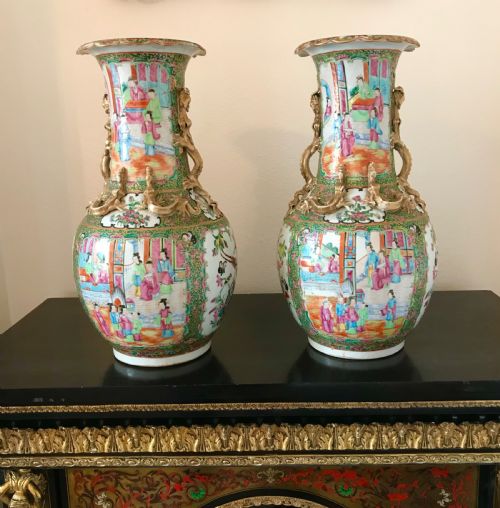
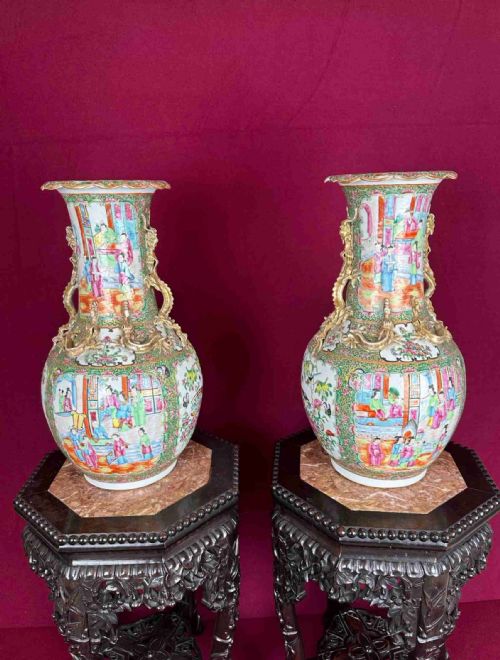
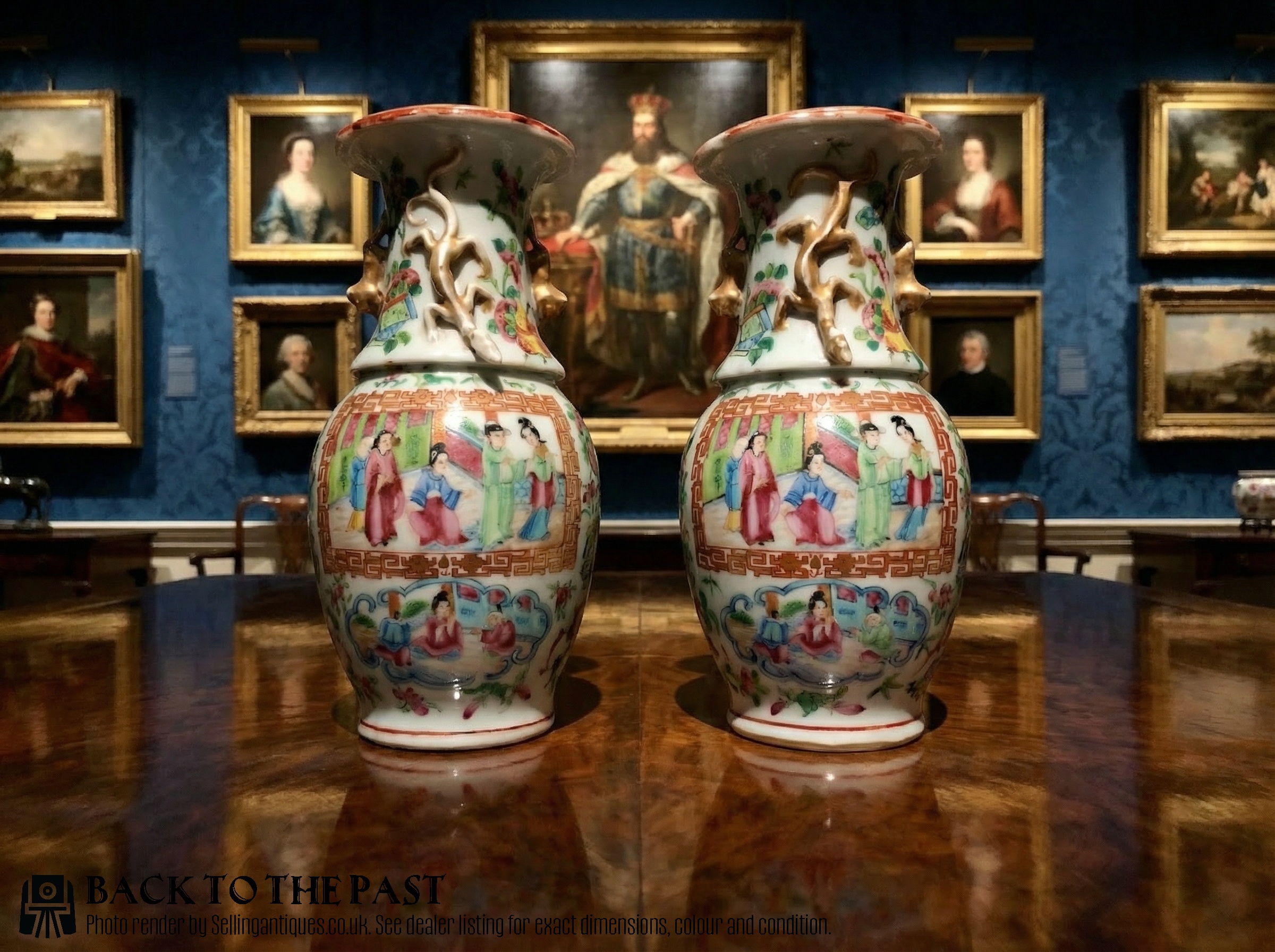
When you search for canton famille rose urns, you encounter nineteenth-century Chinese export porcelain made for Western markets, often featuring intricate figures, birds, and floral panels. The pieces on this page span the nineteenth century, including objects from the Daoguang period and around eighteen-eighty, taking the form of large floor vases, moon flasks, and lidded vessels.
Many examples survive as pairs, while others have been converted into table lamps or mounted with associated stands made from padouk wood or giltwood. You also find them displayed alongside occasional furniture, reflecting how Victorian interiors integrated these decorative imports.
The aesthetic bridges traditional Chinese export production with nineteenth-century taste, presenting dense rose medallion motifs alongside Chinoiserie interpretations. Each vessel demonstrates the scale and visual presence that made these porcelain works enduringly popular with collectors of oriental ceramics.
Materials and Technique
These pieces start as white porcelain bodies, painted by hand using enamel pigments dominated by rose pinks and greens, then enriched with gold leaf and gilt highlights. Firing fixes the glaze and the detailed polychrome designs onto the ceramic surface.
Mounts and display elements incorporate brass, padouk wood, and giltwood, frequently tailored to support heavy vases or to adapt them for electrical lighting during later conversions.
Canton Famille Rose Urns Retail Price Guide 2026
Typical asking prices for canton famille rose urns among the pieces listed under this phrase on Sellingantiques today, from the lower quarter to the upper quarter. They describe what is for sale here now, not the wider market.
Several heavy floor vases spent decades masquerading as reading lamps before returning to their original dignity.
Assessing Quality
Quality rests upon the crispness of the hand-painted brushwork and the complexity of the figural and floral scenes across the porcelain surface. Finer examples display meticulous detail in every panel, maintaining proportion and balance without crowded or rushed execution.
The preservation of the original enamel colours and the integrity of the gilding dictate the visual impact of the piece. Subsidiary elements, such as carved padouk wood stands or heavy brass components, add further distinction when they match the period of the ceramic body.
The Canton Famille Rose Urns Glossary
- Famille rose
- A porcelain palette defined by opaque pink enamel, introduced in the Qing dynasty and widely used in Chinese export wares. This colour scheme allowed for subtle shading and detailed floral rendering.
- Rose medallion
- A specific decorative style of Canton porcelain featuring divided panels filled with alternating scenes of figures, birds, and butterflies. Gold gilt often outlines these compartments.
- Qing dynasty
- The final imperial dynasty of China, spanning from sixteen-forty-four to nineteen-twelve. Production during this era included the major export wares found in nineteenth-century collections.
- Padouk wood
- A dense tropical timber valued for its dark reddish-brown tone and durability. Makers utilised this material for pedestals and stands supporting oriental vases.
- Moon flask
- A flattened circular ceramic vessel with a narrow neck and small loop handles, derived from ancient nomadic leather flasks. These pieces provide a distinctive flat canvas for painted enamel scenes.
Canton Famille Rose Urns: Frequently Asked Questions
How do I date these vases?
Dating relies upon stylistic markers, palette characteristics, and manufacturing traits associated with nineteenth-century production under the Qing dynasty.
Comparison with documented pieces from the Daoguang period or circa eighteen-eighty helps establish a reliable timeframe for each object.
Were these made for export?
Yes, these porcelain works were specifically created in Canton for Western export markets during the Victorian era.
The decorative schemes frequently combined traditional Chinese motifs with forms and presentations that appealed to European buyers.
Can I use them as lamps?
Many nineteenth-century examples were converted into table lamps by wiring through the base or mounting them with appropriate hardware.
This adaptation occurred both historically and in later periods, allowing large decorative vases to function as interior lighting.
How should I clean the surface?
Maintenance requires gentle dusting with a soft, dry cloth to protect fragile enamel pigments and delicate gold leaf highlights.
Avoid chemical cleaners and abrasive materials that can permanently damage the glazed and gilded surfaces.