
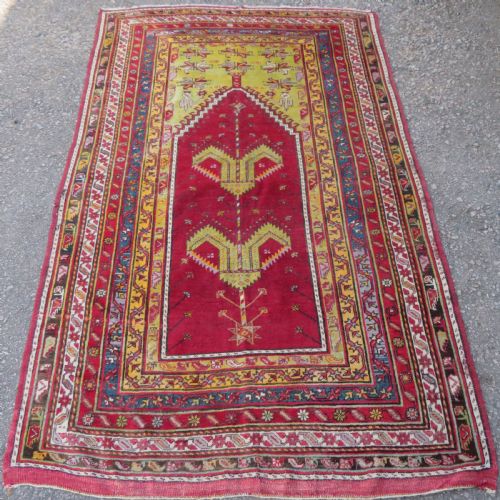


Central Anatolian Carpet
A central anatolian carpet brings centuries of regional weaving traditions into a room, offering geometric motifs and rich vegetable dyes.
Central Anatolian Carpet
A central anatolian carpet represents centuries of village and town weaving traditions from the heart of Turkey, spanning the nineteenth and early twentieth centuries. When searching for a central anatolian carpet, buyers encounter regional village formats such as prayer rugs, runners, and square room-sized carpets.
The pieces on this page originate from specific weaving centres like Kirsehir, Konya, Kayseri, and Oushak. These rugs often display tribal motifs, mihrab designs for prayer, or classic medallion layouts passed down through generations of local artisans.
How they were made
Weavers constructed these textiles primarily using wool foundations and pile, occasionally incorporating cotton for warps and wefts, or silk, floss silk, and art silk for finer city pieces. Natural dyes provided the deep reds, blues, and softer pastel colourways seen across the regional groups.
Hand-knotting techniques varied from coarse, durable village wool weaves to exceptionally fine knots in Sivas and Kayseri workshop productions. The interplay of staple sheep wool and occasional mercerised cotton determined the weight and drape of each individual carpet.
Central Anatolian Carpet Retail Price Guide 2026
Typical asking prices for central anatolian carpet among the pieces listed under this phrase on Sellingantiques today, from the lower quarter to the upper quarter. They describe what is for sale here now, not the wider market.
Listings feature pieces dated from the mid-nineteenth century through to the 1930s, encompassing both village and city origins.
What varies in quality
Knot density and structural integrity dictate the baseline quality of these rugs, separating coarse village utilitarian pieces from finely executed workshop productions. Finer weaves allow for sharper definition in geometric and floral motifs.
The depth, saturation, and stability of the dyestuffs also differentiate examples, as natural dyes age with distinct patination compared to later aniline mixtures. The handling of the wool, whether dense and lustrous or dry, shapes the tactile character of the textile.
The Central Anatolian Carpet Glossary
- Prayer rug
- A small format rug featuring a mihrab or arch design indicating the direction of prayer. These pieces were traditionally used for daily devotions.
- Mihrab
- The arched niche depicted on prayer rugs that points towards Mecca. It serves as the visual focal point of the design.
- Yatak
- A term used for a type of bed rug or heavier sleeping mat produced in the region. These examples tend to have a thicker, longer pile.
- Natural dyes
- Colourants derived from plants, insects, and minerals rather than synthetic chemicals. They produce complex, subtle shades that soften gracefully over time.
- Medallion
- A central ornamental motif placed in the middle of the field. This design element organises the surrounding geometric or floral patterns.
Central Anatolian Carpet: Frequently Asked Questions
How do I identify a central anatolian carpet?
Look for specific regional wool characteristics, traditional village motifs, and distinct colour palettes linked to towns like Kirsehir or Konya. The structure and knotting style often point directly to the central plateau.
Examining the reverse and the fringe finishing provides further clues regarding whether the piece originated from a nomadic camp, a village house, or a city workshop.
What is a prayer rug used for?
A prayer rug was traditionally laid on the floor to provide a clean surface for daily Islamic prayers. The arched mihrab design was oriented toward Mecca during use.
Today, collectors appreciate these smaller formats as decorative wall hangings or accent pieces in hallways and studies.
Are these carpets made of pure wool?
Most traditional village examples utilise wool for both the foundation warp and weft threads as well as the surface pile. Some finer town productions incorporate cotton foundations or silk highlights.
Artisans also utilised floss silk and mercerised cotton in specific urban workshops to achieve a glossy finish and intricate detail.
How should I care for an antique rug?
Protect antique textiles by vacuuming gently without a beater bar and keeping them away from direct, prolonged sunlight. Rotating the rug periodically ensures even wear across the surface.
Professional cleaning by a specialist familiar with antique vegetable dyes is essential to maintain the integrity of the fibres.
What is the difference between an Oushak and a Kirsehir rug?
Oushak carpets typically feature larger-scale floral designs and softer pastel wools suited for broader room settings. Kirsehir rugs generally display sharper geometric village patterns and distinct prayer niches.
Each town developed a recognizable local vocabulary of symbols and colour combinations over generations of weaving.