


Anatolian Prayer Mat
When you handle an anatolian prayer mat, you touch centuries of weaving tradition designed for personal devotion.
Anatolian Prayer Mat
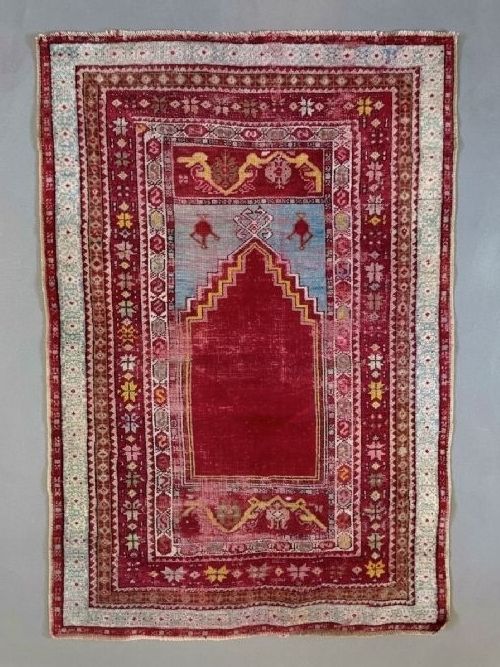
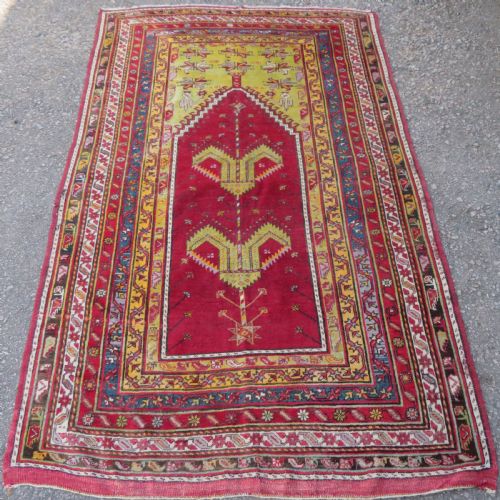
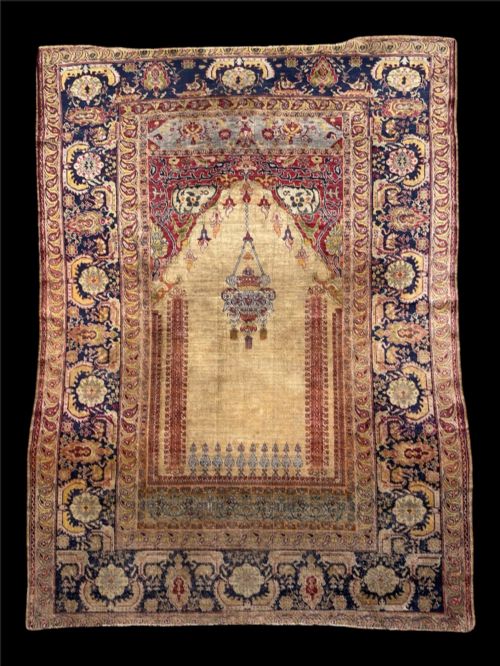
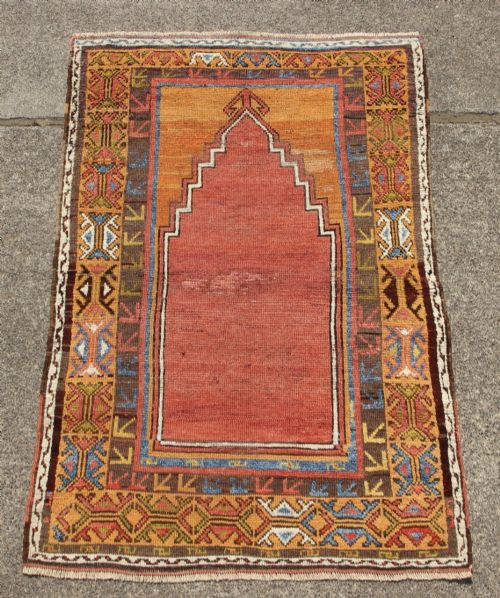
An anatolian prayer mat is a portable woven textile created for daily Islamic ritual, defined by a distinct central arch or mihrab motif that indicates the direction of prayer. These pieces originate from various regions across Anatolia, including traditional weaving centres such as Konya, Ghiordes, Kirsehir, Ladik and Bergama.
You are most likely to encounter nineteenth-century village and town examples on this page, woven in formats ranging from compact single-niche rugs to multi-niche safs. They reflect both Ottoman court aesthetics and distinct regional tribal traditions.
The format typically centres on a single pointed arch that directs the worshipper's gaze, often flanked by stylised floral motifs, columns or hanging mosque lamps. These rugs served a deeply personal, functional role in daily life before entering the collector market.
Materials and construction
Weavers utilised natural sheep's wool, hand-spun yarn and occasionally silk for finer urban pieces, foundation structures commonly relied on cotton or wool warp and weft threads. These organic fibres provide the characteristic handle and structural resilience seen across surviving examples.
Colour comes from natural vegetable dyes, yielding deep madders, indigos and soft yellows that age gracefully over decades of light exposure. The interplay of hand-spun wool and natural dye creates the subtle abrash and tonal variation prized in traditional Anatolian weaving.
Anatolian Prayer Mat Retail Price Guide 2026
Typical asking prices for anatolian prayer mat among the pieces listed under this phrase on Sellingantiques today, from the lower quarter to the upper quarter. They describe what is for sale here now, not the wider market.
Weavers occasionally included tiny comb motifs to ward off the evil eye, ensuring every prayer included a measure of domestic protection.
Distinctions in quality
Quality rests upon the precision of the knotting, the handling of the wool, and the depth and stability of the dye palette. Finer urban workshops achieved higher knot densities and intricate, highly detailed floral geometries, whereas village pieces lean toward robust, bold abstractions.
The visual harmony of the field, the saturation of the natural dyes, and the integrity of the original borders elevate certain pieces above standard production. Survival of original side cordings and kilim ends further distinguishes exceptional survivors from heavily restored examples.
Ghiordes·Kirsehir·Konya·Ladik·Milas
The Anatolian Prayer Mat Glossary
- Mihrab
- The arched niche at the top of the rug that symbolises the direction of Mecca and is oriented toward the qibla during prayer.
- Abrash
- A natural variation in colour tone caused by changes in dye batches or hand-spun wool lots, creating a subtle banded effect across the field.
- Saf
- A long, continuous prayer rug featuring multiple contiguous arches designed to accommodate several worshippers simultaneously.
- Warp
- The vertical foundation threads stretched tightly on the loom before knotting begins, which form the structural skeleton of the rug.
- Weft
- The horizontal threads passed alternately over and under the warp threads after each row of knots to bind the structure firmly together.
Anatolian Prayer Mat: Frequently Asked Questions
What is the purpose of the arch?
The arch, or mihrab, represents the prayer niche of a mosque and directs the worshipper's focus toward Mecca during daily devotions. Its apex often points toward the direction of prayer.
In design terms, this niche organises the entire composition of the rug, separating the sacred inner field from the protective borders.
How do I identify different regional types?
Regional attribution relies on specific colour palettes, border motifs, and the geometry of the central niche. For instance, Ladik pieces often feature distinct pillar motifs, while Kirsehir rugs display hooked gulls and pale grounds.
Examining the structural materials and knot types further clarifies whether a piece originates from a central Anatolian village or a western weaving town.
Where were these rugs used?
These textiles were used primarily within homes, mosques, and travel settings as clean, personal spaces for daily ritual prayer. Their portable nature meant owners rolled them up between prayer times.
Because they served an active devotional function, many pieces exhibit genuine signs of historical handling and wear in the lower field.
Can I use an antique rug on the floor?
These textiles tolerate light foot traffic in low-friction areas, provided you place a suitable breathable underlay beneath them to prevent slipping and fibre abrasion. Rotating the rug periodically ensures even exposure to ambient light.
Many collectors prefer placing them in low-traffic zones, bedrooms, or mounting them on walls to preserve their historical integrity.