
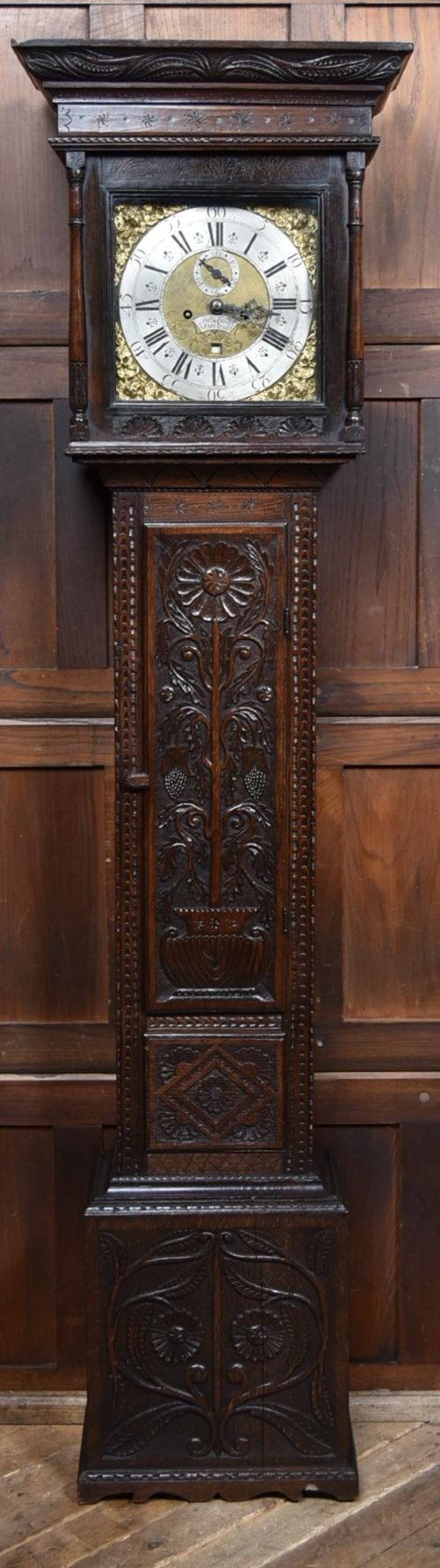
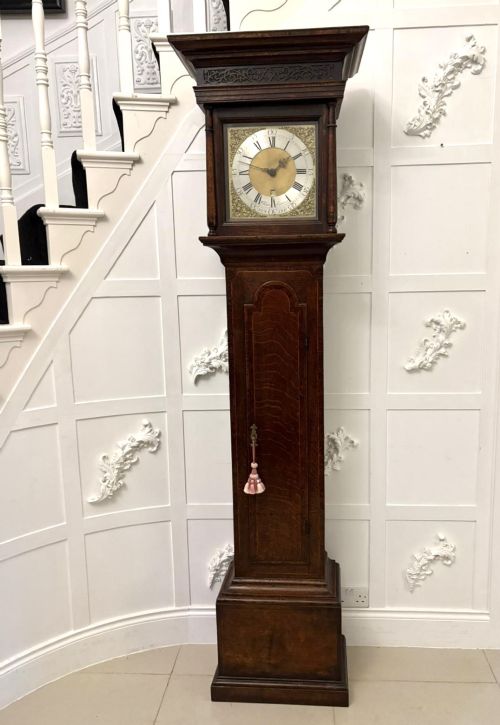
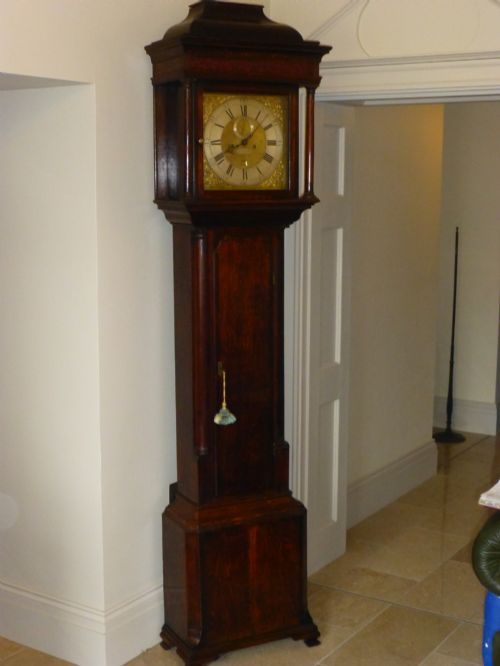
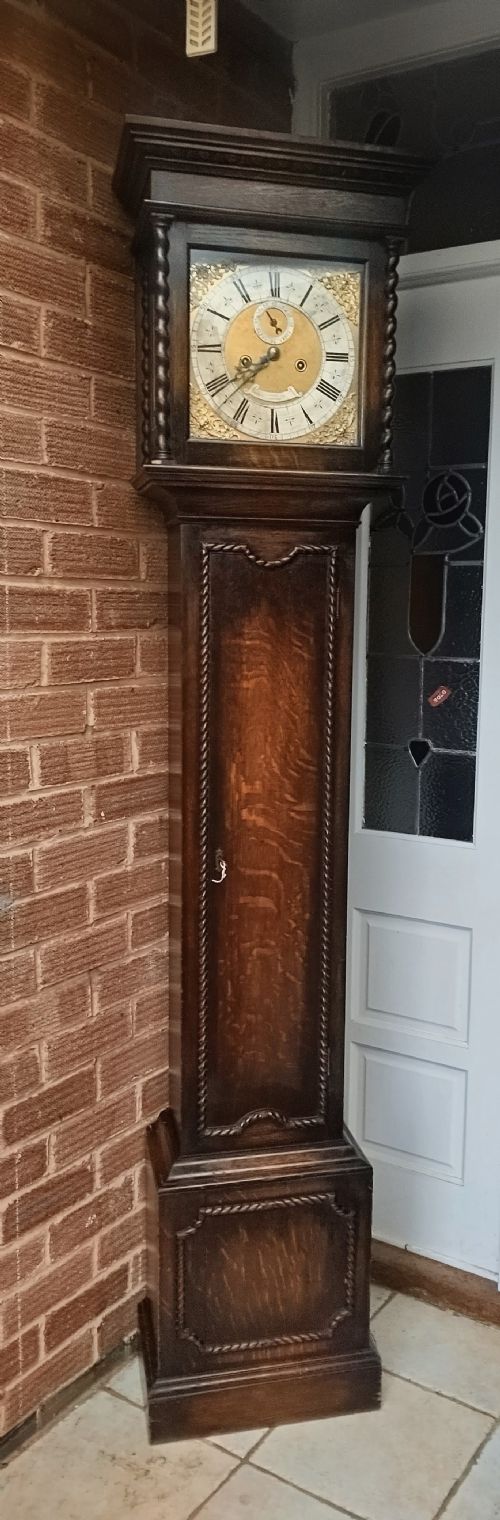


Carved Oak Tall Clock
A carved oak tall clock grounds a room with deep timber grain and steady measurement, bringing the quiet rhythm of past centuries into the present.
Carved Oak Tall Clock
A carved oak tall clock is a vertical timekeeper housed in a wooden floor-standing case, predominantly built from oak with variants in walnut and mahogany. These pieces span the eighteenth century and the Georgian era, alongside later interpretations such as Victorian, Edwardian, and twentieth-century revivals.
The versions most commonly met on this page include eighteenth-century longcase clocks featuring brass dials, single-handed movements, and regional signatures, alongside smaller grandmother clocks and twentieth-century chiming examples. Makers such as Jn° Smith of Macclesfield, Richard Corless of Stockport, and Samuel Young of Nantwich and Bunbury appear across the regional eighteenth-century entries.
The structure typically combines a hood enclosing the dial and movement, a long trunk protecting the falling weights and pendulum, and a solid base. Regional variations range from simple provincial oak cases to richly carved George III designs bearing arched brass faces.
Assessing quality
Quality reveals itself in the crispness of the timber carving and the integration of the dial with the movement. Superior examples exhibit harmonious proportions between the hood, trunk, and base, alongside finely engraved brass faces signed by established regional makers.
The sophistication of the internal movement distinguishes standard production from finer work, with eight-day gear trains and quarter-chiming mechanisms representing higher complexity than simple single-handed thirty-hour variants. The condition and depth of the oak patination further separate provincial utility pieces from master-carved expressions.
One exceptional case wears the carved likeness of a king, watching over the steady drop of the weights.
Jn° Smith·Richard Corless·David Craig Ford·Mappin and Webb·Samuel Young
The Carved Oak Tall Clock Glossary
- Longcase clock
- A tall pendulum clock enclosed in a wooden floor-standing case. These pieces are also frequently designated as grandfather clocks or floor clocks.
- Grandmother clock
- A scaled-down version of the traditional longcase clock. These shorter floor-standing timekeepers emerged largely during the Edwardian and early twentieth-century periods.
- Brass face
- The metallic dial plate fronting the clock movement. They often feature engraved spandrels, chapter rings, and maker signatures.
- Grandfather clock
- A colloquial term for a tall floor clock. The descriptor derives from Henry Clay's nineteenth-century popular song about his grandfather's timepiece.
- Single-handed
- A movement configuration utilising only an hour hand. This mechanical layout is characteristic of early eighteenth-century provincial timekeeping.
Carved Oak Tall Clock: Frequently Asked Questions
How do I wind an eight-day tall clock?
Winding involves inserting a key into the winding holes on the dial face and turning it slowly until the weights reach their upper limit near the top of the trunk.
Care must be taken not to overwind the mechanism, stopping as soon as resistance increases to prevent damage to the brass gear train.
Where should I place a tall clock in my home?
Tall clocks require a stable, level floor and a secure attachment to a sturdy wall via the bracket inside the hood to prevent tipping.
Positioning the case away from direct sunlight, central heating vents, and damp exterior walls protects the historical oak timber and internal mechanics from warping.
What is the difference between a longcase and a grandmother clock?
The primary distinction lies in the overall height and proportions of the wooden case, with grandmother clocks offering a significantly more compact footprint.
These smaller variants typically date from the twentieth-century revival periods, whereas traditional longcase clocks predominantly originate in the eighteenth and Georgian eras.
Why does a tall clock have a single hand?
Early eighteenth-century timekeepers often utilised a single hand because minute accuracy was neither expected nor mechanically prioritised in provincial households.
The single hand points to quarter-hour markers, relying on the division of the chapter ring to tell the time.