
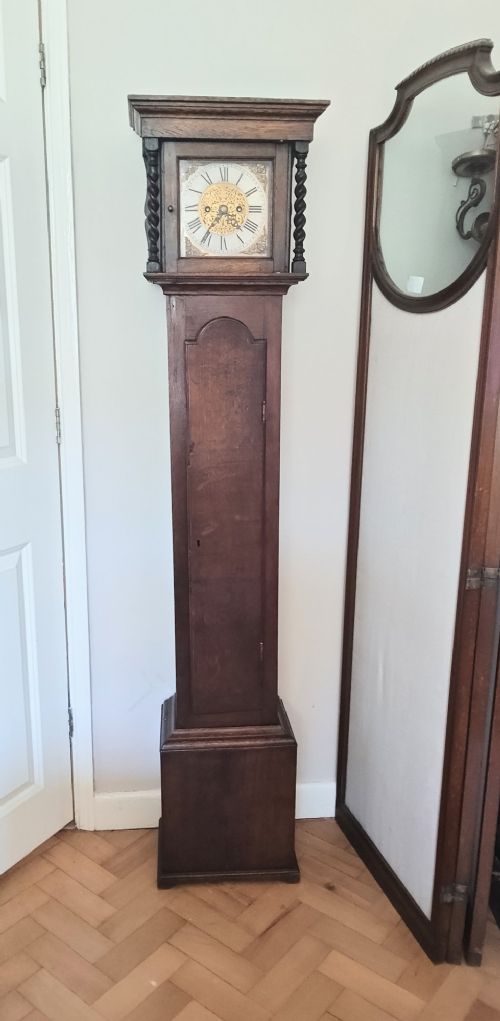
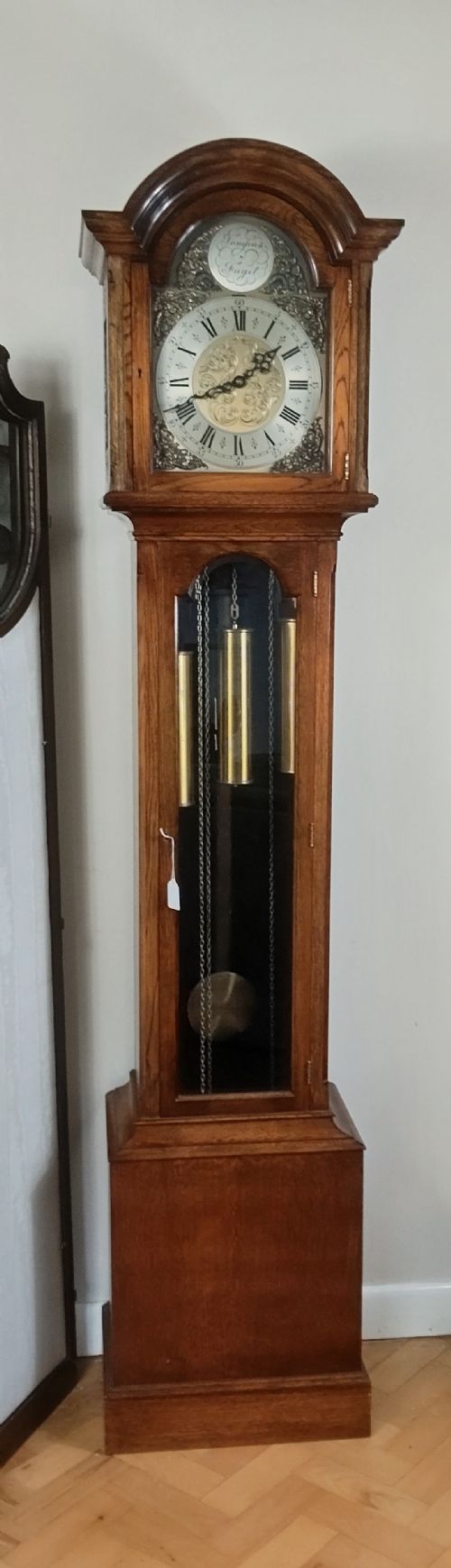


Oak Grandmother Clock
An oak grandmother clock brings the gravitas of a full-sized longcase into a compact footprint, offering timekeeping and music in a refined domestic scale.
Oak Grandmother Clock
An oak grandmother clock is a scaled-down floor-standing timepiece, standing lower than a traditional longcase while retaining the classical hooded dial and trunk proportions. When you search for an oak grandmother clock, you encounter pieces spanning the Edwardian era, the 1920s, and the 1930s, alongside revivals and earlier Georgian antecedents.
These clocks appear in various forms, from simple eight-day striking movements to complex triple-weight musical mechanisms playing Westminster or multiple tunes. The most common examples on this page date from the early twentieth century, rendered in warm English or light oak.
Proportions vary from diminutive models under seventy inches to taller pieces approaching seventy-four inches. Many incorporate glazed trunk doors, brass dials, and barley twist columns, reflecting traditional British cabinet-making sensibilities adapted for smaller Edwardian and interwar interiors.
Materials and Construction
Cabinet makers utilised solid and veneered oak to build the slender cases, often selecting timber with rich figuring and finishing it to a warm, mellow tone. Glass panels protect the dial and form the astragal-glazed trunk doors that reveal the descending weights and swinging pendulums within.
Movements combine brass, steel, and metal components, ranging from spring-driven mechanisms to weight-driven trains with multiple gongs. Brass faces feature prominently, often engraved or cast with spandrels and silvered chapters, housing German or domestic movements supplied by makers and retailers.
Oak Grandmother Clock Retail Price Guide 2026
Typical asking prices for oak grandmother clock among the pieces listed under this phrase on Sellingantiques today, from the lower quarter to the upper quarter. They describe what is for sale here now, not the wider market.
Some interwar models were retailed by chemists like Boots alongside prescription drugs, proving that a dose of Westminster chimes was once just an errand away.
Distinguishing Quality
Cabinet quality shows in the selection of the oak, the precision of the barley twist columns, and the joinery of the glazed door. Weight-driven systems with robust brass plates and finely cut wheels outclass basic spring-driven alternatives in longevity and mechanical integrity.
Harrods·Boots Drug Company·Peerless·Embee·Henry Smith of Petersfield
The Oak Grandmother Clock Glossary
- Grandmother clock
- A floor-standing timepiece that mimics the proportions of a longcase clock but stands significantly shorter, typically between sixty-five and seventy-five inches high. This reduced scale made them suitable for smaller twentieth-century rooms.
- Westminster chime
- A melodic quarter-hour chime pattern played on four or eight bells or gongs, originating from the Cambridge quarters used by the clock at Great St Mary's in Cambridge. It forms the standard acoustic accompaniment for many interwar chiming clocks.
- Astragal glazed
- A door construction where wooden strips divide a glass panel into smaller glazed panes, adding architectural detail to the trunk of the clock. This treatment allows a clear view of the weights and pendulum.
- Barley twist
- A decorative turning technique resembling a spiralling rope, frequently utilised on the pillars flanking the dial or trunk door of revival and Edwardian cases. It adds textural depth and visual movement to the oak exterior.
- Fusee
- A conical pulley connected to the mainspring by a chain or cord, designed to equalise the torque of the declining spring power and maintain steady timekeeping accuracy. It represents a higher standard of mechanical horology.
Oak Grandmother Clock: Frequently Asked Questions
How tall is an oak grandmother clock?
Most examples measure between sixty-five and seventy-five inches in height, making them noticeably more compact than standard grandfather clocks. This reduced stature allows them to fit comfortably under lower ceilings and in narrower hallways.
Despite their smaller dimensions, they house full mechanical gear trains, weights, and pendulums. The height variation often relates to the specific decade of manufacture and the stylistic proportions chosen by the maker.
What is the difference between a grandfather and grandmother clock?
The primary distinction is overall height and case proportion, with grandmother clocks specifically designed as slender, reduced-scale versions of traditional longcase clocks. Grandfather clocks generally exceed seventy-eight inches, while grandmother clocks sit comfortably below that threshold.
Both utilise similar weight-driven or spring-driven movements and brass dials, but the smaller variant was particularly popular during the Edwardian period and the 1920s for modern domestic spaces.
How do triple-weight movements work?
Triple-weight movements suspend three separate weights down the trunk to power the timekeeping train, the striking train, and the chiming or musical train independently. Each weight must be periodically wound up using a key or crank.
This setup allows the clock to maintain complex melodies, such as Westminster quarters, alongside standard hour strikes without draining the main timekeeping power reserve.
How do you identify an Edwardian oak grandmother clock?
Edwardian examples usually display warm, honey-toned oak cases influenced by revival styles like Jacobean or Georgian, often featuring barley twist columns and brass dial faces. The interior houses spring or weight-driven mechanisms tuned to early twentieth-century domestic preferences.
Construction details, such as the thickness of the backboards and the style of the hinges, help distinguish these Edwardian interpretations from later interwar pieces or genuine Georgian antecedents.