
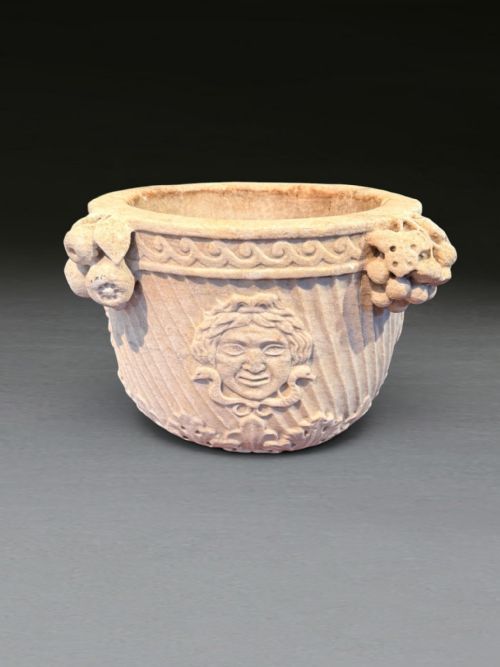


Carved Marble Planters
Carved marble planters bring classical presence and solid weight to rooms and gardens, uniting heavy stone with fine historical form.
Carved Marble Planters
Carved marble planters include solid stone vessels, garden cisterns, and campana urns alongside paired tazza urns. These heavy pieces draw on 16th century Italian Renaissance models and late 18th century neo-classical designs.
Buyers also encounter jardiniere stands and plant pedestals combining marble tops with hardwood, walnut, or rosewood structures. Chinese Export and Qing Dynasty examples introduce carved wood frames paired with stone insets.
The 19th century and Edwardian periods supply numerous classical shaped urns and garden vessels. Pieces range from grand Italian marble carvings to compact Victorian and 1900s plant stands.
How they were made
Makers shaped heavy stone, Carrara marble, and alabaster through manual carving and turning. These dense materials require patient chiselling to achieve crisp classical fluting, curves, and rolled rims.
Stand structures utilise traditional joinery in hardwood, walnut, and rosewood. Craftsmen combined turned timber legs and tiered platforms to support the immense weight of the stone vessels above.
Periods represented stretch from the 16th century through the Georgian, Victorian, and Edwardian eras up to 1930.
What varies in quality
Quality rests in the crispness of the stone carving and the selection of the marble block. Superior examples show deep, clean relief work and harmonious natural veining without clumsy repairs.
The integration between stone bowls and their supportive stands dictates the balance of the piece. Well-matched hardwood frames and stable marble tops demonstrate superior workshop execution.
The Carved Marble Planters Glossary
- Campana urn
- A bell-shaped vessel with a flaring rim and a pedestal base, frequently carved in marble.
- Jardiniere stand
- A tall piece of furniture designed specifically to elevate a plant pot or planter bowl.
- Cistern
- A large, deep container intended for holding water or planting, often decorated with classical motifs.
- Tazza
- A shallow saucer-like vessel on a stem and foot, often formed as a matched pair.
- Neoclassical
- A style drawing on classical Greek and Roman antiquity, prominent in eighteenth century design.
Carved Marble Planters: Frequently Asked Questions
Where should I place a marble urn?
These heavy stone vessels suit both interior hallways and sheltered garden spots. Their dense material withstands outdoor placement if protected from severe frost.
Indoors, they anchor corners or act as focal points on sturdy floors capable of supporting their substantial weight.
How do I care for carved marble?
Dust the carved surfaces regularly with a soft, dry cloth to prevent grime accumulation in the recesses. Avoid acidic cleaners that etch the polished stone.
Treat wooden stands paired with marble according to their timber type, using mild wax sparingly.
Are these planters frost proof?
Solid marble and stone vessels tolerate outdoor conditions well, though trapped wet soil can freeze and crack the material. Empty the planters during freezing winter months or bring them indoors.
Checking for proper drainage holes helps prevent water accumulation.
What is the difference between an urn and a jardiniere?
Urns typically feature a closed classical body on a footed base, designed for decorative impact or formal planting. Jardiniere stands often incorporate a table structure or pedestal to elevate the plant.
Both serve to display greenery but stem from different furniture and architectural traditions.