

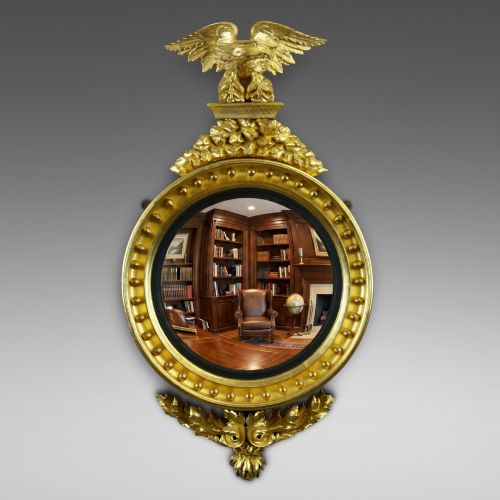
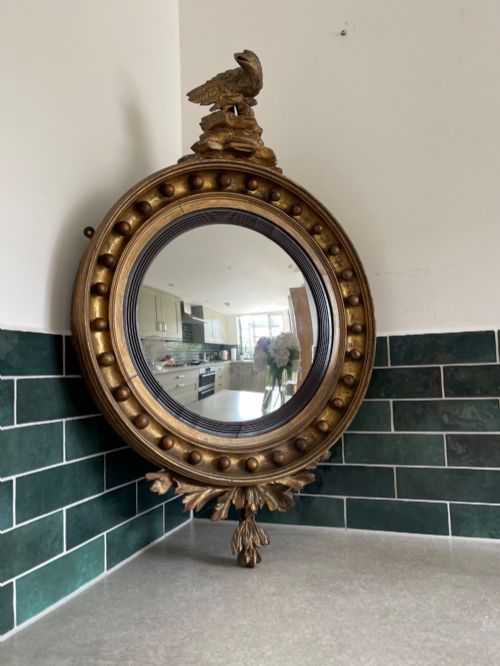
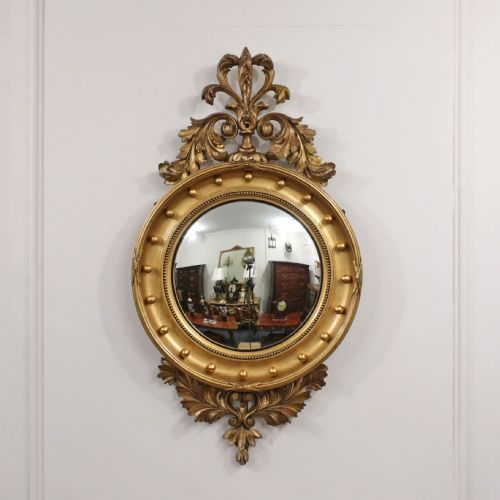
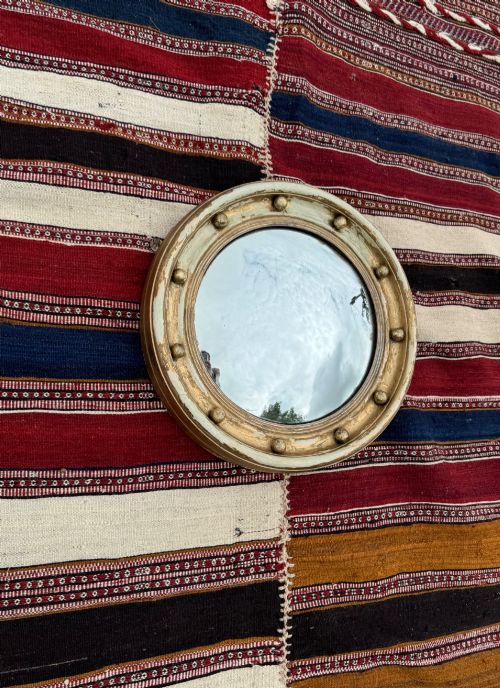

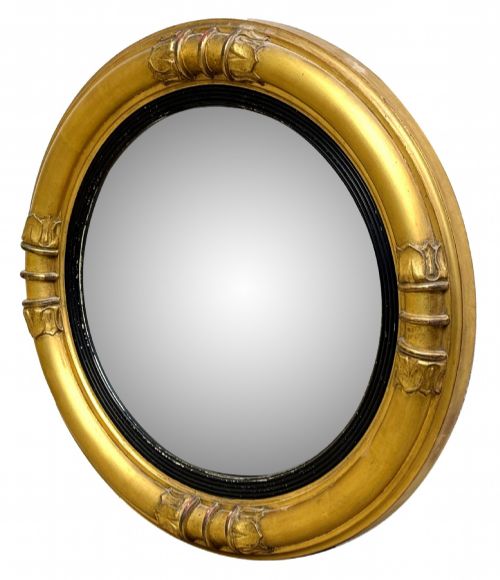
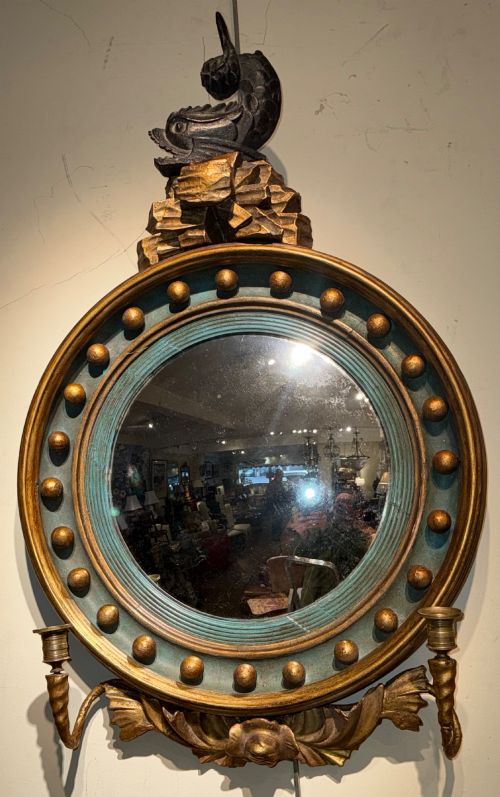
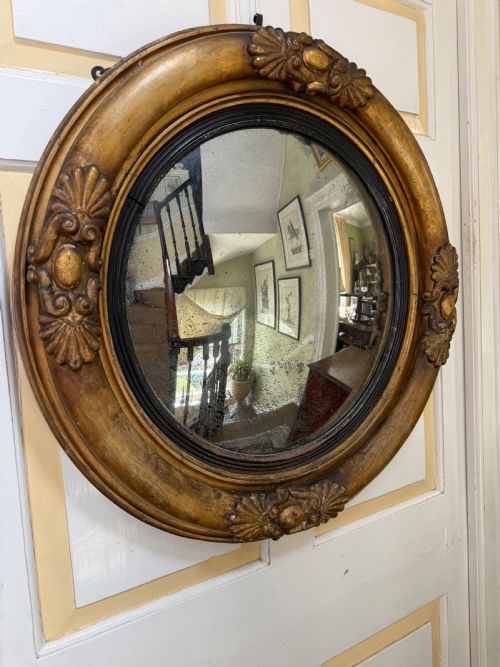


Carved Giltwood Convex Mirror
A carved giltwood convex mirror bends light across a room, bringing the Regency and Victorian drawing room straight into focus.
Identifying Carved Giltwood Convex Mirrors
A carved giltwood convex mirror is a distinctive circular wall mirror designed to reflect a wide angle of an interior space. These pieces typically appear in nineteenth century forms, spanning the Regency and Victorian periods.
The selections on this page draw heavily from the Regency era, along with later Regency revival pieces and general nineteenth century examples. Most items present as circular wall mirrors framed in carved and gilded wood.
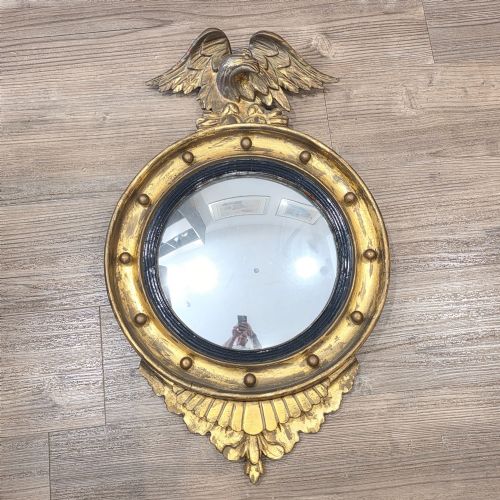
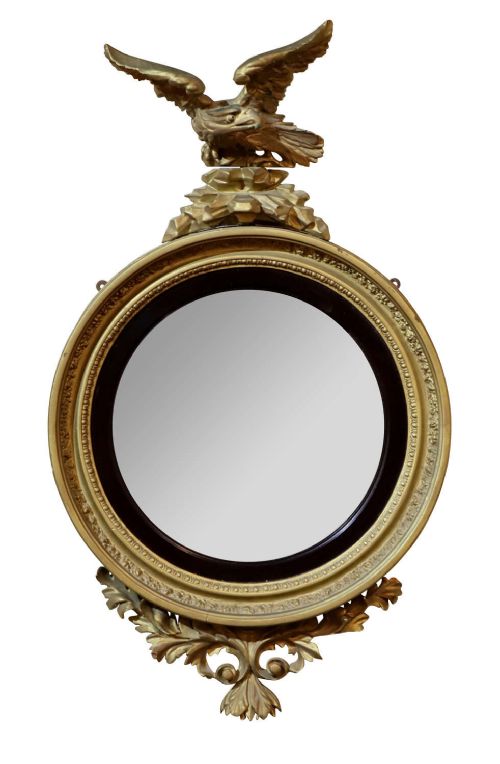
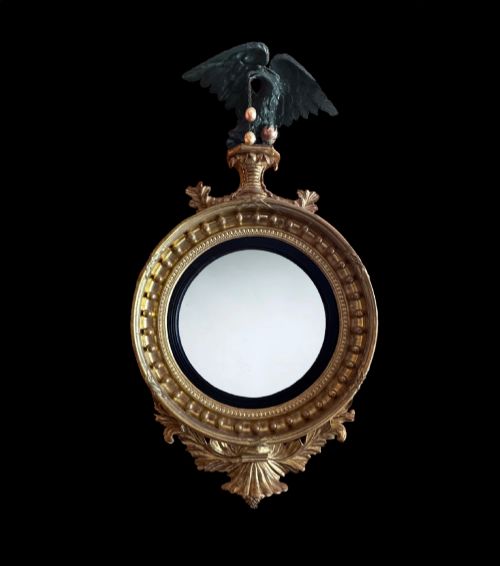
Certain examples incorporate distinct decorative motifs into the wooden frame, such as an eagle surmounting the glass. Other variations focus entirely on the carved giltwood surround without additional sculptural figures.
Materials and Construction
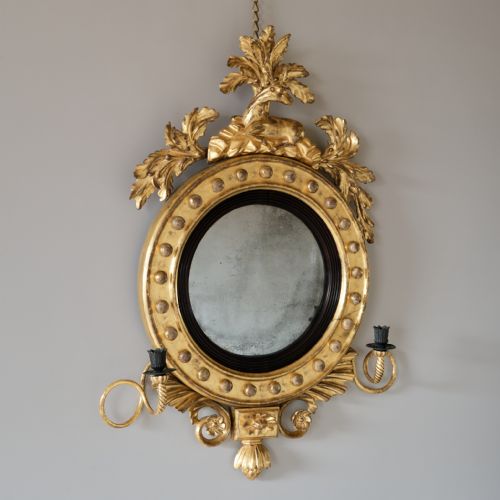
Makers constructed these frames using timber finished with gesso and gold leaf to create the bright gilded surface characteristic of giltwood. Some variations introduce ebonised wood elements alongside the gold leaf to create high contrast details within the frame.
The defining optical component is the convex glass plate, which sits deeply within the circular wooden moulding. Carved ornamentation is applied to the frame, often working gesso over a wooden base before gilding.
Retail Price Guide 2026
Typical UK retail prices for carved giltwood convex mirror, calculated from the Sellingantiques database of over a million retail prices indexed since 2003. This retail price guide relies exclusively on Sellingantiques data; no external sources or auction records are used, so the figures do not describe the wider market.
Listings for this phrase combine nineteenth century periods with giltwood, glass, ebonised wood, gold leaf, and gesso materials.
Distinctions in Quality
Quality in a carved giltwood convex mirror rests upon the depth and crispness of the wood carving and the finesse of the gesso work beneath the gold leaf. Finer pieces display sharply defined ornamentation that retains its original brilliance without heavy restoration.
Scale also dictates character, as larger proportions command greater presence on a wall compared to small variants. The treatment of secondary details, such as ebonised accents or sculptural additions like eagles, separates standard decorative pieces from exceptional examples.
The Carved Giltwood Convex Mirror Glossary
- Giltwood
- Wood that has been coated with gold leaf over a prepared gesso ground. This technique creates a luminous metallic finish that defines nineteenth century frames.
- Convex
- Curving outward like the exterior of a sphere. This curved plate captures a panoramic reflection of the surrounding room.
- Gesso
- A plaster mixture applied to wood frames to provide a smooth surface for gilding and fine carving. It allows craftsmen to model crisp decorative details.
- Ebonised
- Wood treated to resemble ebony, typically through staining or painting dark. This technique provides a sharp visual contrast against bright gold leaf.
- Regency
- An English design period spanning the early nineteenth century. Pieces from this era are celebrated for classical restraint and bold circular forms.
Frequently Asked Questions
Where should I hang a convex mirror?
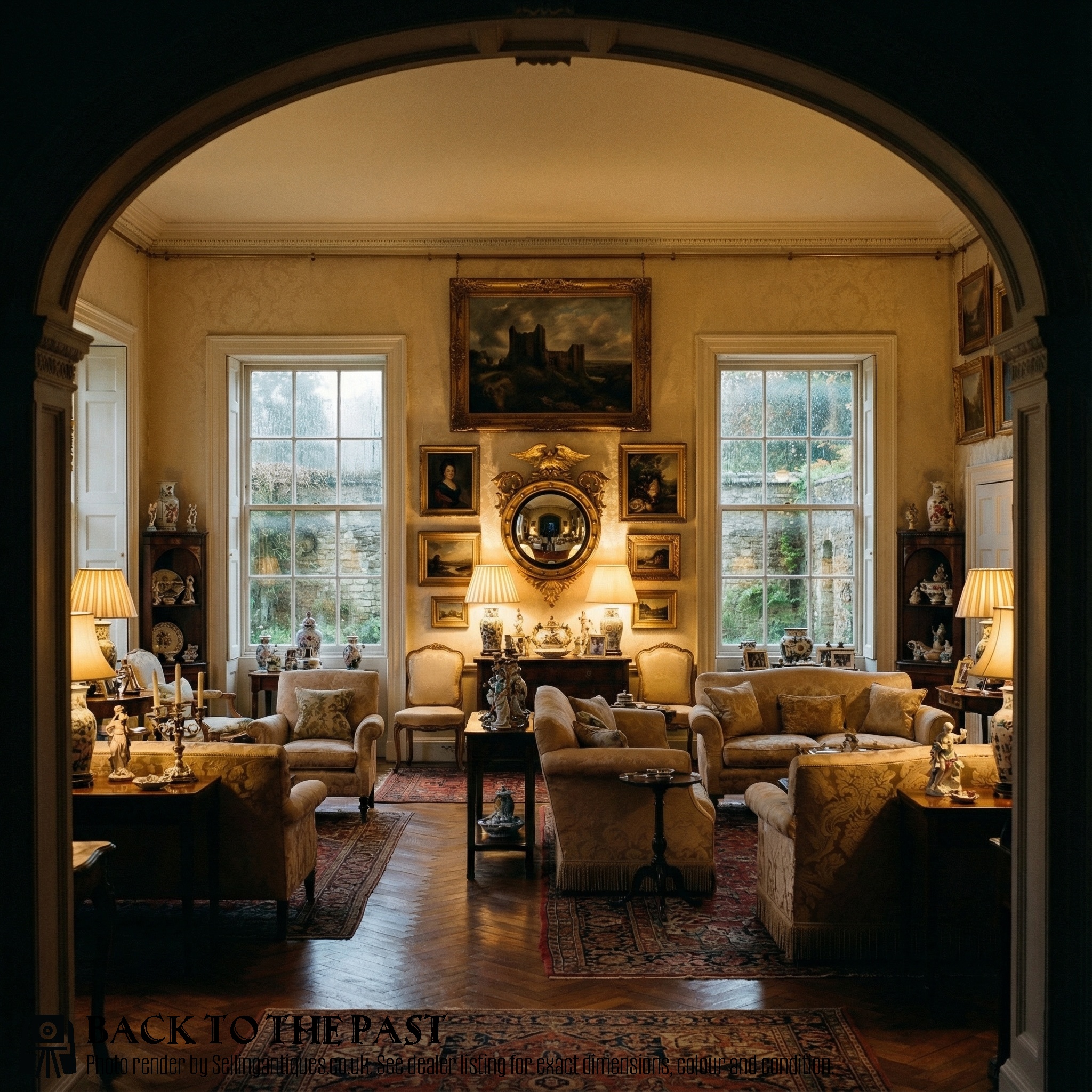
These mirrors were traditionally placed on principal drawing room walls to reflect light and movement across the space.
Because the curved glass shrinks the reflection, hanging them opposite a window or focal point maximises their optical reach in a room.
How do I date a convex mirror?
Dating relies on examining the construction of the wooden frame, the composition of the gesso, and the characteristics of the glass plate.
Nineteenth century pieces often show specific Regency or Victorian stylistic markers in their carving and gilding techniques.
Are all convex mirrors from the Regency period?
While many examples date to the Regency era, the archive and current listings also include Victorian pieces and later revival works.
Craftsmen continued to produce this classic circular form throughout the nineteenth century using traditional giltwood methods.
What is the purpose of the curved glass?
The curved glass creates a wide-angle reflection that encompasses nearly the entire room within a single circular frame.
This unique optical property made them popular in formal interiors for practical illumination and decorative effect.