




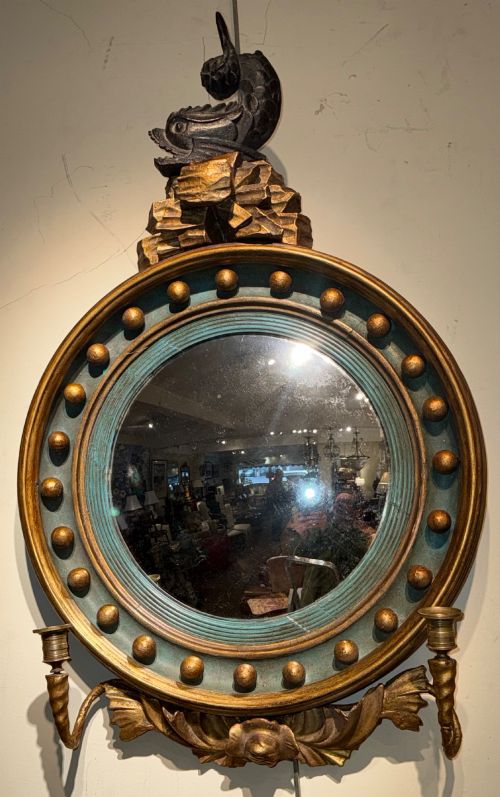


Antique Bullseye Mirror
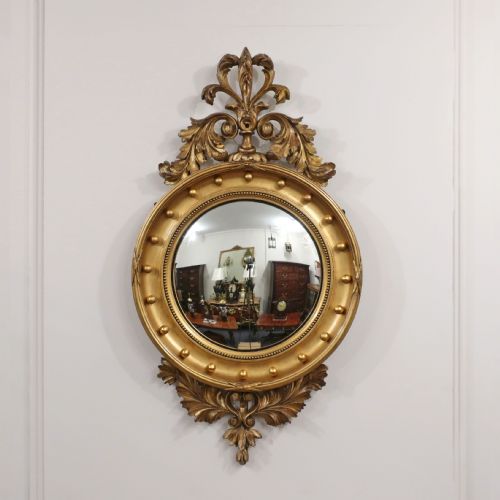
An antique bullseye mirror bends light across a room, capturing the whole interior in a curved sphere of glass.
Antique Bullseye Mirror
When you search for an antique bullseye mirror, you encounter round wall mirrors defined by their protruding, spherical glass plates. These pieces gather and distribute ambient light from across a chamber, creating a distinctive fish-eye perspective of the interior. The design dates back centuries, serving both practical lighting and decorative display functions in domestic spaces.
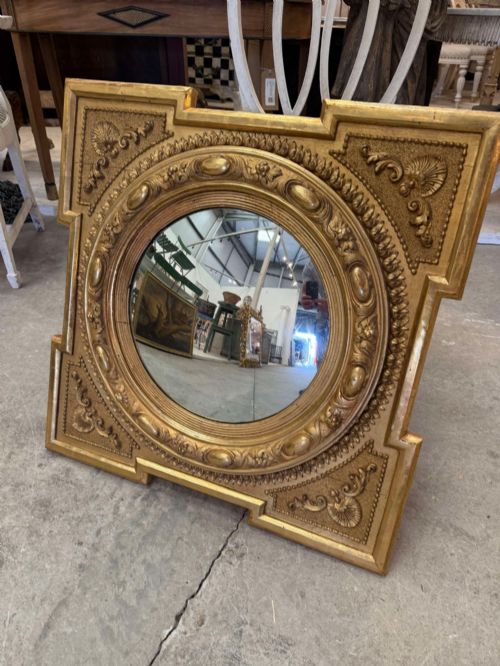
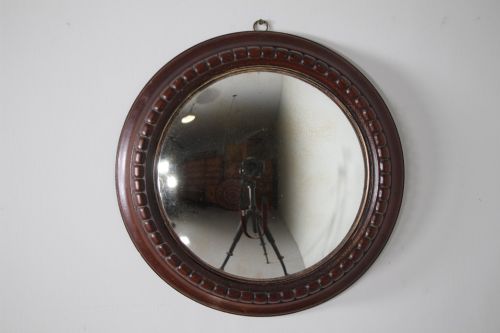
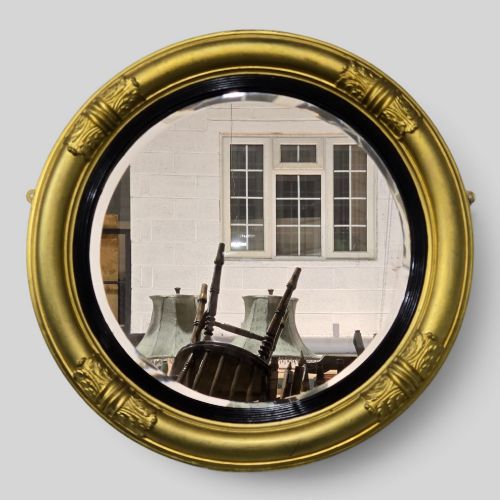
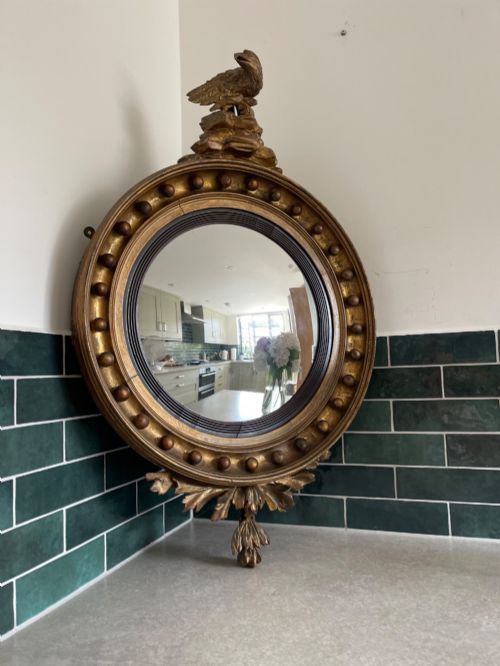
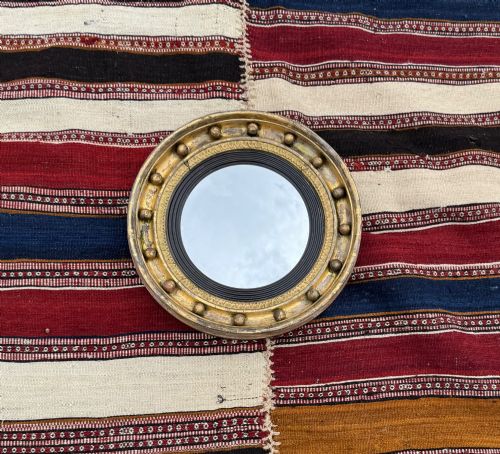
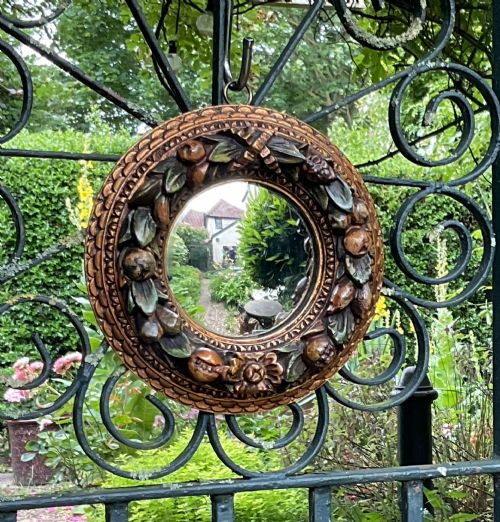
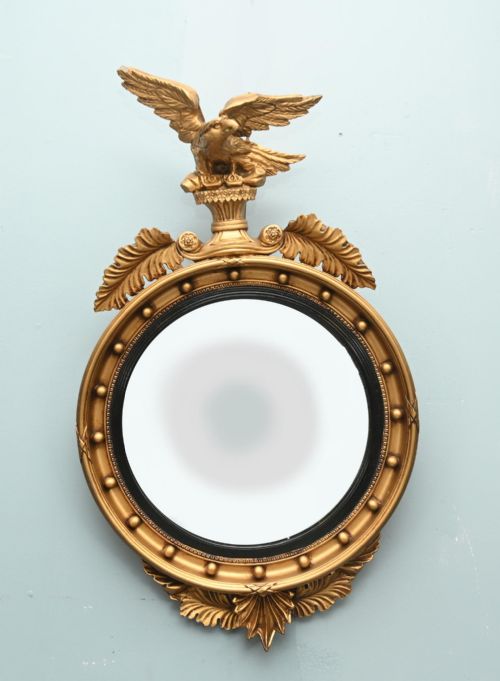
The version you meet most often on this page belongs to the Regency period or its later revivals. These examples typically present a circular wooden frame, heavily gilded, often featuring applied ornamentation such as carved eagles perched at the crest. Alongside these formal Regency pieces, the listings include simpler timber frames, ebonised elements, and brass and mahogany combinations from the early twentieth century.
Origins span the Georgian era through the nineteenth century and into the 1920s and 1930s. While Regency pieces dominate the selection, later Victorian and early twentieth-century interpretations demonstrate the enduring appeal of the convex form. Wall mirrors of this type appear in various scales, from small hall mirrors to large, commanding focal points.
Materials and Construction Techniques
Makers constructed the frames using timber carcasses, frequently employing wood, mahogany, or ebonised wood as a stable base. Artisans applied layers of gesso to this wooden foundation to build up smooth surfaces and intricate decorative mouldings. This gesso layer provided the ideal bed for subsequent gilding, allowing crisp detail in carved motifs like foliage, balls, and eagles.
The mirror glass itself is typically convex, blown or cast to achieve the curved plate that defines the style. Giltwood and plain gilt finishes dominate the visual presentation, reflecting the Regency and Georgian preference for bright, reflective surfaces. Brass elements appear in specific pieces, often combined with mahogany frames to create a contrasting aesthetic.
Antique Bullseye Mirror Retail Price Guide 2026
Typical asking prices for bullseye mirror among the pieces listed under this phrase on Sellingantiques today, from the lower quarter to the upper quarter. They describe what is for sale here now, not the wider market.
Many a butler used these wide-angle mirrors to keep an eye on the entire dining room while pretending to polish the silver.
Distinctions in Quality and Craftsmanship
The refinement of the carved ornament dictates much of the distinction across these pieces. Finer examples display deeply undercut carving on details like the eagle surmount, acanthus leaves, and the reeded ebonised inner rings. Softer, less defined moulding indicates later revival work or hurried production.
The integrity of the gilt surface and the condition of the convex glass plate also separate the output. Original gilding showing honest signs of age holds greater visual cohesion than crude later repainting. Similarly, mirror glass with authentic foxing and depth complements the antique frame better than flat modern replacements.
The Antique Bullseye Mirror Glossary
- Convex mirror
- A circular wall mirror featuring a curved, outward-protruding glass plate. This form distorts reflections to encompass a wide-angle view of the surrounding room.
- Giltwood
- Timber carved and coated with a thin layer of gold leaf or gilt finish. It forms the primary bright surface for most Regency wall mirrors.
- Gesso
- A plaster-like mixture applied to wood frames to create a smooth surface for carving and gilding. It allows for crisp relief details on the moulded frame.
- Ebonised wood
- Timber treated to imitate ebony, producing a deep black finish. It frequently appears on the inner reeded rings of convex mirror frames.
- Eagle mount
- A carved wooden bird figure placed at the top of the mirror frame. This decorative surmount is a characteristic feature of formal Regency convex mirrors.
Antique Bullseye Mirror: Frequently Asked Questions
What is an antique bullseye mirror?
An antique bullseye mirror is a circular wall mirror with a convex glass plate that curves outward. These pieces reflect a wide-angle view of an entire room.
They were traditionally placed in grand reception rooms and hallways to distribute light and monitor activity.
How were convex mirrors used in homes?
Historically, these mirrors served both decorative and practical purposes in domestic interiors. Their curved glass gathered ambient daylight from windows and illuminated darker corners.
Servants also used them in large houses to keep watch over multiple doorways from a single vantage point.
How do I date a convex mirror?
Dating relies on examining the frame construction, wood types, and decorative motifs present in the piece. Regency examples often feature giltwood frames with eagle surmounts and ebonised sight rings.
Later Victorian and 1920s revivals display simpler timber structures or alternative materials like brass and mahogany.
How should I hang a heavy giltwood mirror?
Hanging requires locating a secure anchor point in the wall capable of supporting the combined weight of the wood and glass. Professional fixings suited to the specific wall type ensure the frame remains secure.
Positioning the mirror at eye level allows it to function effectively as a visual focal point in the room.