


Brown Sail Marine Watercolour
These brown sail marine watercolour works capture coastal vessels and maritime scenes on paper.
Brown Sail Marine Watercolour
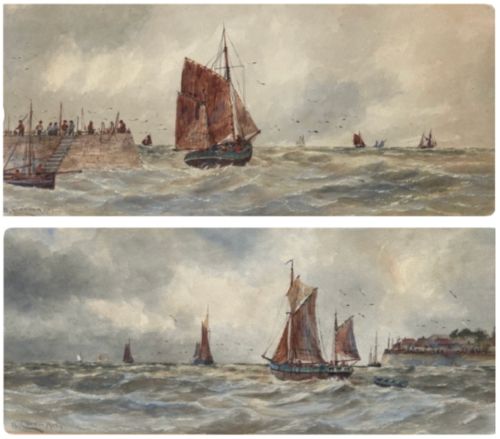
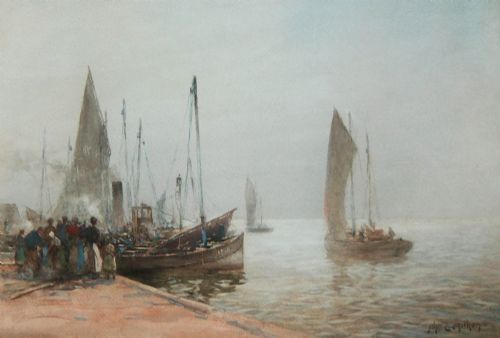
A brown sail marine watercolour depicts maritime scenes, coastal views and shipping vessels using watercolour pigment on paper. These paintings frequently record harbours, estuaries, fishing boats and larger sailing ships in British and European waters.
The works date primarily from the nineteenth century and the early decades of the twentieth century. Examples span Victorian marine art, Edwardian pieces and British Impressionist marine styles.
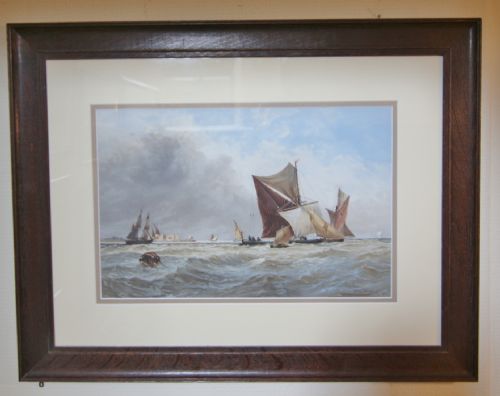
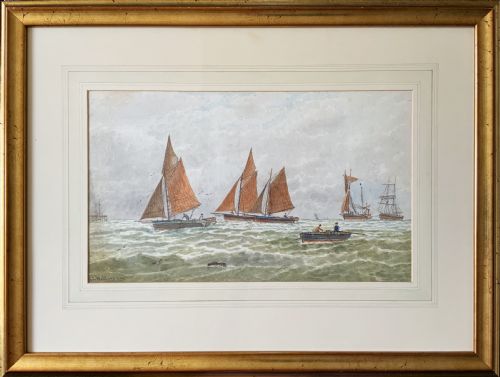
Framed artwork in this category typically incorporates wood, oak or gilt wood framing around glass to protect the paper surface. Common formats include single paintings, pairs and framed wall art.
Materials and technique
Artists apply watercolour pigment directly onto paper using washes and brushwork to render skies, water and vessels. Many works incorporate preparatory pencil lines or pen work beneath the pigment.
Finished paintings are mounted behind glass within wooden frames, often constructed from oak or gilt wood. This framing protects the delicate paper surface from atmospheric moisture and handling.
Listings span the nineteenth century, Victorian era, Edwardian period and early twentieth century up to nineteen fifty.
Markers of quality
Quality rests upon the artist's handling of light, atmosphere and maritime detail. Stronger works demonstrate confident brushwork in rendering rigging, hull forms and shifting weather conditions.
Condition of the paper and pigment integrity influence the character of each piece. Minimal fading and stable paper support preserve the intended tonal balance of the composition.
Thomas Bush Hardy·George Stanfield Walters·William Wyld·Samuel John Milton Brown·Frank Wasley·Edward Wesson·Rowland H. Hill
The Brown Sail Marine Watercolour Glossary
- Watercolour
- A paint consisting of colour pigment suspended in a water-soluble vehicle, applied to paper to create translucent washes.
- Barque
- A sailing vessel with three or more masts, having the fore- and main-masts square-rigged and the mizzen-mast fore-and-aft rigged.
- Estuary
- The tidal mouth of a large river, where the tide meets the stream, frequently featured in nineteenth-century maritime art.
- Gilt wood
- Wood that has been covered with a thin layer of gold leaf or metallic gilt, commonly used in traditional picture framing.
- Seascape
- A work of art that depicts the sea, ships and coastal views, forming the primary subject of these marine paintings.
Brown Sail Marine Watercolour: Frequently Asked Questions
What periods do these watercolours date from?
The works originate largely from the nineteenth and early twentieth centuries, spanning the Victorian and Edwardian eras. Artists active during these decades recorded coastal and harbour scenes across Britain and Europe.
Individual pieces often bear dates or stylistic markers aligning with the late Victorian period up to the interwar years.
How should I frame and hang these watercolours?
Watercolours on paper require protection behind glass to prevent atmospheric damage from dust and moisture. Frames constructed from wood or gilt wood match the traditional presentation of these maritime paintings.
Position pieces away from direct sunlight to prevent the watercolour pigments from fading over time.
What subjects appear in these marine paintings?
The compositions focus on shipping, fishing vessels, barques and coastal harbours. Scenes frequently capture specific locations such as river estuaries, Dutch ports and British coastal towns.
Artists document both working vessels under sail and steam and sail vessels navigating coastal waters.
Are these watercolours usually signed by the artist?
Many of the works bear signatures, initials or inscriptions added by the artist, often referencing specific locations or harbour names. Some pieces remain initialed rather than fully signed.
Attributions rely on recorded styles, signatures and period documentation associated with the British marine school.