


Brown Mahogany Knife Boxes
Brown mahogany knife boxes are classic Georgian storage pieces that bring rich timber grain and period elegance to a room.
Brown Mahogany Knife Boxes
When you search for brown mahogany knife boxes, you encounter traditional dining room containers designed to hold cutlery securely during the eighteenth and nineteenth centuries.
The pieces on this page span the Georgian period, including George III examples, alongside nineteenth century interpretations and later Victorian variations.
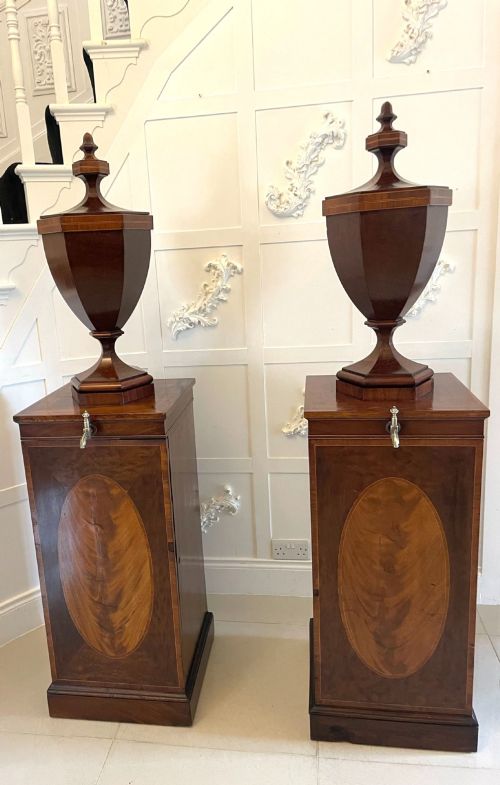
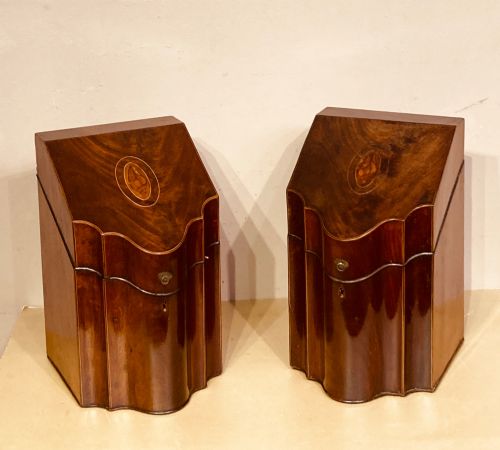
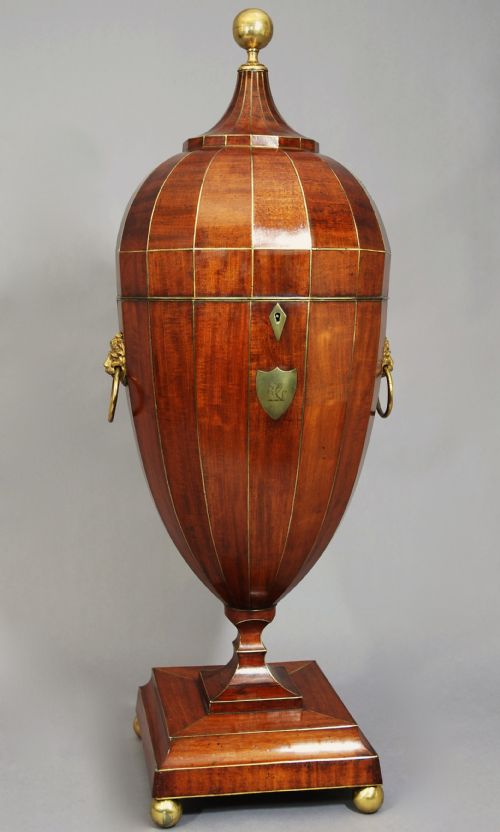
Beyond standard knife boxes, the listings include serpentine cutlery boxes, stationery boxes, letter holders, and tall cutlery urns mounted on pedestals.
How they were made
Craftsmen built these items primarily from solid mahogany, selecting figured timber for the main exterior surfaces to display deep natural grain patterns.
Many examples incorporate decorative details such as boxwood and satinwood inlay, adding contrasting geometric or linear borders to the dark wood.
Functional metal elements, notably brass fittings and hinges, secure the lids and provide operational hardware for daily use.
What varies in quality
The standard of the timber selection dictates visual appeal, with highly figured mahogany displaying richer depth and movement than plain boards.
Precision in the cabinetmaking shows in the execution of serpentine shapes and the clean alignment of contrasting boxwood and satinwood inlay.
Original brass fittings and intact internal compartments elevate an example above those altered or repaired over subsequent centuries.
The Brown Mahogany Knife Boxes Glossary
- Serpentine
- A gently undulating curved shape with a convex centre flanked by concave sides. This profile appears frequently on the fronts of eighteenth century boxes.
- Inlay
- A technique where contrasting materials like boxwood or satinwood are set flush into the mahogany surface to create decorative patterns.
- George III
- The stylistic and historical period spanning the reign of George III from 1760 to 1820. Pieces from this era often feature refined classical proportions.
- Cutlery Urn
- A tall, vase-shaped container designed to store flatware on a sideboard or dedicated pedestal. These vessels are sometimes found as matched pairs.
- Mahogany
- A durable tropical hardwood prized for its deep reddish-brown tone and stable grain. It served as the primary material for high-end dining room storage.
Brown Mahogany Knife Boxes: Frequently Asked Questions
What were brown mahogany knife boxes used for?
These boxes stored silver and steel cutlery on sideboards in grand dining rooms before fitted fitted cutlery drawers became common in furniture.
Servants brought them out when setting the table and locked the lids to protect valuable tableware between meals.
How do I identify a Georgian knife box?
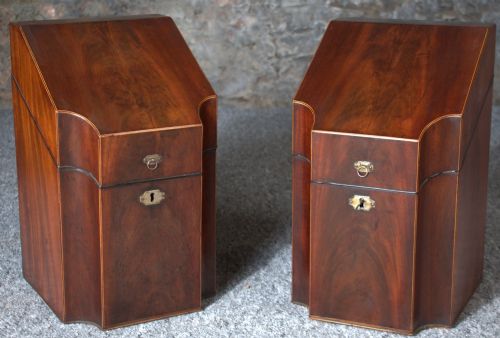
Look for characteristic sloping lids and serpentine or straight fronts made from dense mahogany timber with period brass hardware.
Many genuine examples also feature delicate boxwood and satinwood stringing or fan inlays typical of the eighteenth century.
Are all these boxes from the eighteenth century?
While the form originates in the Georgian era, the selection includes pieces made across the nineteenth century and into the Victorian period.
Construction details and secondary woods help distinguish earlier eighteenth century items from later nineteenth century interpretations.
Where should I place a knife box at home?
They sit well on top of sideboards, side tables, or chests of drawers where their sculptural shapes and figured timber remain visible.
Their internal compartments also make them practical for storing modern letters, stationery, or small household items.