
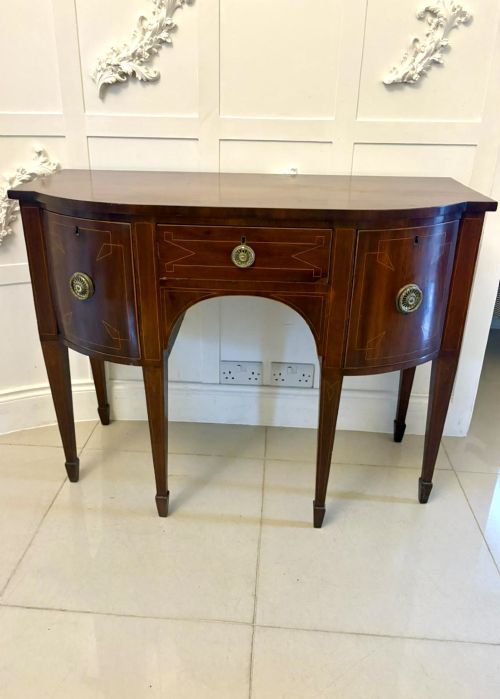
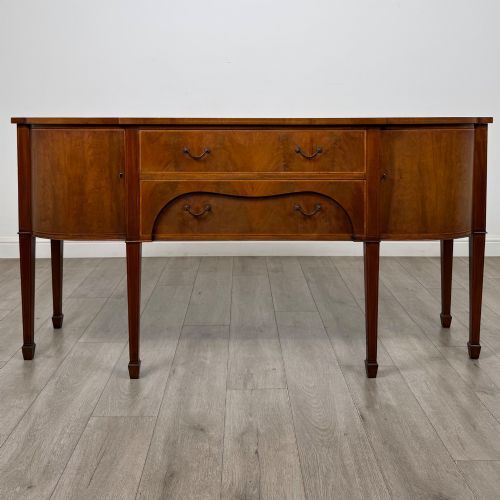
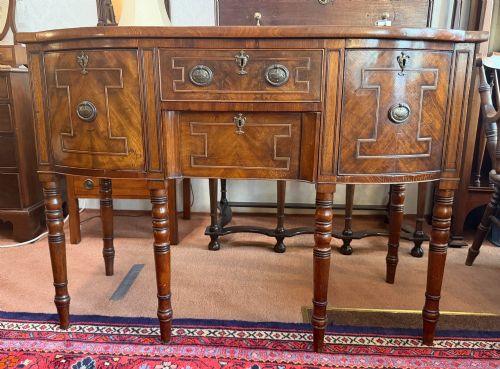
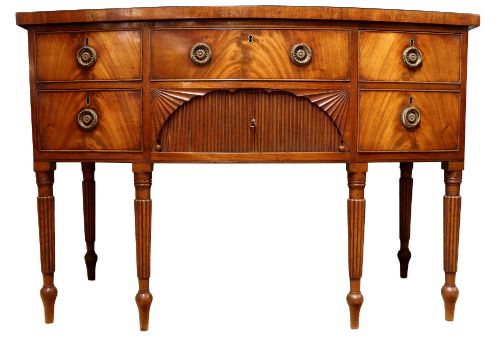
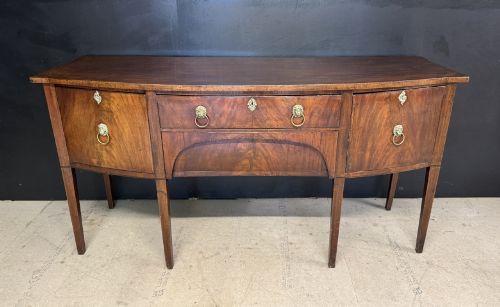
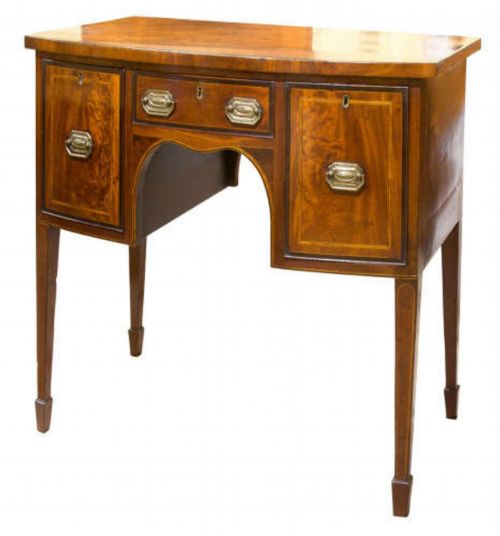
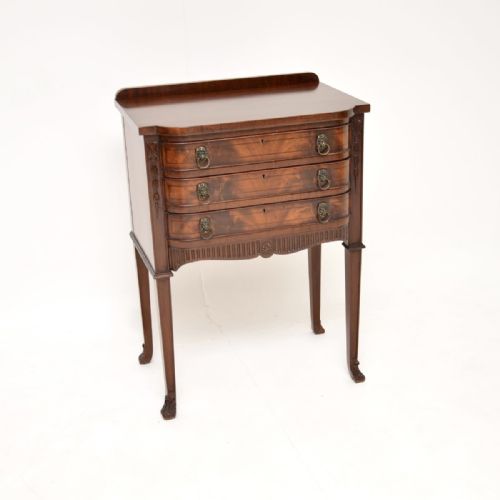
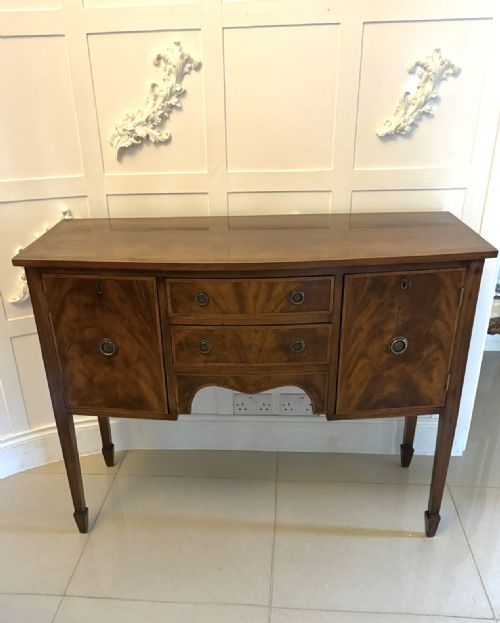
Bowfront Mahogany Buffet
A bowfront mahogany buffet brings practical dining room storage and sweeping curved lines to an interior.
Bowfront Mahogany Buffet
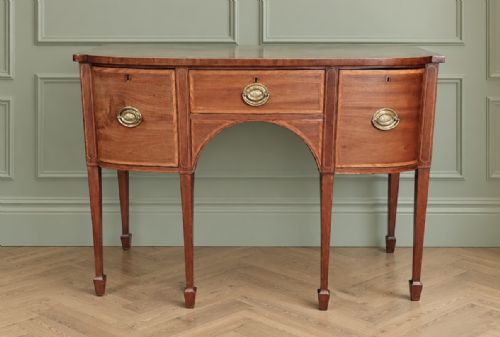
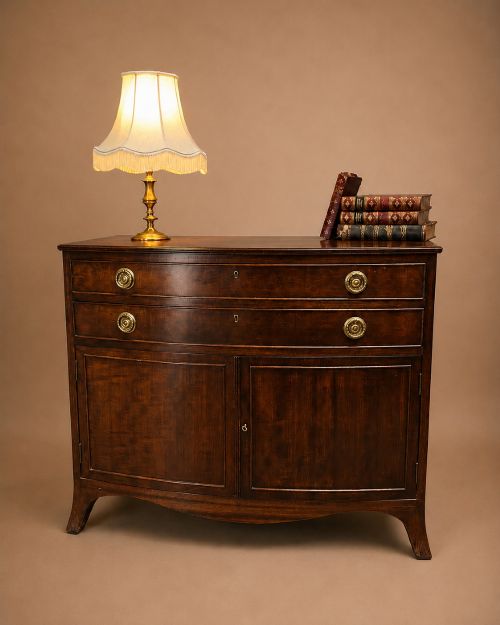
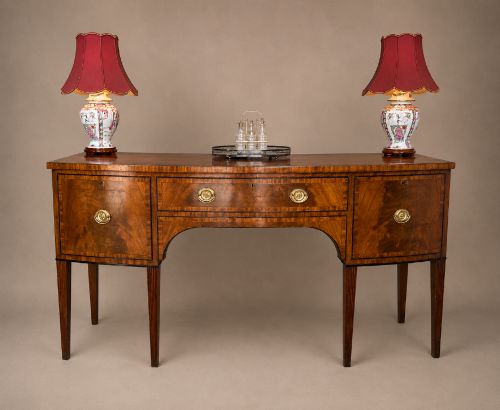
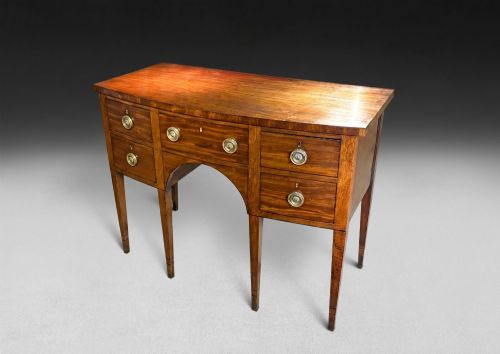
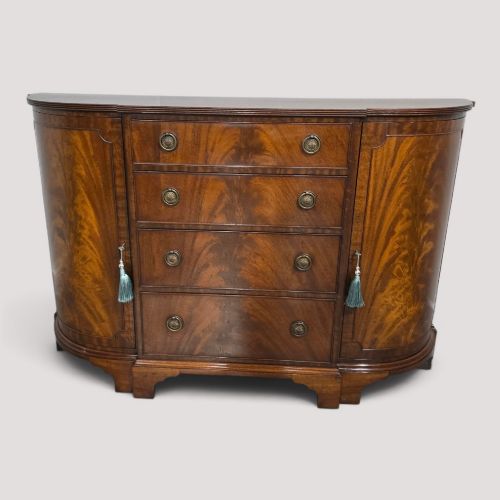
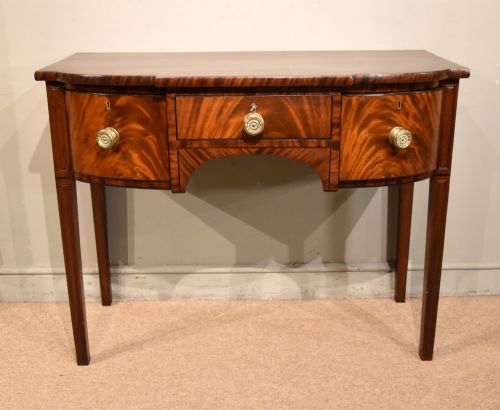
A bowfront mahogany buffet functions as a principal serving and storage piece in a dining room, combining cupboards and drawers behind a curved front. These pieces emerge predominantly from the eighteenth century, the Georgian period, and the Regency era, alongside later revival interpretations from the Edwardian period and the early twentieth century.
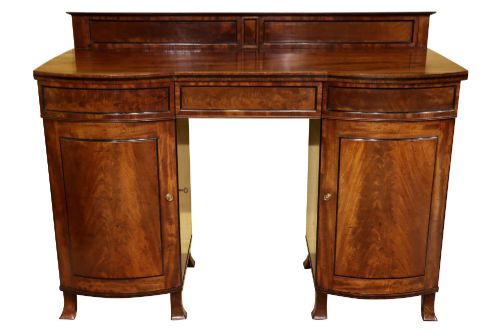
The form relies on a protruding central curve that softens the rigid geometry of a dining space while offering substantial depth for interior storage. Buyers encounter varying proportions, ranging from small compact sideboards to larger six-legged formats and grand pedestal designs.
Originating as formal dining furniture, these pieces bridge the gap between utility and display. The enduring appeal of a bowfront mahogany buffet lies in its balanced proportions and warm timber tones.
What varies in quality
Quality rests upon the selection of the timber grain and the precision of the cabinetmaker's joinery along the complex curve of the front. Superior examples display continuous, book-matched flame mahogany veneers that flow naturally across multiple drawers without abrupt interruptions.
Finer construction reveals itself in tight dovetail joints, crisp boxwood inlay work, and the retention of original brass hardware. Lesser examples demonstrate simpler timber selection and heavier, less refined secondary woods within the drawer linings.
Listings span the eighteenth century, the Georgian and Regency eras, through to Edwardian and early twentieth-century revivals.
The Bowfront Mahogany Buffet Glossary
- Bowfront
- A curved convex front cabinet design that projects outward in a smooth arc. This shape defines the primary silhouette of the pieces found here.
- Crossbanding
- A decorative border of veneer laid perpendicular to the grain of the surrounding wood. Cabinetmakers utilise this technique to frame drawer fronts and tabletops.
- Inlay
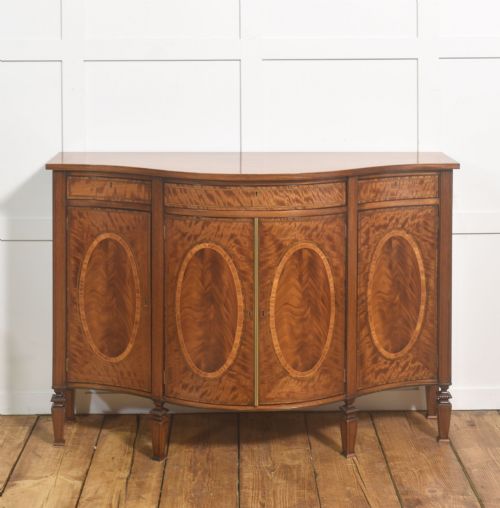
- The technique of inserting contrasting strips of timber such as boxwood or satinwood into recessed portions of the primary wood. This creates geometric patterns and sharp visual borders.
- Flame mahogany
- A highly figured cut of mahogany displaying a dramatic, flickering flame-like pattern. Furniture makers reserve this timber for prominent surfaces like drawer fronts.
- Pedestal sideboard
- A form featuring distinct cabinet pedestals flanking a central section, common in Regency examples. These pieces offer substantial architectural presence.
Bowfront Mahogany Buffet: Frequently Asked Questions
Where did people place these buffets?
Dining rooms served as the primary home for these pieces, where they held serving platters, cutlery, and linens during large meals. Their finished backs and refined fronts also allowed them to stand prominently against dining room walls.
Today, buyers frequently place them in hallways, living rooms, or large entryways to provide surface display space and concealed storage.
How do I date a bowfront sideboard?
Examining the secondary timbers, construction methods, and hardware styles provides clues to the period of origin. Eighteenth-century and Georgian pieces often display hand-cut dovetails and native secondary woods, whereas Edwardian and later revivals show machine-sawn components.
Stylistic cues like Sheraton satinwood inlay or Regency pedestal forms help narrow the decade of manufacture when combined with structural inspection.
What is the difference between a buffet and a sideboard?
The terms often overlap in historic furniture, though sideboards historically served formal dining rooms with a combination of cupboards and cellarette drawers. Buffets lean slightly toward lower serving formats designed for holding food dishes during gatherings.
Both categories utilise the curved bowfront shape to soften room layouts while offering deep interior capacity.
How do I care for mahogany timber?
Maintaining mahogany requires simple dusting with a soft, dry cloth and avoiding direct exposure to strong sunlight or heat sources. Natural waxes applied sparingly help preserve the depth of the polished grain over time.
Keeping indoor humidity stable prevents the timber and veneers from experiencing stress or movement along the curved carcase.