
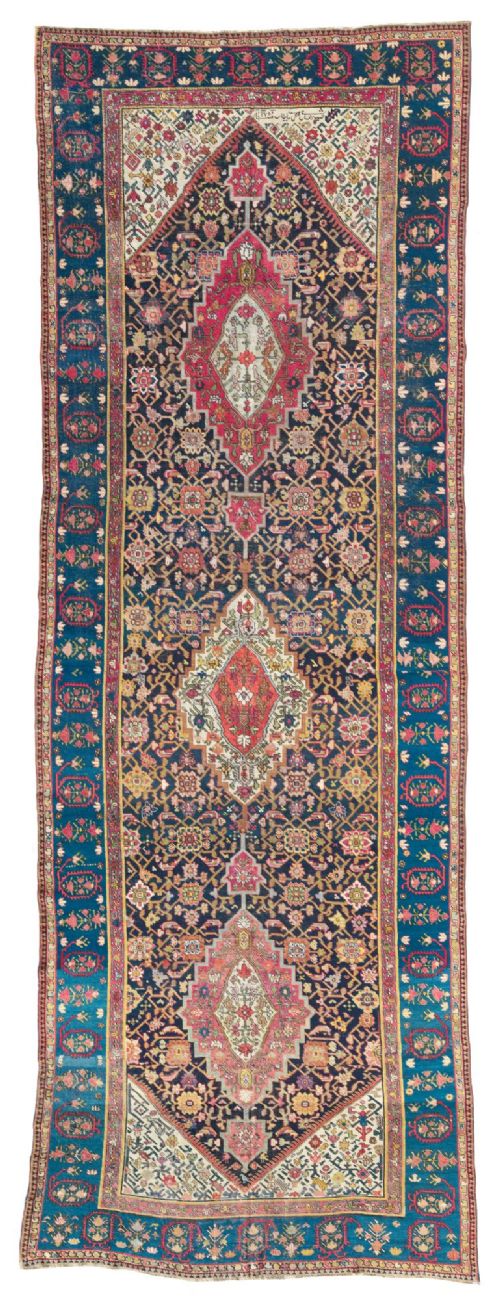
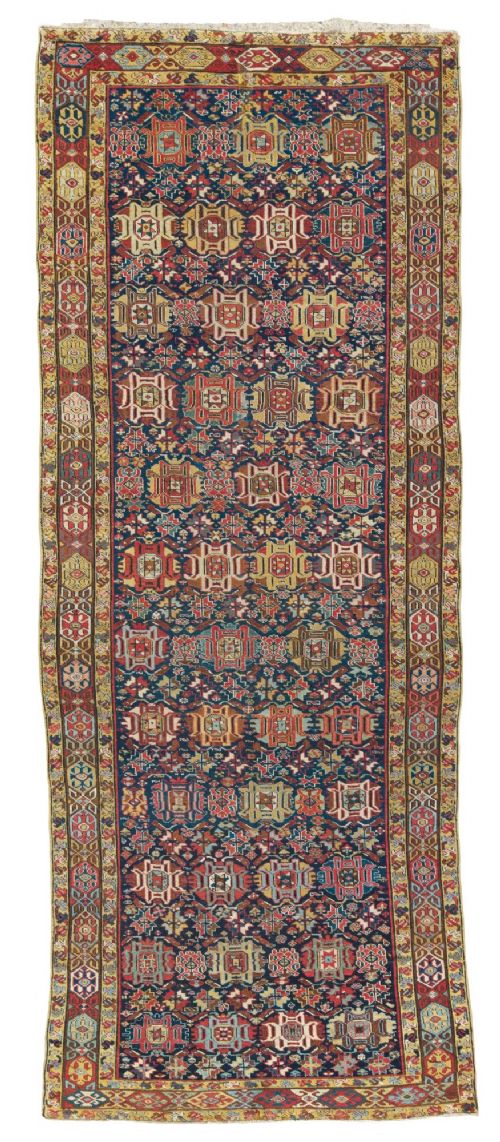


Blue Wool Kelleh Rug
These large-format blue wool kelleh rug pieces bring deep indigo palettes and substantial tribal presence to a room.
Blue Wool Kelleh Rug
A blue wool kelleh rug is a grand, room-sized tribal floor covering defined by an elongated rectangular format rather than a square or standard runner shape. These pieces originate primarily from Persian and Caucasian weaving traditions, spanning regional groups such as Kurdish, Khamseh, Malayer, Bidjar, Karabagh, and Kuba.
The format sits between a standard area rug and a long hallway runner, historically designed to fit specific architectural proportions in traditional houses. Surviving examples on this page date from the mid-nineteenth century through the early twentieth century, reflecting generations of village and nomadic craftsmanship.
How they were made
The construction relies on hand-spun wool for the pile, knotted densely onto robust cotton or wool foundation warps and wefts. This combination yields a heavy, resilient textile built to endure decades of heavy use on stone or timber floors.
Dyers utilised natural organic colorants to achieve the deep blue ground colours characteristic of these carpets, supplemented by secondary mineral and plant dyes for motifs like boteh, dragon borders, and harshang crab patterns.
Several carpets feature fierce dragon borders, standing guard beneath your coffee table against imaginary nomadic intruders.
What varies in quality
The fineness of the knotting and the tightness of the weave dictate the structural integrity and the clarity of the geometric or floral design. Tightly beaten foundations prevent the rug from distorting over time and keep the pile upright under foot.
The depth, saturation, and stability of the natural indigo dyes govern the visual impact of the piece. Subtle shifts in tone, known as abrash, indicate natural hand-dyeing processes rather than uniform chemical immersion.
The Blue Wool Kelleh Rug Glossary
- Kelleh
- A large format rectangular carpet, traditionally longer than a standard room rug but wider than a corridor runner. This distinctive proportion was favoured in Persian and Caucasian weaving centres.
- Abrash
- Variations of colour within a single field of tone caused by changes in dye batches or hand-spun wool lots. It creates a subtle, banded appearance that seasoned collectors prize for authenticity.
- Boteh
- A stylised floral or almond-shaped motif representing a-seed, shrub, or flame. It appears frequently in traditional Persian and Kurdish designs across this selection.
- Harshang
- A recurring crab-like floral border or field pattern found in Northwest Persian weaving. The motif combines angular palmettes with serrated leaves.
- Warp
- The stationary vertical threads stretched across the loom that form the structural skeleton of the carpet. The knotted pile wraps securely around these foundational strands.
Blue Wool Kelleh Rug: Frequently Asked Questions
What is a kelleh rug?
A kelleh is a traditional format of oriental carpet that is significantly longer than it is wide, sitting between a standard room-sized rug and a runner.
Historically woven by tribal and village communities in Persia and the Caucasus, these large formats served as formal floor coverings in reception rooms.
How do I care for an old wool rug?
Vacuum these textiles gently with a suction-only attachment, avoiding motorized rotary brushes that can pull at the hand-spun wool pile.
Keep the rug out of direct, prolonged sunlight to protect the natural indigo and madder dyes from fading over the decades.
How do I identify a Kurdish kelleh?
Kurdish pieces typically display robust, dense wool foundations and sturdy construction designed for durability.
Their designs often incorporate repeating geometric motifs, tribal symbols, or distinct border patterns characteristic of weavers from the western regions of Persia.
Where were these carpets used?
These large format textiles were traditionally placed along the perimeter or down the centre of main reception spaces in traditional homes.
Their elongated rectangular shape suited the specific architectural proportions of nomadic and village dwellings.