





Blue Satsuma Vases
Blue satsuma vases bring together rich cobalt grounds and meticulous hand-painted detail from late nineteenth and early twentieth century Japan.
Blue Satsuma Vases
When buyers search for blue satsuma vases, they encounter earthenware vessels distinguished by deep cobalt blue grounds rather than the typical cream-coloured crackle glaze. These pieces originate predominantly from the Meiji period, alongside examples stretching into the Taisho and early Showa eras.
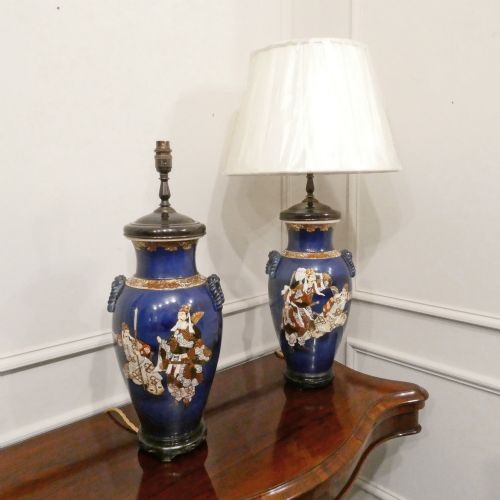
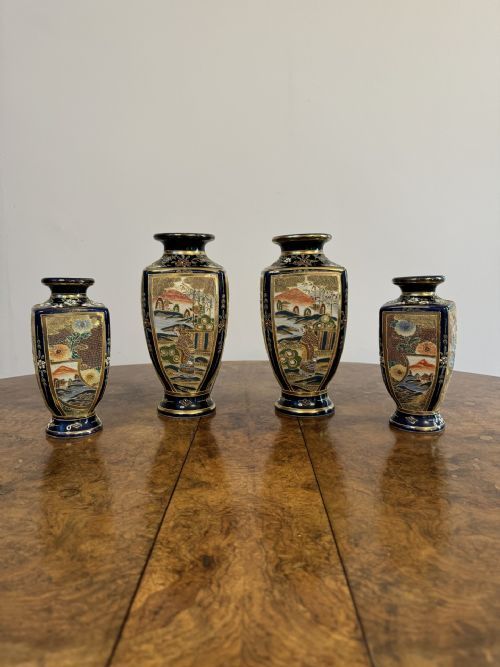
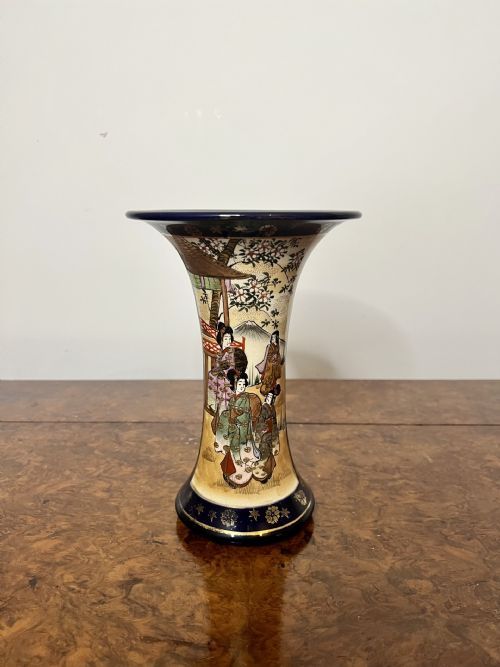
The selection on this page centres heavily on pairs, garnitures of four, and individual decorative vases, occasionally adapted as table lamps. Surviving examples showcase court figures, religious scenes, and landscape panels executed with fine precision.
Originating from workshops in Japan, these items reflect the sophisticated decorative output exported to Western markets during the late Victorian era and the turn of the twentieth century.
How they were made
Potters formed these pieces using earthenware clay before applying a rich cobalt glaze as the foundational ground. Artisans then hand-painted intricate narrative scenes directly onto the ceramic body.
Raised moriage work and gold leaf or heavy gilt detailing were layered over the glaze to accentuate court figures and decorative borders. Wood and fabric elements appear in associated components such as converted lamp bases.
Blue Satsuma Vases Retail Price Guide 2026
Typical asking prices for blue satsuma vases among the pieces listed under this phrase on Sellingantiques today, from the lower quarter to the upper quarter. They describe what is for sale here now, not the wider market.
Listings feature earthenware vessels spanning the Meiji period to the Taisho and early Showa eras, decorated with enamel and gold leaf.
What varies in quality
The application of gold leaf and gilt creates a marked hierarchy, where superior vessels retain thick, burnished gilding across intricate borders. Attributions to notable makers or documented workshops elevate the standing of a piece within this category.
Kinkozan·Nanzan·Tashiro
The Blue Satsuma Vases Glossary
- Moriage
- A Japanese decorating technique where slip is piped onto the ceramic surface to create raised designs before glazing and gilding. This method gives garments and decorative borders a tactile, three-dimensional quality.
- Meiji Period
- The era of Japanese history spanning from 1868 to 1912, characterised by the opening of trade with the West and a surge in decorative ceramic exports. Pieces from this time often exhibit exceptional technical mastery.
- Garniture
- A set of matching vases designed to be displayed together on a mantelpiece or sideboard. These groupings typically comprise three, four, or five coordinated vessels.
- Cobalt Ground
- The deep blue underglaze background that distinguishes these specific Satsuma pieces from traditional cream-coloured wares. It provides a striking contrast for gilt ornamentation and polychrome figures.
- Earthenware
- A porous ceramic body fired at lower temperatures than stoneware or porcelain. It serves as the traditional substrate for Satsuma pottery before the application of glazes and enamel.
Blue Satsuma Vases: Frequently Asked Questions
What is a blue satsuma vase?
These are Japanese earthenware vessels featuring a deep cobalt blue glaze rather than the traditional pale crackle-glaze background.
They are typically decorated with hand-painted court figures, landscapes, and raised gold ornamentation from the Meiji period and subsequent eras.
How do I date a satsuma vase?
Dating relies on stylistic markers, historical periods such as the Meiji era, and specific artist signatures or workshop marks painted on the base.
Earlier pieces generally exhibit tighter brushwork and heavier gilt application compared to later twentieth-century productions.
Where were these vases made?
They were produced in Japan, primarily within traditional ceramic workshops and kilns catering to both domestic and export markets during the late nineteenth and early twentieth centuries.
Kyoto served as a major centre for the production of highly decorated Satsuma wares destined for Western collectors.
How should I display them?
Because many survive as pairs or garniture sets, placing them symmetrically on sideboards or mantelpieces highlights their original decorative purpose.
Ensure they sit away from direct sunlight and heavy foot traffic to protect the delicate gilt and enamel surfaces.