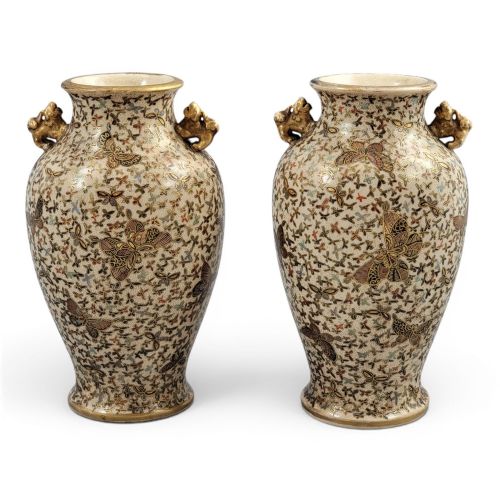
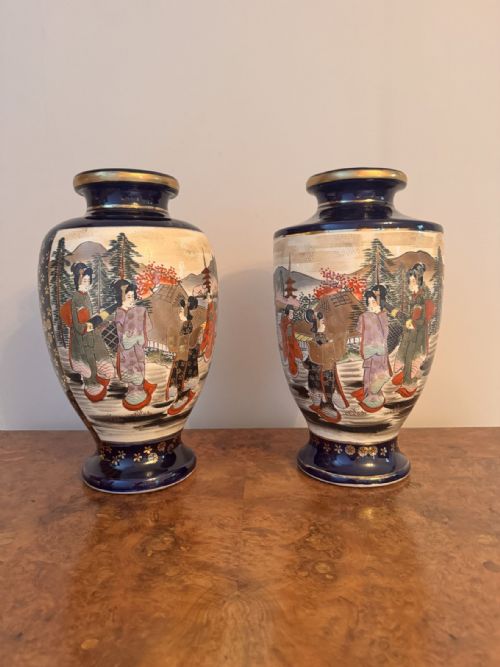
Ritas Bazaar has dated this Japanese Meiji Satsuma Vase to the 19th Century.

The surface is animated by a finely painted genre scene depicting women and a child in a landscaped garden setting, surrounded by flowering trees and delicate seasonal flora. The figures are rendered with remarkable naturalism: facial features remain balanced and expressive even under magnification, while the proportions of garments and posture are preserved with exceptional accuracy.

Particularly notable is the use of meticulously applied gold stippling, arranged in precise and evenly spaced rows across the background. This technique—often compared to sharkskin or pointillist texturing—is closely associated with the highest tier of Kyoto Satsuma decoration and recalls the refined surface treatments seen in the works of Yabu Meizan. The gold is not merely painted but carefully layered to create depth and visual rhythm.

The relief decoration (moriage) is another defining feature. Flowers and elements of the women’s costumes are raised to the touch, a labor-intensive technique reserved for elite workshop production. Achieving such refinement on a vase of modest size demands exceptional control and mastery; the consistency and clarity of detail here strongly indicate the hand of a highly skilled artist.

The base shows traces of a former signature or inscription, now worn and unreadable. While a definitive attribution is therefore impossible, specialists commonly associate works of this style, quality, and technical language with Kinkozan or a closely related master within the Kinkozan circle.

Beyond its artistic merits, this vase embodies the enduring appeal of genuine Meiji-period Satsuma. In periods of market uncertainty, museum-quality decorative arts with proven historical significance continue to attract collectors and investors alike, serving as a stable and tangible store of cultural value.

Measurements
Dimensions: Height 12.3 cm; Diameter 7 cm.
Shipping & Packaging
Please study the accompanying photographs carefully as they form an integral part of this description.
If you have any questions, we will be happy to answer them.
The item will be shipped with full tracking and insurance.
It is important to note that shipping costs include labour, packaging and postage.
Ritas Bazaar has dated this Japanese Meiji Satsuma Vase to the 19th Century.
You can view the stock and full dealer information on the Ritas Bazaar Profile Page

Exceptional Meiji Period Satsuma Vase, Attributed to the Kinkozan Circle, C. 1890