



Blue Porcelain Garniture
Blue porcelain garniture sets bring symmetry and rich colour to a mantelpiece, pairing matched ceramic vessels with ormolu or gilt bronze mounts.
Blue Porcelain Garniture
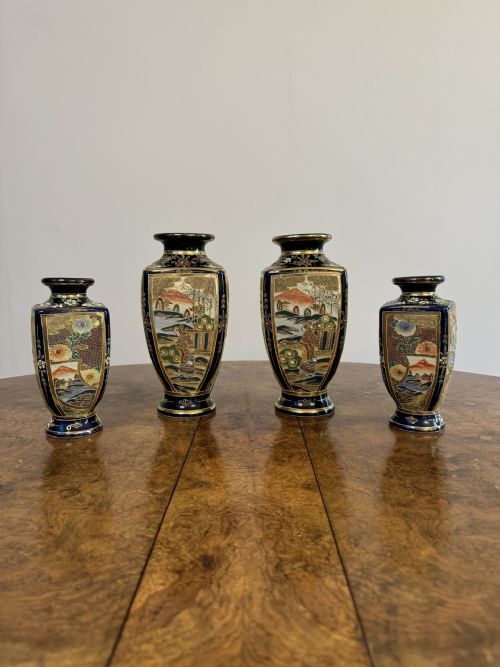
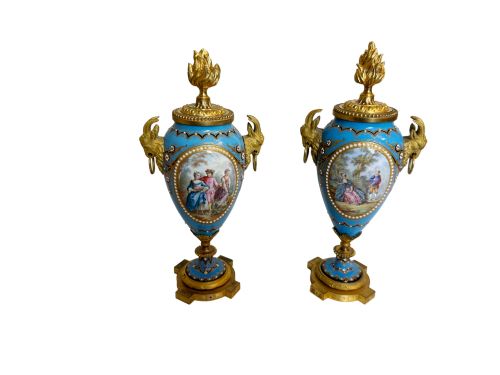
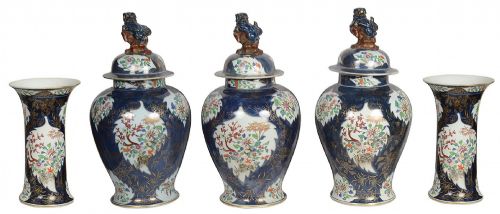
A blue porcelain garniture comprises a matching set of three or more ceramic vessels, often accompanying a mantel clock to create a balanced decorative display. These arrangements stem predominantly from nineteenth-century European and Japanese traditions, reflecting both continental taste and global trade.
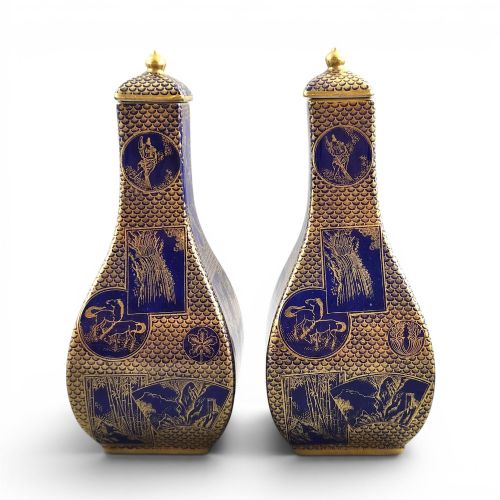
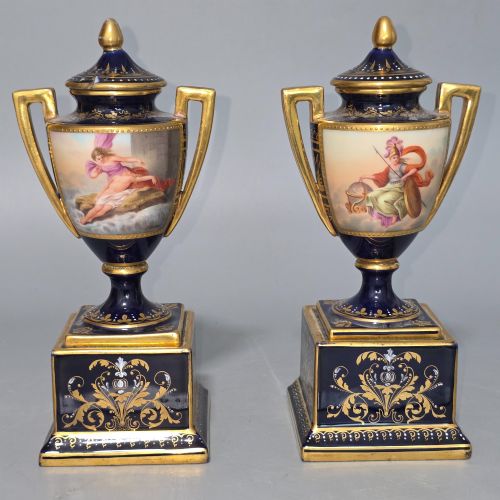
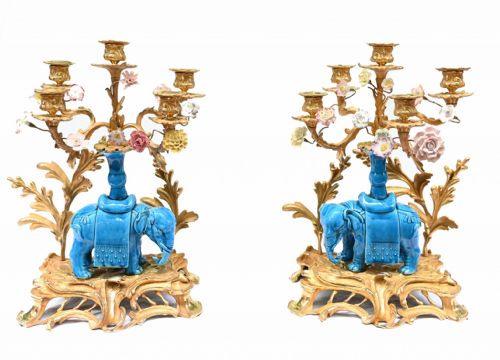
The objects on this page appear most commonly as pairs of lidded urns or vases flanked by a central timepiece, or simply as matched groupings of three to four vases. Forms range from French neoclassical amphorae to Japanese Imari shapes and Chinese export styles.
Makers and decorators utilised rich ceramic bodies paired with metal mounts, drawing on Sèvres, Vienna, and Paris porcelain traditions. Buyers encounter these sets spanning the Victorian era through the turn of the twentieth century.
Assessing quality and execution
Quality reveals itself in the crispness of the porcelain potting, the depth of the cobalt or bleu de roi glaze, and the precision of the hand-painted enamelling. Superior sets display finely detailed figural panels or botanical studies rather than repetitive transfer printing.
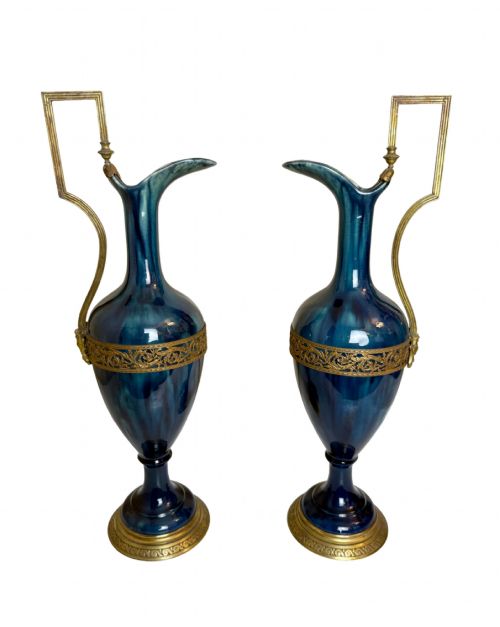
The execution of the ormolu or gilt bronze mounts distinguishes masterwork garnitures from standard production. Heavier, crisply chased bronze fittings that integrate seamlessly with the ceramic body indicate superior workshop output.
Some nineteenth-century French clocks sport porcelain lyre shapes that look ready to serenade the mantelpiece.
Mason's Patent Ironstone·F Koller·KPM Berlin·Finnigan Manchester·Thomas Steel·Vincenti of Paris
The Blue Porcelain Garniture Glossary
- Garniture
- A matched set of ornamental vases or vessels designed to be displayed together on a mantelpiece or sideboard. These sets typically consist of three or five pieces sharing a unified decorative scheme.
- Ormolu
- Finely ground high-carat gold applied to a bronze base using a mercury amalgamation process, or simply gilt bronze used for mounts. This technique prevents tarnishing and gives a rich yellow sheen.
- Bleu de Roi
- A deep, rich cobalt blue glaze developed at the Sèvres porcelain factory in France during the eighteenth century. It became widely emulated across European porcelain houses.
- Cassolette
- A decorative vessel shaped like a vase or urn, often featuring a reversible lid that functions as a burner for perfumes. They form part of many antique clock garnitures.
- Imari
- A style of Japanese export porcelain decorated in underglaze blue, iron red, and gold. The palette derives from wares produced in Arita and shipped through the port of Imari.
Blue Porcelain Garniture: Frequently Asked Questions
What is a clock garniture?
A clock garniture is a matching set comprising a central mantel clock accompanied by two side pieces, such as vases, urns, or candelabras. These sets were designed to create a balanced decorative arrangement on a fireplace mantel or console table.
The pieces share identical materials, glazes, and metal mounts, ensuring a cohesive aesthetic across the entire group.
How do you style a garniture set?
Garniture sets are traditionally placed symmetrically on a mantelpiece, with the tallest or central piece positioned in the middle and the matching vessels flanking it. This arrangement draws the eye and anchors the visual weight of a room.
They also sit effectively on large sideboards, cabinets, or dedicated display tables where the matching profile can be fully appreciated.
Are all blue porcelains from Sèvres?
While Sèvres is the most famous name associated with blue French porcelain, many other factories produced similar wares. Paris workshops, German houses like KPM Berlin, and English potteries created their own interpretations using deep blue grounds and gilt mounts.
Distinguishing between them depends on factory marks, paste consistency, and the style of the hand-painted decoration.
What does ormolu mounting mean?
Ormolu mounting refers to cast bronze elements that have been gilded and fitted to ceramic bodies to provide structural support and decoration. These mounts protect the edges of the porcelain and elevate the decorative status of the object.
In antique garnitures, they often take the form of scrolled feet, handles, rims, or finials designed specifically for each vessel.