
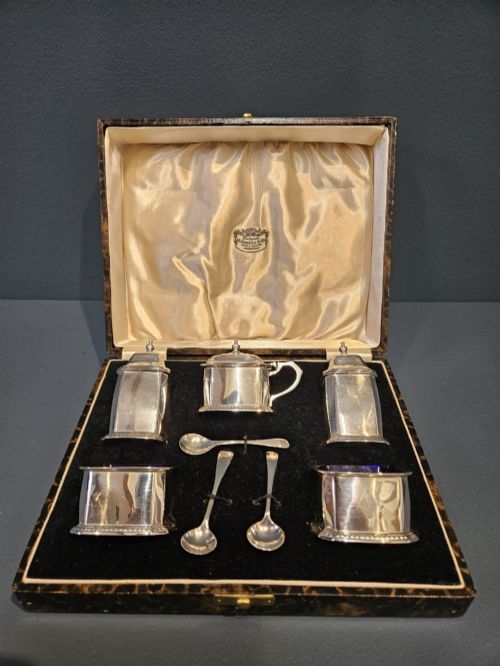

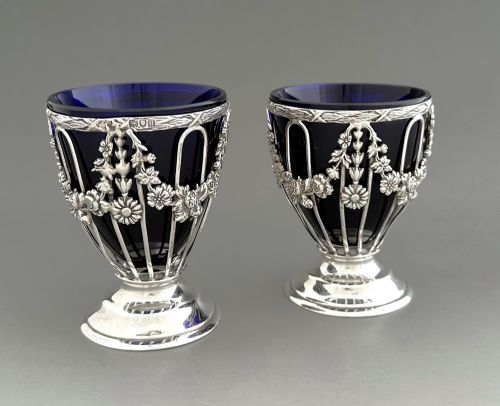
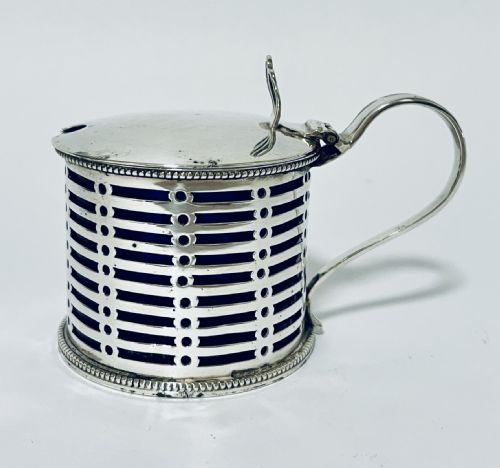
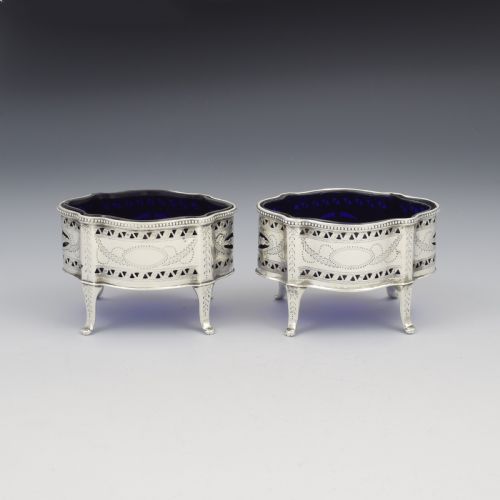


Blue Glass Liner Salt
A blue glass liner salt brings rich colour to the dining table, pairing precious metal frames with vibrant blown or moulded glass.
Blue Glass Liner Salt
A blue glass liner salt pairs an open metal framework with a removable insert, protecting the metal from corrosive saline contents. When collectors search for a blue glass liner salt, they encounter open salts, mustard pots, and cruet sets spanning the Georgian, Victorian, Edwardian, and Art Deco periods.
The metal holders take various forms, including boat-shaped vessels, serpentine pierced galleries, wirework tubs, and horse hoof designs. Sterling silver and silver plate form the outer mount, while the internal container utilises cobalt glass or blue opaline glass.
Victorian and Georgian examples dominate the early work, often featuring intricate piercing or cast detailing. Later Edwardian and Art Deco pieces bring simpler geometric lines or streamlined plating to the table.
How they were made
Silversmiths shaped the outer frames through casting, piercing, and wirework fabrication, applying hallmarks to sterling silver or coating base metals with silver plate. Master craftsmen pierced intricate patterns into silver sheets or soldered wire frames together to form openwork galleries.
Glassmakers blew or moulded cobalt and opaline glass to fit snugly inside the metal mounts, sometimes leaving pontil marks on the base of earlier vessels. Velvet linings occasionally accompanied fitted presentation boxes, though the glass insert remained the functional centrepiece.
Victorian silversmiths occasionally cast salt cellars in the exact likeness of horse hooves, complete with tiny silver shoes.
What varies in quality
Quality rests upon the crispness of the metalwork, the weight of the silver frame, and whether the glass liner is original to the piece. Hand-pierced galleries and heavy cast mounts demonstrate superior craftsmanship compared to mass-produced plated alternatives.
The depth of colour and clarity in the glass insert also dictate worth. Blown glass with smooth rims and even saturation outranks cloudy or heavily chipped replacements.
David Hennell I·Elkington and Co·William Neale
The Blue Glass Liner Salt Glossary
- Cobalt glass
- A deep blue glass coloured with cobalt oxide. It provides a striking contrast against polished silver mounts.
- Salt cellar
- A small open vessel used to hold salt at the dining table before the invention of the spring-loaded shaker.
- Cruet set
- A matched grouping of condiment containers, including mustard pots, pepperettes, and salt cellars, held within a frame or tray.
- Pierced silver
- Metalwork decorated by cutting decorative patterns right through the silver sheet. This technique lightened the vessel while displaying the coloured glass within.
Blue Glass Liner Salt: Frequently Asked Questions
What is a blue glass liner salt?
A blue glass liner salt consists of an open metal holder paired with a removable blue glass insert. The metal frame supports the glass container while allowing the rich colour to show through pierced or openwork designs.
These pieces served salt at the dining table before modern shakers became common. They function today as both decorative tableware and historic examples of silversmithing.
How do I date a silver salt cellar?
Dating relies heavily upon hallmarks stamped into the silver, which record the assay office, date letter, and maker's mark. Stylistic clues such as Georgian piercing or Art Deco geometry also help determine the period.
Comparing the shape of the metal mount and the manufacturing technique of the glass liner provides further confirmation of age.
How do I care for antique silver and glass?
Clean the silver frame using a soft cloth and a gentle, non-abrasive polish designed for antiques. Avoid getting polish on the glass or trapping residue in pierced galleries.
Wash the glass liner separately in warm, soapy water and dry it thoroughly before placing it back into the metal mount.