
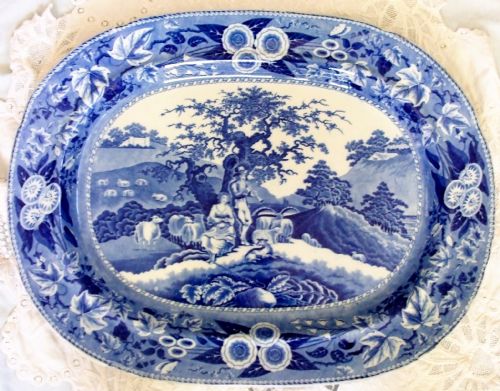


Blue Ceramic Meat Platter
A blue ceramic meat platter brings grand nineteenth-century dining tables to life with deep cobalt scenes and robust earthenware.
Blue Ceramic Meat Platter
A blue ceramic meat platter serves as the centrepiece for joint roasts and game in Georgian and Victorian dining rooms. These large serving dishes appear frequently in transfer-printed earthenware, ironstone, and occasionally porcelain.
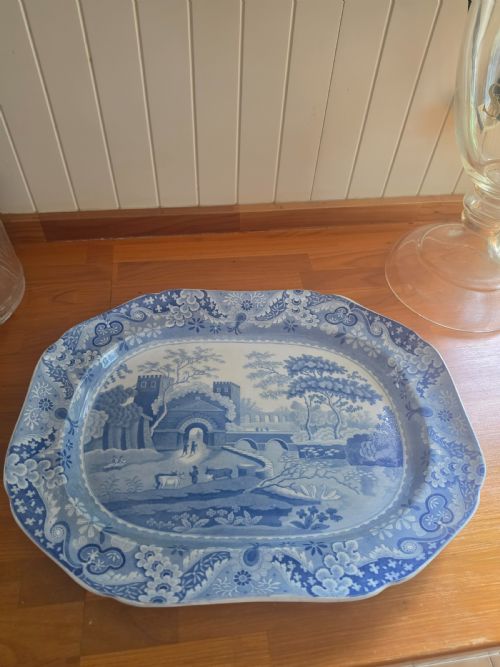
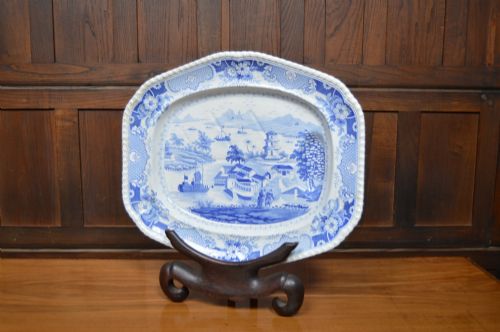
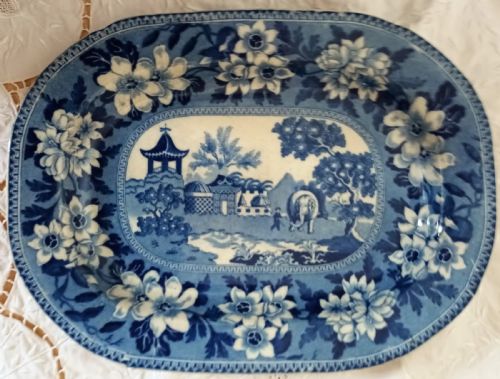
The inventory on this page ranges from early nineteenth-century English earthenware plates to Chinese export porcelain and substantial Mason's ironstone pieces. Many examples feature pictorial transfer prints depicting topographical views, classical ruins, or Chinoiserie landscapes.
Buyers encounter heavy platters designed with dedicated wells and drainage inserts to collect juices from roasted meats. These sturdy utility items combined domestic practicality with elaborate decorative schemes suited for formal dining.
Materials and production methods
Potters shaped these large platters from earthenware, ironstone, or porcelain bodies before applying cobalt pigment by hand or through copperplate transfer printing. Glaze was then applied over the surface to seal the design and create a glossy finish during high-temperature kiln firing.
Transfer printing allowed potteries to replicate intricate topographical scenes and exotic patterns consistently across heavy serving ware. Ironstone provided extra durability for large platters, while porcelain and refined earthenware offered a finer white ground for cobalt blue decoration.
Listings feature eighteenth and nineteenth-century eras, utilising earthenware, ironstone, and porcelain with cobalt pigment.
Qualities of distinction
Clarity of the transfer print and depth of the cobalt pigment separate standard production from superior pieces. Crisp lines in complex patterns like classical ruins or architectural views indicate skilled copperplate engraving and careful kiln control.
The presence of matching drainers, gravy wells, or large proportions elevates the status of a platter. Substantial ironstone bodies and well-preserved glaze surfaces without heavy staining also determine the desirability of individual pieces.
Spode·John Rogers and Son·Mason·Minton·Don Pottery·Thomas Lakin·Copeland and Garrett·Davenport
The Blue Ceramic Meat Platter Glossary
- Transferware
- Pottery decorated by applying a printed design from a copper plate onto paper, which was then transferred onto the unglazed ceramic body. This technique enabled intricate multi-figurative patterns to be produced efficiently.
- Ironstone
- A dense, hard ceramic patented in the nineteenth century as a durable alternative to porcelain. It withstands heavy use and thermal shock better than standard earthenware.
- Meat drainer
- A perforated ceramic insert placed inside a platter to lift roast meat above accumulated juices. These often feature matching transfer-printed patterns.
- Well and tree
- A platter design featuring a recessed channel around the edge and a sloped well at one end to collect meat juices during carving. This kept the joint elevated and dry.
- Chinoiserie
- A European decorative style imitating Chinese artistic traditions. It appears frequently on nineteenth-century blue and white ceramics depicting imaginary oriental landscapes.
Blue Ceramic Meat Platter: Frequently Asked Questions
How were meat platters used?
These large dishes held roasted joints of meat, poultry, or game at the dining table during formal family meals and large gatherings.
Servants used them to present food carved from the kitchen, often utilising integrated wells and drainers to manage juices.
Can I use these platters for serving food today?
Most nineteenth-century ceramic platters remain structurally sound for serving dry foods, cold meats, or bread at modern dining tables.
Due to age, historical glazes, and potential crazing, hand washing is essential, and dishwasher use must be avoided.
How do I identify the date of a platter?
Makers' marks stamped or printed on the reverse, combined with specific pattern names and ceramic bodies, help pinpoint manufacturing eras.
Early nineteenth-century pieces often display characteristic deep cobalt hues on porous earthenware, whereas later Victorian ironstone is heavier and denser.
What is the purpose of a drainer insert?
Perforated ceramic drainers sat inside the well of the platter to elevate heavy roasts above their own cooking liquids.
This prevented the meat from sitting in fat during service and directed juices toward the lower end of the dish.
How should I display a large ceramic platter?
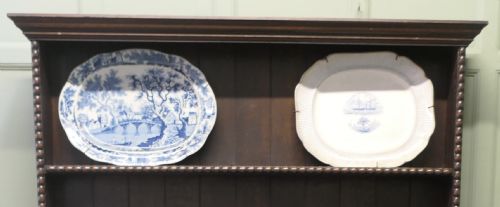
Large platters look effective mounted securely on walls using appropriate wire plate hangers or displayed upright on sturdy dressers.
Their substantial weight and decorative transfer-printed borders make them strong visual focal points in a dining room or kitchen.