




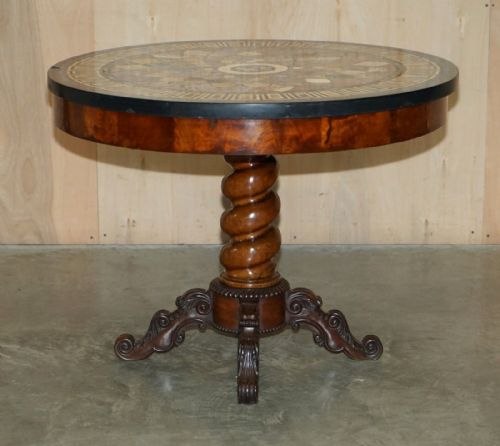


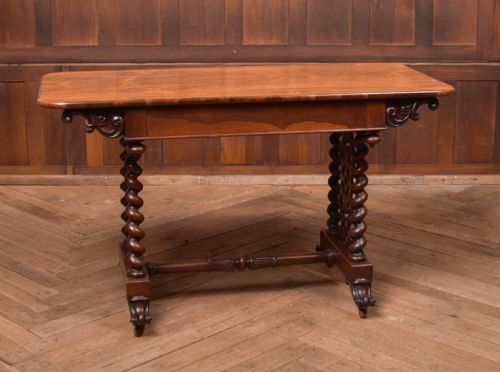

Barley Twist Centre Table
A barley twist centre table brings architectural turnings and rich timber to the middle of a room, offering both a useful surface and a strong period presence.
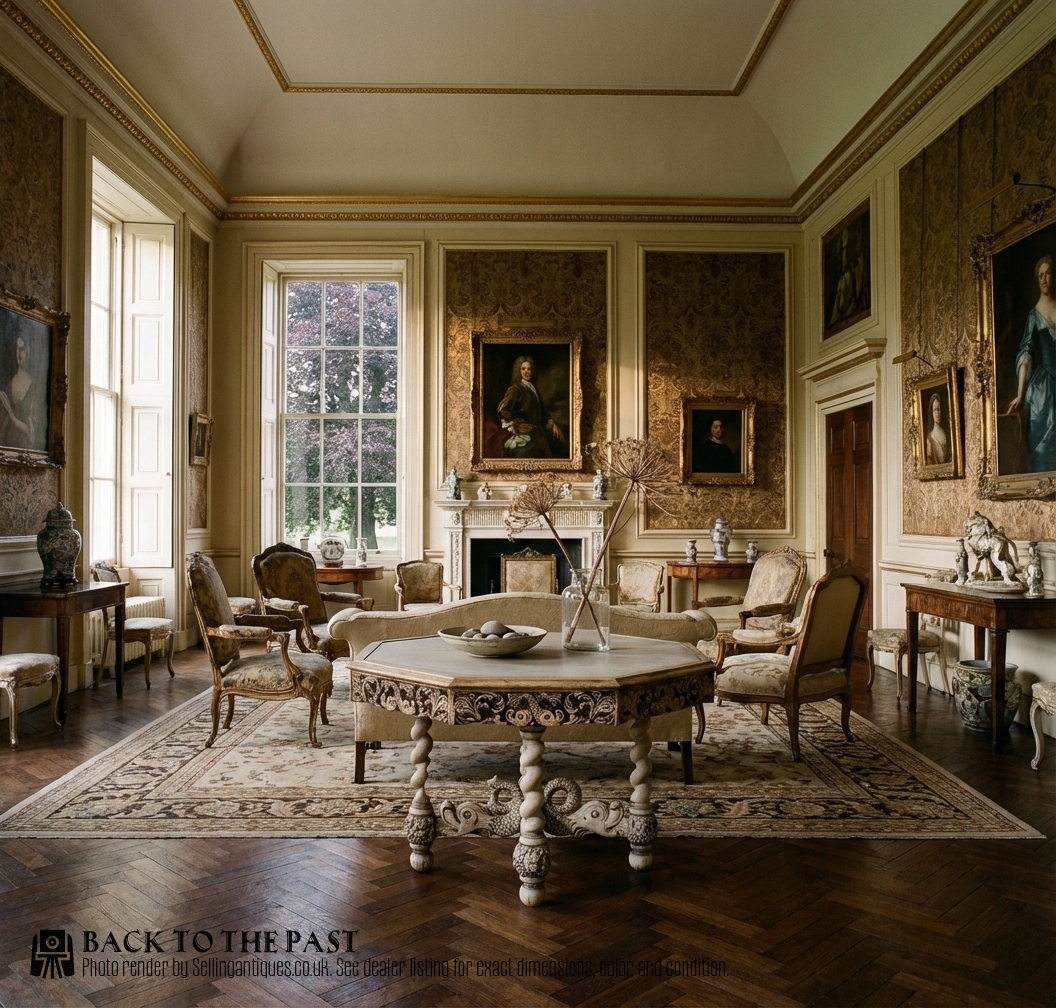
Barley Twist Centre Table
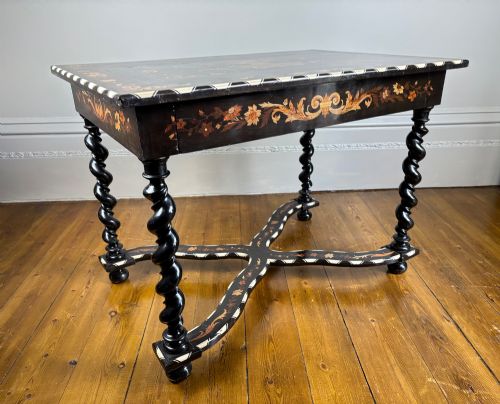
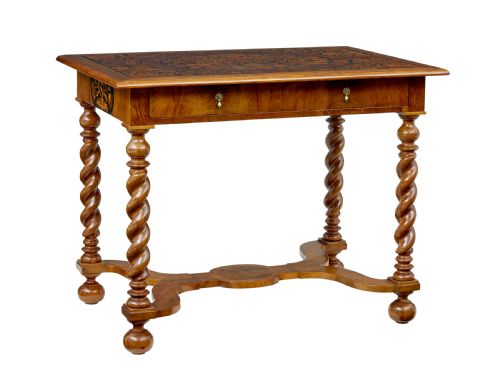
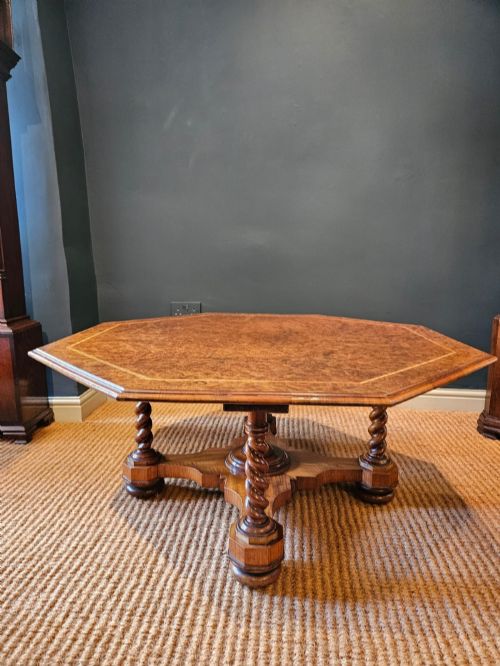
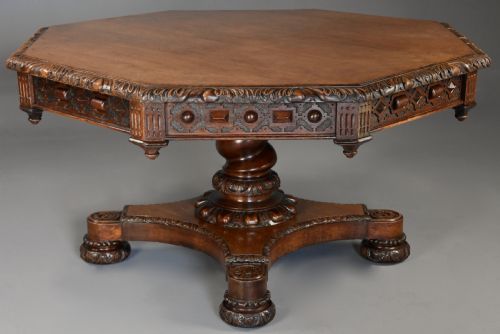
A barley twist centre table stands independently in a room, designed to be viewed from all sides rather than pushed against a wall. The phrase points directly to pieces supported by spiral-turned legs or central pillars, drawing heavily on seventeenth-century joinery traditions revived across the nineteenth century.
Most examples encountered here date from the Victorian era and the nineteenth century, though earlier seventeenth-century survivals and later twentieth-century interpretations also appear. They range from compact occasional stands and octagonal coffee tables to expansive library and breakfast tables.
Makers utilised various forms, including circular, oval, and square tops, often fitted with pedestals, stretchers, or tripod bases. The primary function remains a stable, central platform for lamps, books, or decorative objects within a principal room.

Timber and turning
Cabinetmakers constructed these tables using a variety of dense and figured timbers, most notably walnut, mahogany, oak, and rosewood, alongside decorative veneers such as laburnum oyster and satinwood. Ebonised finishes and parcel gilding also appear, offering a dramatic contrast to natural wood grains.
The characteristic spiral legs were formed by hand-turning timber on a lathe or through skilled carving, requiring precise alignment to maintain a continuous, even helix. Additional decorative flourishes include marquetry, bone inlay, pietra dura specimen marble tops, and cast brass sabots.
Barley Twist Centre Table Retail Price Guide 2026
Typical asking prices for barley twist centre table among the pieces listed under this phrase on Sellingantiques today, from the lower quarter to the upper quarter. They describe what is for sale here now, not the wider market.
Listings feature walnut, mahogany, oak, rosewood, and fruitwood across centuries ranging from seventeenth-century Dutch styles to Edwardian designs.
Distinguishing quality
Quality rests primarily on the crispness of the timber turning and the depth of the grain in woods like burr walnut or rosewood. Superior pieces display harmonious proportions between the heavy turned base and the top, with tight joints and well-executed inlay work rather than surface-level decoration.
Exhibition-grade pieces reveal meticulous attention to interior construction and secondary timbers, whereas simpler utilitarian versions rely on straightforward joinery. The integrity of the twist, the weight of the timber, and the subtlety of any marquetry or parquetry separate standard examples from finer works of cabinetmaking.
Daniel Cottier·Cottier and Co·James Winter
The Barley Twist Centre Table Glossary
- Barley twist
- A spiral turning resembling a twisted rope, popular in seventeenth-century furniture and revived during the Victorian period. It adds dynamic visual movement to table legs and central pillars.
- Centre table
- A freestanding table finished on all sides, intended to occupy the middle of a room rather than sit against a wall. These pieces often function as display surfaces or library tables.
- Marquetry
- Decorative patterns formed by fitting together contrasting pieces of veneer onto a solid wood carcase. This technique creates elaborate floral, geometric, or pictorial scenes on table tops.
- Pietra dura
- An inlay technique using cut and fitted polished coloured stones to create pictorial designs. It appears on high-status nineteenth-century table tops.
- Stretcher
- A horizontal timber connecting the legs of a table to provide structural stability. In twist tables, these stretchers often mirror the spiral turning of the legs.
Barley Twist Centre Table: Frequently Asked Questions
Where should I place a centre table?
A centre table belongs in the middle of a room where it can be approached from all sides. It works effectively in a large hallway, a library, or the middle of a drawing room as a focal point.
Ensure there is sufficient clearance around the piece for movement. Placing a lamp or a stack of books on top grounds the table visually within the space.
How do I care for a polished wood table?
Protect timber surfaces from direct sunlight and excessive heat fluctuations to prevent the wood from splitting or warping. Use coasters and felt pads beneath objects to avoid scratches on the polish.
Apply a traditional beeswax occasionally to nourish the grain and maintain a soft sheen. Avoid modern silicone sprays that can build up and damage antique finishes.
How can I date a barley twist table?
Dating relies on timber selection, construction methods, and the style of the turning. Seventeenth-century originals often feature heavier, hand-carved oak or walnut structures with pegged joints.
Victorian revivals tend to use machine-turned spirals in dense mahogany, walnut, or ebonised wood, sometimes accompanied by nineteenth-century hardware and secondary timbers.
What is the difference between an occasional table and a library table?
An occasional table is typically smaller and lighter, designed to be moved around a room as needed for drinks, lamps, or display. A library table is much larger, heavier, and built for heavy daily use.
Library tables often incorporate drawers for stationery and offer a stable, expansive surface suited to reading and writing.