
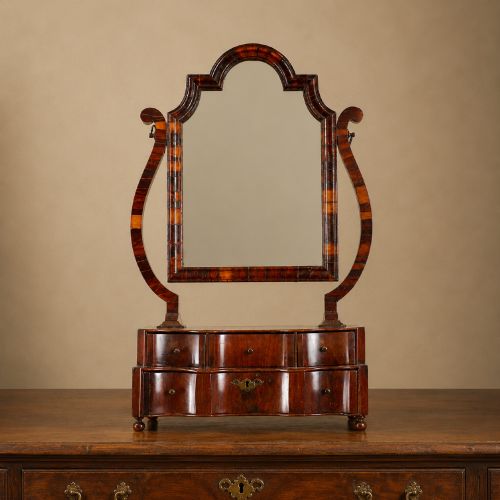


Oyster Veneer Table
An oyster veneer table brings cross-grain timber work into a room, offering patterned wooden surfaces cut from small branches.
What an oyster veneer table is
An oyster veneer table displays circular and oval wood cross-sections arranged across the top to create repeating patterns. These pieces appear in forms such as coffee tables, side tables, console tables, centre tables, lamp tables, wine tables, box forms, and gypsy tables. The evidence records examples originating from the seventeenth century, the eighteenth century, the early twentieth century, and the nineteen thirties, alongside a Regency revival style.
Buyers encountering this search phrase find historical pieces alongside later revivals and vintage interpretations. Seventeenth-century examples emerge from British and Italian workshops, while later iterations span the early twentieth century and nineteen thirty. The selection balances functional occasional furniture with decorative small tables.

How these pieces were made
Cabinet makers produced oyster veneer tables by slicing small branches or roots across the grain to yield small round or oval discs. Workers laid these thin sections closely together across a primary timber base to form decorative geometric or all-over surface patterns. Inlaid details in contrasting woods frequently complement the main veneered field.
The materials recorded across the evidence include walnut, yew wood, olive wood, holly wood, burr walnut, laburnum, and rosewood, sometimes accented with brass fittings. Workshops selected these figured timbers specifically for the natural growth rings and varied tones revealed by transverse cutting.
Retail Price Guide 2026
Typical UK retail prices for oyster veneer table, calculated from the Sellingantiques database of over a million retail prices indexed since 2003. This retail price guide relies exclusively on Sellingantiques data; no external sources or auction records are used, so the figures do not describe the wider market.
Materials span walnut, yew, olive, holly, burr walnut, laburnum, and rosewood.
What varies in quality
The standard of an oyster veneer table rests upon the precision of the cross-cutting and the tightness of the arrangement across the surface. Finer examples maintain an even thickness in the discs and a close, seamless fit that preserves the visual rhythm of the timber rings without awkward gaps.
The choice of secondary and primary woods dictates the depth and richness of the finished piece. Grain selection, such as the contrast between olive and holly or the deep warmth of laburnum and walnut, separates standard utility work from more ambitious cabinet making.
Maple
The Oyster Veneer Table Glossary
- Oyster veneer
- A method of cutting branches or small trunks transversely to produce small, circular or oval wooden discs with concentric growth rings. These discs are laid together to form decorative parquet surfaces.
- Cross-grain
- Wood cut perpendicularly to the direction of the tree's vertical growth. This technique exposes the rings of the timber rather than the longitudinal grain.
- Inlay
- A technique where pieces of contrasting timber, such as holly or boxwood, are inserted into recessed portions of the base material to create ornamental borders or motifs.
- Burr walnut
- A specialised tree growth containing deformed grain that produces intricate, swirling patterns when sliced. It provides rich visual texture when utilised alongside standard veneers.
Frequently Asked Questions
What is an oyster veneer table?
An oyster veneer table is a piece of furniture surfaced with small, transverse slices of branches that display concentric growth rings.
These pieces range from seventeenth-century side tables to twentieth-century coffee tables.
How do I identify the period?
Dating relies upon the construction methods, the choice of secondary timbers, and the overarching furniture style.
Seventeenth-century examples often feature walnut, olive, or laburnum, while twentieth-century revivals utilise yew wood.
Where were these tables used?
These tables served as decorative occasional pieces in reception rooms, parlours, and drawing rooms.
Their compact forms made them suitable for placement beside seating or against walls as console and side tables.
How do I care for the surface?
Maintenance involves protecting the thin wooden discs from excessive moisture, direct sunlight, and extreme temperature shifts.
Applying a traditional wax polish helps preserve the sheen of the timber.