
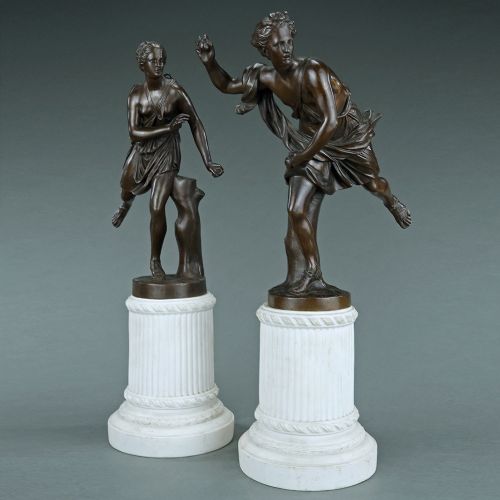

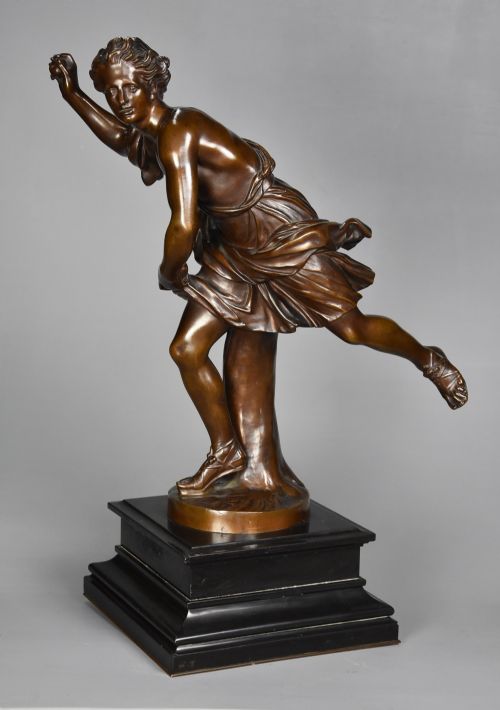


Barbedienne Bronze Statue
A barbedienne bronze statue brings nineteenth-century French foundry mastery into a room, offering classical figures and animalier subjects cast with exceptional fidelity.
Barbedienne Bronze Statue
A barbedienne bronze statue represents nineteenth-century French sculpture production, spanning mythological figures, historical portraits, and animalier subjects. Buyers seeking a barbedienne bronze statue will encounter works cast by the renowned Parisian foundry during the decades between eighteen-sixty and nineteen-hundred.
The selections on this page demonstrate the distinct breadth of the foundry, moving from monumental classical deities like Venus and the Spinario to realistic studies of eagles, lions, hares, and storks. These pieces reflect both original artist models and accomplished reductions of antique sculpture.
Most examples originate from the nineteenth century, utilising standard formats such as patinated bronze, parcel-gilt bronze, and cast bronze, frequently mounted on marble or ebonised wood bases.
Materials and casting methods
These sculptures are produced from cast bronze, utilising both dark patination and parcel-gilt highlights to define musculature, drapery, and feather detail. The metal captures the precise intent of modellers and sculptors working within academic and animalier traditions.
Foundry processes often paired the cast bronze elements with structural supports or decorative plinths formed from marble and ebonised wood. This combination provided stability and visual contrast for the heavier metal figures.
Among the bronze menagerie, a gilded stork balances intently upon a turtle, capturing a moment of unlikely aquatic curiosity.
Distinctions in craftsmanship
Quality in these bronzes rests upon the crispness of the chasing and the depth of the patination. Finer casts preserve the subtle textures of hair, feathers, and skin without softening the underlying form.
The precision of the foundry stamp or signature also influences the piece, alongside the integrity of any associated marble or ebonised wood bases that complete the composition.
Ferdinand Barbedienne·Antoine Louis Barye·Louis Ernest Barrias
The Barbedienne Bronze Statue Glossary
- Patinated bronze
- Bronze treated with chemical solutions to produce a controlled surface colour, typically ranging from warm brown to deep black. This finish protects the metal and accentuates sculptural contours.
- Animalier
- A nineteenth-century artistic movement focusing on the realistic depiction of animals, particularly predators, birds, and game. Sculptors in this style studied live subjects closely to capture natural movement.
- Parcel-gilt bronze
- Metalwork where specific areas are highlighted with applied gold leaf or gilding while the rest retains its dark patina. This technique draws the eye to decorative details or insignia.
- Grand Tour
- A traditional trip through Europe undertaken by upper-class scholars and collectors to study classical art and architecture. Bronzes from this context often reproduce famous antique statues.
- Ebonised wood
- Timber treated to resemble ebony, providing a dark, uniform contrast for bronze sculptures mounted upon it. It serves as a stable and traditional base material.
Barbedienne Bronze Statue: Frequently Asked Questions
Who was Ferdinand Barbedienne?
Ferdinand Barbedienne operated a prominent nineteenth-century Parisian foundry that collaborated with leading sculptors to produce high-quality bronze editions.
The foundry became celebrated for its rigorous casting standards and reduction techniques that made classical and modern sculptures accessible to collectors.
What is animalier sculpture?
Animalier sculpture is a nineteenth-century genre dedicated to the naturalistic portrayal of animals in various poses and interactions.
Artists observed creatures in menageries and the wild to achieve anatomical precision in works cast in bronze.
How do I care for a bronze statue?
Bronze requires minimal maintenance, primarily consisting of gentle dusting with a soft, dry cloth to prevent particulate buildup.
Avoid liquid cleaners or polishes that can strip the original patina and damage the metal surface.
What is a Grand Tour bronze?
Grand Tour bronzes are smaller-scale replicas of famous classical antiquities purchased by travellers touring European cultural centres.
These pieces served as scholarly keepsakes and decorative ornaments for nineteenth-century interiors.