
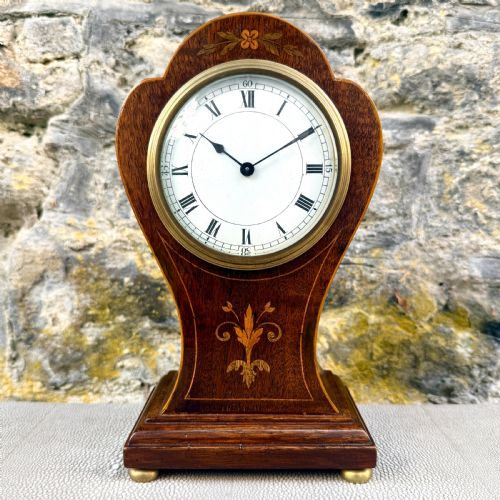
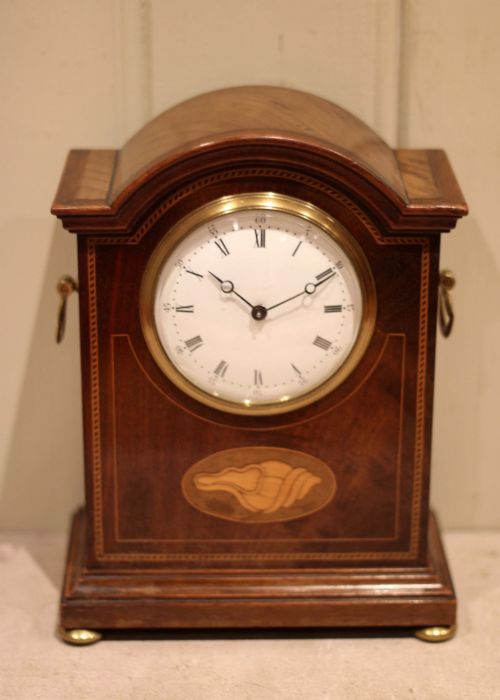
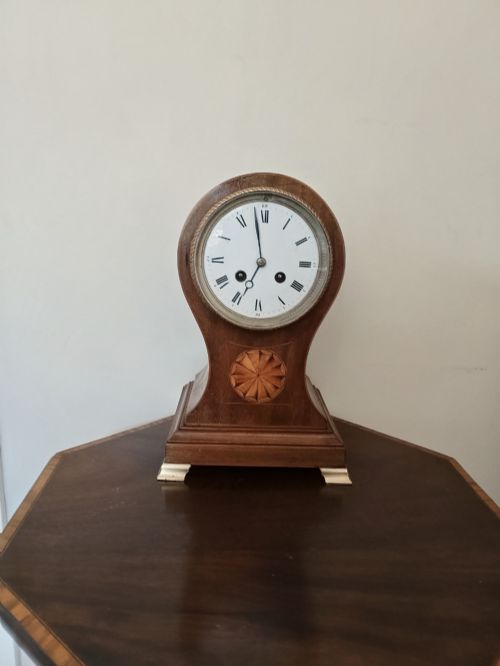
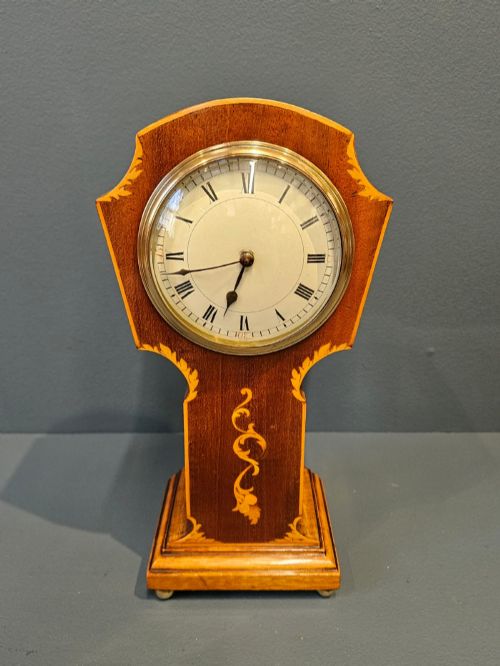


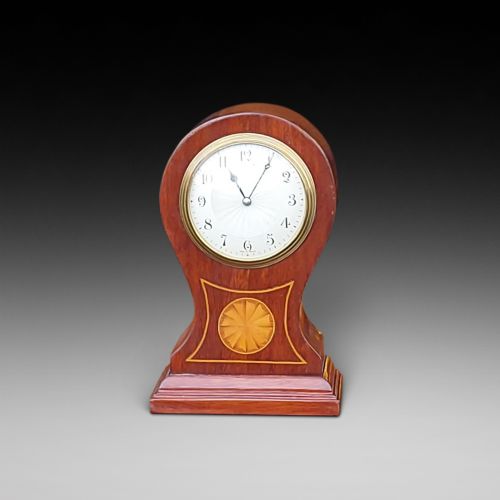


Balloon Mantel Clock
A balloon mantel clock brings curved mahogany and polished brass to a shelf, offering a distinct Georgian or Edwardian silhouette that appeals to collectors of period timepieces.
Balloon Mantel Clock
A balloon mantel clock is a portable timekeeper housed in a distinctive case that swells outwards towards the base, resembling the shape of a hot air balloon. When you search for a balloon mantel clock on this page, you meet pieces predominantly from the Edwardian era and the nineteenth century, alongside earlier eighteenth-century examples.
The form appears most frequently in mahogany cases, sometimes enriched with satinwood inlay, boxwood stringing, or ebonised wood details. These clocks range from small tabletop timepieces to larger bracket clocks fitted with striking movements or single and twin fusee mechanisms.
Makers and retailers such as Joseph Jump, John Leroux, William Smith, Brockbank and Atkins, Dwerrihouse, and Asprey of London demonstrate the high standard of horology often found within this specific case shape. Whether French striking movements or English fusee designs, each piece combines domestic utility with refined cabinetmaking.
How they were made
The construction of a balloon mantel clock relies heavily on seasoned mahogany timbers, selected for stability and rich grain, shaped to create the characteristic curved silhouette. Craftsmen frequently embellished these wooden cases using fine stringing of boxwood and contrasting satinwood inlay, or applied ebonised finishes for dramatic effect.
Dials are commonly formed from white enamel or silvered brass, protected behind bevelled glass within a cast brass bezel. Internally, the mechanism relies on precision brass gears and plates, driven either by standard springs or by chain and fusee movements that ensure even tension as the clock runs down.
Listings feature mahogany cases enriched with satinwood inlay, boxwood stringing, and brass fittings across Edwardian, Victorian, and Georgian periods.
What varies in quality
The distinction between ordinary and exceptional examples rests in the crispness of the cabinetwork and the sophistication of the movement. Superior pieces exhibit seamless curves in the mahogany veneer, delicate and intact stringing, and well-executed floral or geometric inlay rather than simple stamped decoration.
Internally, quality is marked by the presence of fusee movements, finely engraved backplates, and signed dials by respected makers. The integration of the brass bezel and the clarity of the silvered or enamelled dial further separate standard production clocks from masterworks of the horological trade.
Joseph Jump of London·John Leroux London·William Smith London·Brockbank and Atkins London·Asprey London
The Balloon Mantel Clock Glossary
- Fusee
- A conical pulley used in mechanical clocks to maintain even power as the mainspring unwinds. This mechanism ensures more accurate timekeeping throughout the duration of the winding.
- Satinwood inlay
- A contrasting light-coloured wood used to create decorative banding or motifs on darker mahogany surfaces. It requires great skill from the cabinetmaker to fit flush into the primary timber.
- Bracket clock
- A portable clock designed to sit on a bracket or table, typically featuring a fine mechanical movement and a substantial handle on top for carrying.
- Silvered dial
- A brass clock face treated with a silver solution to create a matte metallic finish, usually featuring engraved numerals and text filled with black wax.
- Bezel
- The brass ring that holds the glass protecting the clock face, frequently hinged to allow access for hand-setting or winding.
Balloon Mantel Clock: Frequently Asked Questions
How do I wind a fusee movement?
A fusee movement requires a specific key inserted into the dial or back door to tension the chain around the conical pulley. Care must be taken not to overwind the mechanism.
Most antique fusee clocks run for eight days per wind, demanding a steady and gentle turn until resistance is felt.
Where should I place a balloon clock?
These clocks suit flat, stable surfaces such as mantelpieces, chests of drawers, or dedicated bracket shelves away from direct heat sources. A level surface ensures the pendulum or balance wheel maintains an even beat.
Avoid placing them in damp rooms or areas subject to extreme temperature fluctuations to protect the mahogany veneer and internal oils.
How do I tell an Edwardian clock from an 18th-century one?
Eighteenth-century examples often feature robust twin fusee movements and simpler, heavier mahogany proportions by named London makers. Edwardian reproductions and contemporary pieces frequently employ lighter inlaid satinwood and mass-produced French or standard English movements.
Examining the internal brass plates, screw types, and dial construction usually reveals the true period of manufacture.
Did these clocks always have glass doors?
Most balloon mantel clocks feature a glazed brass bezel or a small glass door on the reverse to protect the dial and movement while allowing visibility. The glass is traditionally bevelled and fitted tightly into the cast metal frame.
Missing or flat non-bevelled glass often indicates a later replacement rather than original factory specification.