


Asian Wooden Console
An asian wooden console brings structural timber grain and traditional joinery straight into a room.
Asian Wooden Console
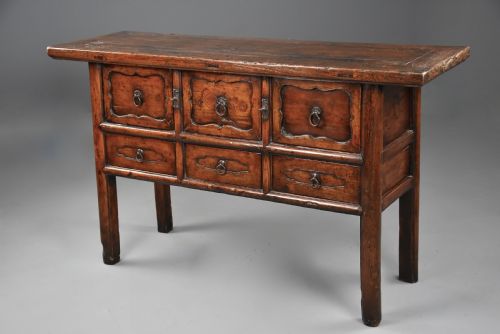
When searching for an asian wooden console, a buyer encounters pieces originating primarily from the nineteenth and early twentieth centuries, spanning Qing Dynasty traditions, provincial workshops, and Burmese vernacular forms. These items take the shape of altar tables, side tables, side cabinets, writing desks, and low sideboards designed for practical utility and formal placement.
The version most commonly met on this page is the nineteenth-century Chinese elm side table or altar table, often characterised by simple linear frames, drawers, or altar-style upturned ends. Alongside elm, items appear in mixed hardwoods, teak, and red lacquer, reflecting regional domestic and temple workshops.
These surfaces served domestic interior needs long before entering the antique market, functioning as storage units, writing desks, or display ledges for ritual objects. Their longevity stems from robust native timbers chosen by makers to withstand shifting humidity and daily domestic use.
How they were made
Makers relied on native timbers such as elm, teak, and dense regional hardwoods, frequently joining structural elements without relying on metal fasteners. Timber selection dictated the eventual surface weight, stability, and grain pattern visible across the topboards.
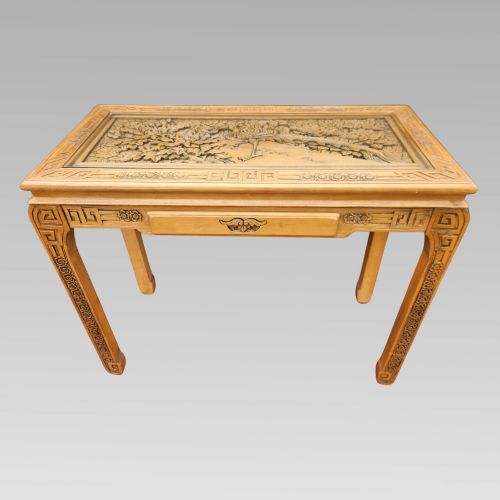
Surfaces were finished with natural oils, clear lacquers, or red lacquer coatings, sometimes incorporating carved details, gilding, and brass mounts. These applications protected the underlying wood while developing a deep patina through decades of handling.
Object forms appearing in the inventory include console tables, side cabinets, writing desks, altar tables, and low sideboards.
What varies in quality
Quality separates through the integrity of the original joinery, the crispness of any carved detailing, and the depth of the surface patina achieved over generations of use. Elm and hardwood examples with undisturbed patinas and intact structural framing sit at the higher end of the scale.
Pieces that retain their original red lacquer, gilding, or brass hardware demonstrate greater workshop investment at the time of construction than plain utility items. The proportion and balance of the console legs and aprons also determine how successfully the piece sits within a modern interior.
The Asian Wooden Console Glossary
- Altar table
- A rectangular table traditionally placed against a wall for ceremonial displays, featuring flanged ends or upturned upturns on the top surface. These forms provide narrow footprints suitable for hallways and corridors.
- Elm
- A resilient timber utilised extensively in Chinese provincial cabinetmaking for its fibrous grain and structural strength. It takes wear well and develops a rich surface glow over time.
- Qing Dynasty
- The imperial dynasty ruling China from sixteen forty-four to nineteen twelve, whose aesthetic traditions influence many carved and lacquered tables of the nineteenth century.
- Lacquer
- A durable resin coating applied in multiple layers to wood surfaces, often finished in red and polished to a smooth, lustrous sheen.
Asian Wooden Console: Frequently Asked Questions
Where should I place an asian wooden console?
These tables fit naturally in narrow hallways, entrance lobbies, or living room perimeters where depth is limited. Their linear profiles allow them to sit flat against walls without dominating floor space.
Altar tables and side tables provide useful display surfaces for lamps, ceramics, or books while introducing warm timber tones and historic character into a room.
How do I care for antique elm and hardwood?
Maintain the wood by dusting regularly with a dry cloth and avoiding placement near direct heat sources or strong sunlight. Sudden temperature shifts can cause timber to dry out or split.
Apply occasional natural wax if the surface appears dry, working it gently into the grain to preserve the historic patina without creating a heavy buildup.
Are these tables sturdy enough for daily use?
Nineteenth-century console tables and side cabinets were built for demanding domestic or temple environments using traditional frame and panel construction. Their native hardwoods and elm timbers provide substantial structural resilience.
While they handle everyday items such as lamps and decorative objects easily, heavy industrial loading should be avoided to protect the historic joinery.
How can I tell a provincial table from a formal one?
Provincial tables generally display simpler lines, utilitarian elm construction, and minimal carving, reflecting domestic workshop production. They prioritise sturdy function over ornate decoration.
Formal or altar styles often incorporate flanged ends, elaborate dragon carvings, red lacquer, or gilded finishes that indicate higher status origins within Qing Dynasty traditions.