




Architectural Table Clock
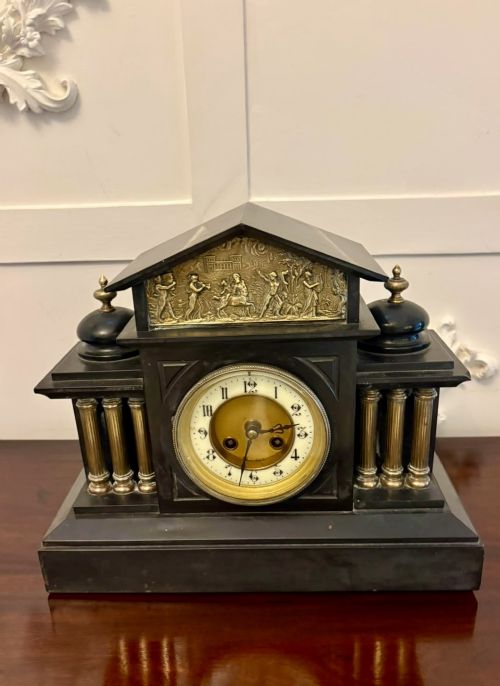
An architectural table clock brings monumental design to the mantelpiece, mirroring the columns and pediments of classical buildings in miniature.
Architectural Table Clock
When searching for an architectural table clock, collectors encounter substantial mantel and portico pieces that echo the grandeur of large buildings. These objects take the form of domestic timekeepers built with structural facades.
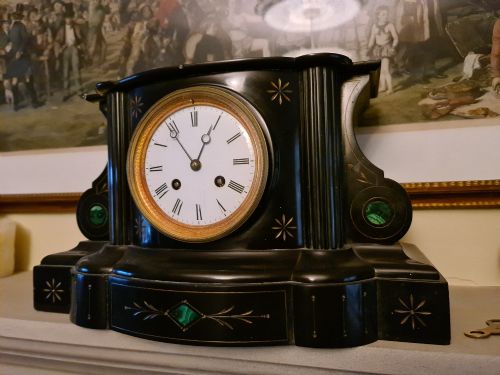
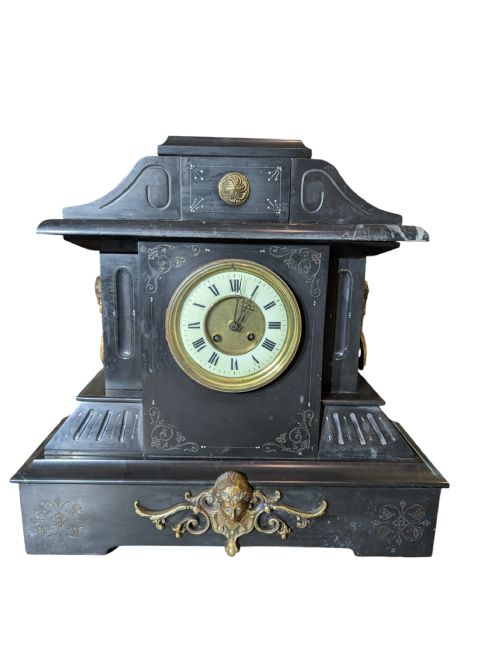
The specimens on this page originate predominantly from the nineteenth century, including the Victorian era and the periods of Charles X and the French Empire. They appear as marble porticos, ebonised architectural boxes, and heavy slate or bronze monuments.
Makers housed these movements within facades of black slate, rouge marble, mahogany, and rosewood. The structural designs draw on Neoclassical, Gothic Revival, and Egyptian Revival vocabularies to create miniature temples and porticos for the domestic interior.
Assessing quality in structural timepieces
The hierarchy of quality rests on the precision of the stone cutting, the weight and crispness of the gilt bronze or ormolu mounts, and the integration of the movement within the stone or wooden carcass. Superior examples maintain strict symmetry and architectural proportions without crude joints.
Complexity of the movement further separates standard production from finer workshop output, particularly where twin fusee or quarter-striking mechanisms are present. The crispness of dial engraving and the originality of the mercury pendulum or suspension system complete the assessment.
Philippes Paris·Baby and Jannings·D. Munsey of Cambridge·L.Donne Birchin Lane·FATTON ELEVE DE BREGUET LONDON·Thwaites and Reed·Benson Ludgate Hill
The Architectural Table Clock Glossary
- Portico clock
- A distinct architectural clock form featuring twin vertical columns supporting a horizontal entablature above the dial. This classical layout gained great popularity in France during the early nineteenth century.
- Fusee
- A conical pulley used in better mechanical clocks to maintain even power as the mainspring unwinds. It ensures consistent timekeeping across the duration of the wind.
- Ormolu
- Finely ground high-carat gold mercury-gilded onto a bronze base metal. The technique produces a rich, durable golden surface seen on high-status nineteenth-century mounts.
- Bracket clock
- A portable spring-driven clock originally designed to sit on a wall bracket or a table. These pieces often feature fine wooden cases with carrying handles.
- Slate
- A fine-grained metamorphic rock utilised extensively for nineteenth-century mantel clock cases. It takes a smooth, dark polish that mimics more expensive black marble.
Architectural Table Clock: Frequently Asked Questions
How do I wind an architectural mantel clock?
Most models employ a key inserted into the dial holes to tension the springs every eight days. Care must be taken not to overwind the mechanism.
Ensure you turn the key smoothly in the direction specified by the movement design to avoid damaging the internal components.
Where should I place a heavy marble clock?
Due to the substantial weight of marble and slate cases, place these timekeepers on a sturdy, level surface such as a heavy sideboard or a solid mantelpiece. Uneven weight distribution can strain the stone structure.
A level foundation also ensures the pendulum swings evenly for accurate timekeeping.
How do I date a nineteenth-century portico clock?
Examine the materials, dial style, and pendulum design alongside any maker signatures stamped on the movement backplate. Ormolu and mercury gilding often point to earlier decades like the Charles X period.
Later Victorian adaptations frequently utilise black slate or faux marble finishes with simpler stamped brass bezels.
What is the difference between a portico and a bracket clock?
A portico clock displays an architectural post-and-lintel construction with visible columns framing a central suspended pendulum. A bracket clock is a more enclosed wooden box form with a flat top and handle.
Both serve as table clocks but belong to entirely distinct stylistic traditions of the nineteenth century.