

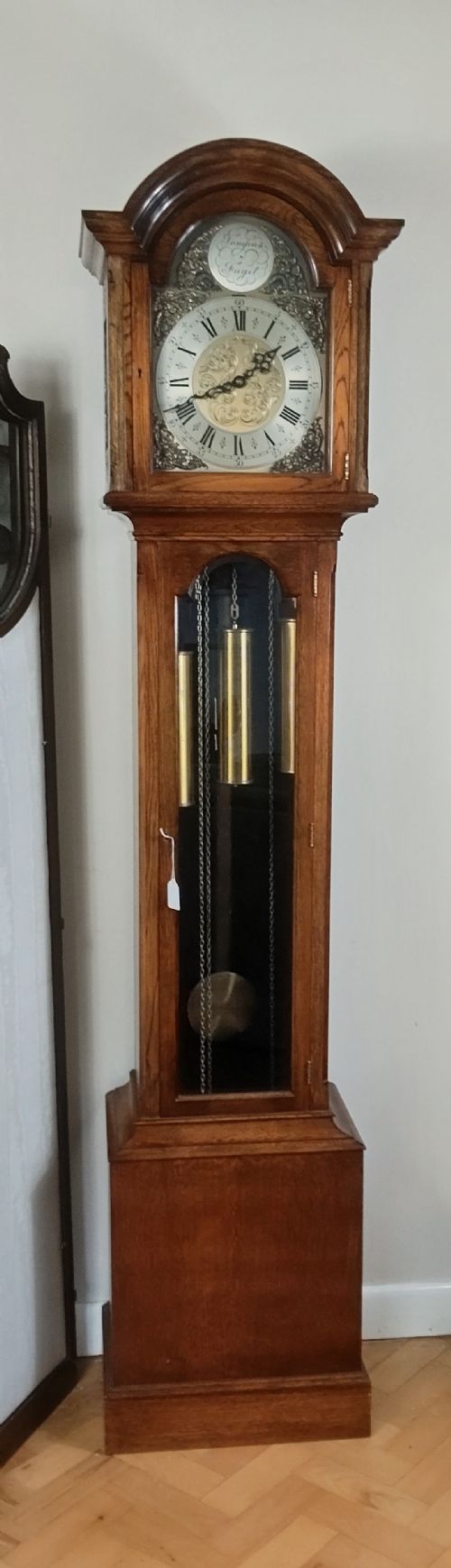
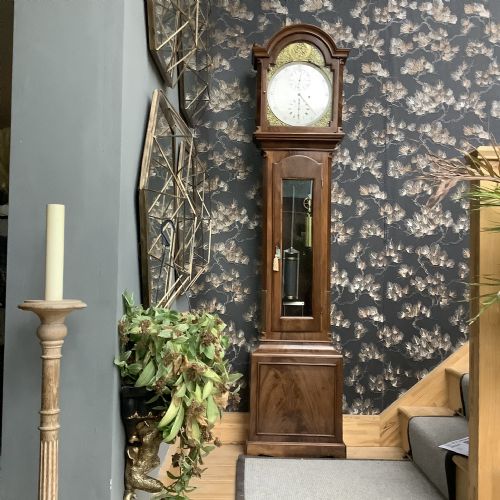


Arched Hood Grandfather Clock
An arched hood grandfather clock is a commanding timepiece that anchors a room with its height and rhythmic motion.
Understanding the arched hood grandfather clock
An arched hood grandfather clock is a tall floor-standing timepiece featuring a curved pediment above the dial, taking the form of a longcase clock. These substantial wooden cases house intricate weight-driven movements designed to keep accurate time while marking the hours.
The versions met on this page span the Georgian, Regency, and Victorian periods, alongside specific 19th-century interpretations. Makers from London and Scotland produced these pieces, incorporating musical chiming capabilities and silent pull mechanisms.
Forms range from simple regional longcase examples to high-quality London pieces with multiple pillars supporting the movement. The overarching style follows Georgian and Victorian traditions, maintaining traditional proportions and architectural details.
Materials and construction methods
Makers constructed these tall cases primarily in mahogany, selected for its rich grain and durability, paired with clear glass doors to protect the dial. Brass and iron formed the vital internal components, from the gears and plates to the decorative dial faces and hanging weights.
London workshops and provincial makers alike employed traditional joinery to build the towering trunks and arched hoods. Skilled metalworkers cast and finished the brass dials and movement parts, while clockmakers fine-tuned the gear trains for steady operation.
Retail Price Guide 2026
Typical UK retail prices for arched hood grandfather clock, calculated from the Sellingantiques database of over a million retail prices indexed since 2003. This retail price guide relies exclusively on Sellingantiques data; no external sources or auction records are used, so the figures do not describe the wider market.
Distinctions in quality
The standard of a longcase clock rests in the sophistication of its movement and the precision of its joinery. Finer London examples, such as those by established makers, feature complex additions like musical chiming barrels or five-pillar movements that demonstrate advanced horological skill.
Case construction likewise divides the ordinary from the exceptional, as seen in the choice of well-figured mahogany and the crispness of the arched hood mouldings. The overall harmony between the cabinetmaker's woodwork and the clockmaker's engineering determines the lasting standing of each piece.
The Arched Hood Grandfather Clock Glossary
- Longcase clock
- A tall, weight-driven pendulum clock enclosed in a wooden case that stands directly on the floor. This is the technical term often interchanged with the colloquial grandfather clock.
- Arched hood
- The upper glazed section of the case featuring a curved top that houses and displays the dial. This architectural feature defines the silhouette of the piece.
- Five pillar movement
- A clock mechanism supported by five brass pillars instead of the usual four, providing extra rigidity and stability for complex gear trains. This indicates a higher grade of workshop production.
- Silent pull
- A mechanism that allows the owner to silence the striking train on demand by pulling a cord. It is found on better quality domestic clocks from the Georgian and Regency periods.
- Musical chiming
- An advanced mechanism capable of playing tunes on bells or gongs in addition to striking the hours. Such additions elevated the status and cost of the timepiece when new.
Frequently Asked Questions
How do I wind a grandfather clock?
Winding involves using a specialised crank key to pull up the heavy weights suspended inside the trunk by lines or chains. Care must be taken not to overwind the springs or pull the weights too high against the dial.
Most eight-day movements require winding once a week, ideally on the same day to maintain consistent tension and timekeeping accuracy.
Where should I place a longcase clock?
These tall clocks need an interior wall away from direct sunlight, central heating vents, and damp exterior walls. Wood and delicate internal mechanics react poorly to drastic changes in temperature and humidity.
The floor beneath must be completely level and stable so the pendulum swings evenly and the tick remains steady.
How do I tell Georgian clocks from Victorian ones?
Georgian and Regency examples tend to feature more restrained architectural lines, finer mahogany veneers, and brass dials with traditional silvered chapter rings. Victorian pieces often display heavier proportions, more ornate carvings, and sometimes larger painted or brass dials.
Maker signatures and regional styles also offer clues, as London workshops maintained distinct design traits compared to provincial makers in Scotland or the English regions.
What is a silent pull mechanism?
A silent pull is a secondary mechanism operated by a cord on the side of the case that silences the striking train on demand. This allowed owners to prevent the clock from chiming during the night without stopping the timekeeping.
It represents a higher level of mechanical complexity usually reserved for superior quality London longcase clocks.