
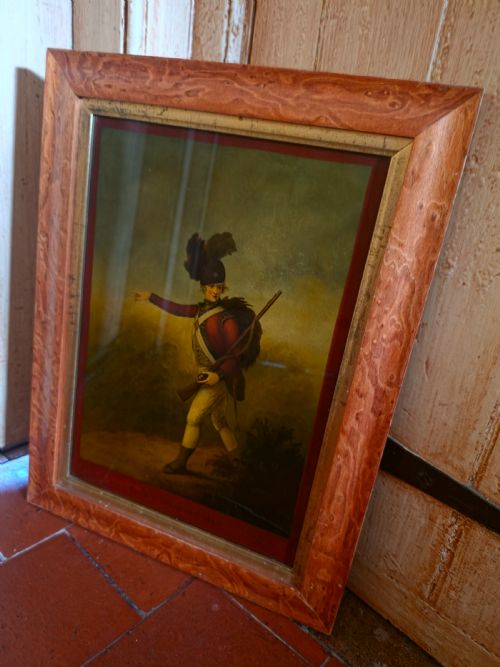


Antique Transfer Glass Picture
An antique transfer glass picture captures the delicate, luminous charm of early portraiture and narrative art through historical printmaking on glass.
Antique Transfer Glass Picture
An antique transfer glass picture represents a fascinating intersection of printmaking and decorative wall art found primarily across the Georgian and Regency periods. These works bring historical subjects, military figures, and elegant portraits into domestic interiors through a distinct technique of applying printed imagery to glass.
Buyers browsing this selection most frequently encounter reverse glass prints and mezzotints framed in wood, maple, or gilt wood. The subjects range from notable historical personages like Queen Caroline and Princess Caroline to literary and pastoral scenes such as The Lady of the Manor and The Match Boy.
How they were made
Craftsmen created these pieces by transferring a paper print face down onto a glass panel, allowing the delicate ink layers to adhere permanently before the paper backing was carefully rubbed away. Artisans then applied oil paint, pigment, and paint by hand to the reverse side of the glass to illuminate the composition with vibrant colour.
The finished glass panels were secured within bespoke frames, often utilising maple or gilt wood to complement the sheen of the surface. This intricate layering protects the delicate pigments from dust and fading while producing a distinctive luminous depth impossible to achieve on standard canvas or paper.
Current listings feature eighteenth and nineteenth century works utilising glass, paper, oil paint, pigment, maple, and gilt wood.
What varies in quality
Quality in these works rests upon the precision of the initial transfer and the skill of the subsequent hand-colouring applied behind the glass. Superior examples exhibit fine, crisp linework in the mezzotint or engraving combined with subtle, harmonious applications of pigment that enhance rather than obscure the printed details.
The choice of framing and the preservation of the original glass panel significantly influence the overall character of the piece. Masterful works maintain their structural integrity within period wooden frames, showing careful alignment between the mechanical print and the hand-painted highlights.
W Bishop·Richard Phillips
The Antique Transfer Glass Picture Glossary
- Reverse glass print
- An image transferred face down onto a glass panel and viewed through the smooth front surface. This method protects the delicate pigments from environmental damage.
- Mezzotint
- A printmaking process of the intaglio family where tonal gradations are achieved by roughening the copper plate with a rocker. It allows for rich, velvety dark areas and subtle mid-tones.
- Chrystoleum
- A specialised method of applying hand-colouring to a convex photograph or print mounted on glass during the nineteenth century. The paper backing was made transparent with oil before painting.
- Gilt wood
- Timber treated with a thin layer of gold leaf or metallic powder to produce a lustrous decorative finish. It frames many of the finest Georgian and Regency wall art pieces.
Antique Transfer Glass Picture: Frequently Asked Questions
What is a reverse glass picture?
A reverse glass picture is a piece of wall art where a paper print or mezzotint is transferred directly onto a glass panel. The image is viewed from the clean front side while being hand-painted from behind.
This technique seals the delicate pigments beneath the glass, protecting them from atmospheric soot and moisture while giving the colours a distinct luminous quality.
How old are these pictures?
The pieces available in this category predominantly date from the eighteenth and nineteenth centuries, spanning the Georgian and Regency eras. Makers utilised refined printmaking methods combined with hand-applied pigments during these periods.
Collectors can identify the age through the framing materials, the style of the script, and the specific method of glass preparation characteristic of those decades.
How should I hang them?
These framed pictures require a secure wall fixing due to the heavy combination of glass panels, wooden surrounds, and backing materials. Position them away from direct sunlight to protect the fragile oil paints and pigments applied behind the glass.
Ensure the hanging wire and wall hook match the substantial weight of the timber and gilt wood frames to prevent accidental slips.