




Antique Malayer Rug
An antique malayer rug brings West Persian village weaving into a room, offering rich geometric and floral layouts built to anchor a floor.
Antique Malayer Rug
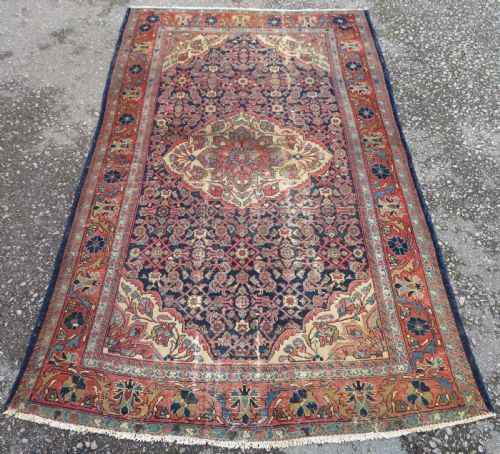
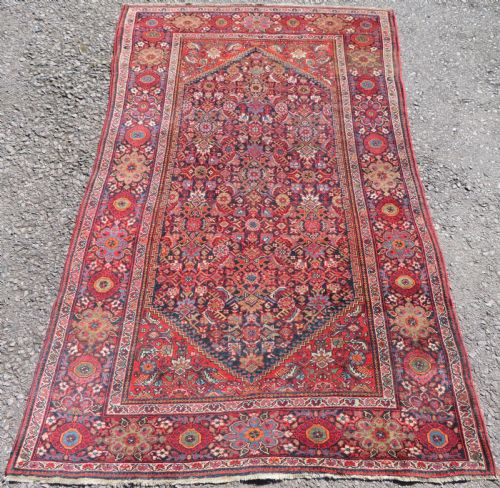
When you search for an antique malayer rug, you encounter hand-knotted floor coverings originating from West Persia, spanning formats from compact area rugs to substantial carpets and long narrow hallway runners. These village and tribal pieces date from the late nineteenth century through to the early decades of the twentieth century, reflecting traditional Persian craftsmanship.
The versions most frequently met on this page include standard area rugs alongside elongated runners, often displaying distinct regional motifs such as the boteh, Herati patterns, lattice arrangements, or pictorial elements like birds and lions. Makers adapted traditional Persian styles to create flexible village rugs that suited both large spaces and narrow corridors.
Evaluating quality and execution
The distinction between standard examples and finer pieces lies in the precision of the knotting and the complexity of the design layout, where pictorial elements like butterflies or lions demand greater weaver skill. Tighter pile density and clearer delineation of motifs separate more accomplished village workshop output from simpler production.
Preservation of the original wool pile height and side cordings also governs desirability, as consistent wear across the surface maintains the integrity of the ground colour and pattern harmony.
Antique Malayer Rug Retail Price Guide 2026
Typical asking prices for malayer rug among the pieces listed under this phrase on Sellingantiques today, from the lower quarter to the upper quarter. They describe what is for sale here now, not the wider market.
Listings span production dates from 1880 through to 1930, demonstrating wool and cotton construction in village formats.
The Antique Malayer Rug Glossary
- Boteh
- A stylised almond or pear-shaped motif representing a leaf or flame, frequently repeated across Persian village textiles.
- Herati
- A traditional repeating geometric pattern composed of a central rosette enclosed by a diamond and flanked by curved leaves.
- Kelleh
- A large rectangular format of Persian carpet, typically longer than it is wide, designed for specific room dimensions.
- Runner
- An elongated narrow carpet format utilised primarily in hallways, corridors, and staircases.
- Lattice
- An all-over interconnected grid pattern dividing the field into repeating geometric compartments.
Antique Malayer Rug: Frequently Asked Questions
Where were these rugs made?
These textiles originate from the Malayer region in West Persia, produced in village and tribal workshops.
Weavers combined local aesthetic traditions with durable materials to create floor coverings suited for domestic use.
How do I clean an antique malayer rug?
Maintenance requires gentle vacuuming without a rotating brush bar to protect the wool pile from unnecessary friction and fibre loss.
Professional specialist cleaning is recommended for deep washing to preserve the original dye stability.
Can I place a runner in a hallway?
Long narrow formats function well in hallways, corridors, and entryways where foot traffic is regular.
Using a suitable underlay beneath the piece prevents sliding and reduces abrasion against hard flooring.
How do I identify a Herati design?
The Herati pattern consists of a central floral rosette framed by a diamond shape, accompanied by four curved lancet leaves.
This repeating motif forms a dense, continuous field across the ground of the rug.