


Herati Pattern Rug
A herati pattern rug brings centuries of Persian weaving tradition into a room through its repeating fish and rosette motif.
Herati Pattern Rug
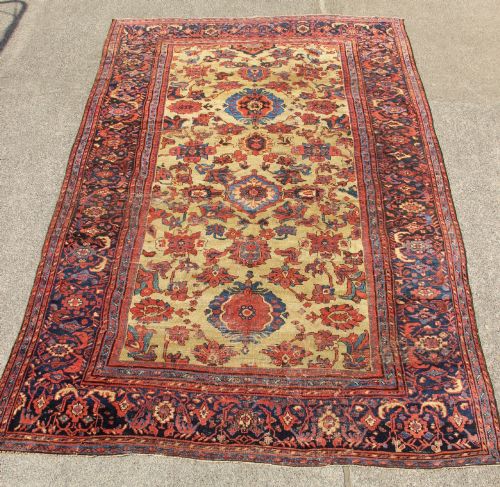
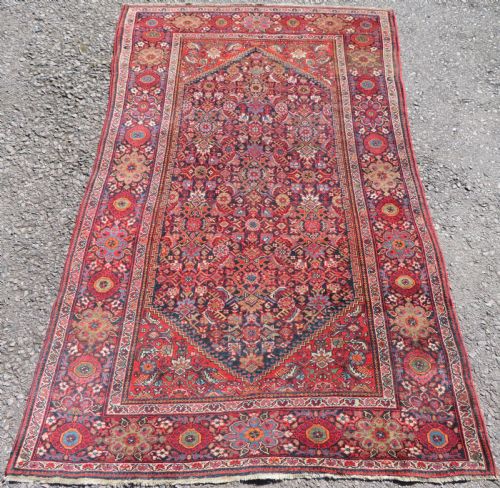
A herati pattern rug displays an intricate, repeating design of a central floral rosette framed by two curved leaves, often resembling fish alongside a diamond trellis. When searching for a herati pattern rug, buyers encounter nineteenth and early twentieth-century examples originating from Persian weaving centres and tribal regions.
The selections span various formats from compact scatter rugs and runner carpets to large room-sized carpets and kilims. Pieces from traditional workshops in Fereghan, Malayer, Senneh, and Bidjar dominate the selection, showcasing distinct regional adaptations of this classic motif.
Materials and Construction
These floor coverings rely on natural wool for the pile and foundation yarns, combined with cotton foundations for structural stability and crisp pattern definition. Weavers knotted the wool by hand onto vertical looms, creating dense structures designed to withstand decades of daily use.
Dyers utilised natural botanical and mineral sources to colour the wool, yielding deep indigos, madder reds, and ivory grounds that develop a rich patina over time. The tension of the weave and the grade of the wool determine the weight and flexibility of each finished carpet.
Herati Pattern Rug Retail Price Guide 2026
Typical asking prices for herati pattern rug among the pieces listed under this phrase on Sellingantiques today, from the lower quarter to the upper quarter. They describe what is for sale here now, not the wider market.
Nomadic weavers frequently incorporated small spontaneous design errors or colour shifts into their work, deliberately defying perfection to ward off the evil eye.
Distinguishing Quality
The refinement of a piece rests upon knot density, the precision of the geometric or floral curves, and the clarity of the colour palette. Higher-grade examples display finely drawn details where the repeating motifs maintain strict symmetry across the field.
Material selection also dictates distinction, as finer wool grades impart a soft handle and luminous appearance to the pile. Uniformity in the weave and integrity of the original selvedges and ends further separate standard village productions from master workshop creations.
Fereghan·Malayer·Senneh·Bidjar·Afshar
The Herati Pattern Rug Glossary
- Herati
- A repeating ornamental design composed of a central rosette enclosed by leaf motifs, frequently likened to fish swimming around a flower. This classic motif appears across many Persian and tribal weaving traditions.
- Kelleh
- A long, narrow carpet format traditionally used alongside larger room carpets or in gallery spaces. These rectangular formats offer balanced proportions for corridors and extended rooms.
- Kilim
- A flat-woven carpet produced without a pile by tightly interweaving warp and weft threads. These pieces offer lightweight versatility and sharp geometric rendering of traditional patterns.
- Pushti
- A small scatter mat or cushion cover often utilised for compact spaces or seating areas. Their modest dimensions make them accessible examples of tribal village craftsmanship.
- Warp
- The vertical foundation threads stretched tightly on the loom before knotting begins. The visible warp ends frequently form the fringe at either end of the rug.
Herati Pattern Rug: Frequently Asked Questions
How do I identify a genuine antique rug?
Examine the materials, natural dye variations, and hand-knotted structure on the reverse side of the textile. Irregularities in the knotting often indicate authentic tribal or village production rather than machine manufacture.
Look closely at the foundation yarns and fringe construction to confirm age. Wear patterns should appear natural and consistent with decades of gentle use.
Where were these traditional carpets woven?
Most pieces originate from Persian towns, nomadic tribes, and village workshops across West Persia. Specific regions like Senneh, Bidjar, and Malayer developed distinct regional variations of the classic pattern.
Local access to specific wool grades and dye materials shaped the unique aesthetic of each production centre. Tribal groups also adapted the urban motifs into geometric interpretations.
How should I care for an antique wool carpet?
Protect the textile by placing it in a low-traffic area or utilising a breathable rug underlay to prevent sliding and friction. Regular gentle vacuuming without a rotating brush roll helps remove embedded dust from the wool pile.
Rotate the floor covering periodically to ensure even exposure to natural light and foot traffic. Professional cleaning by specialists in antique textiles is recommended when maintenance is required.