
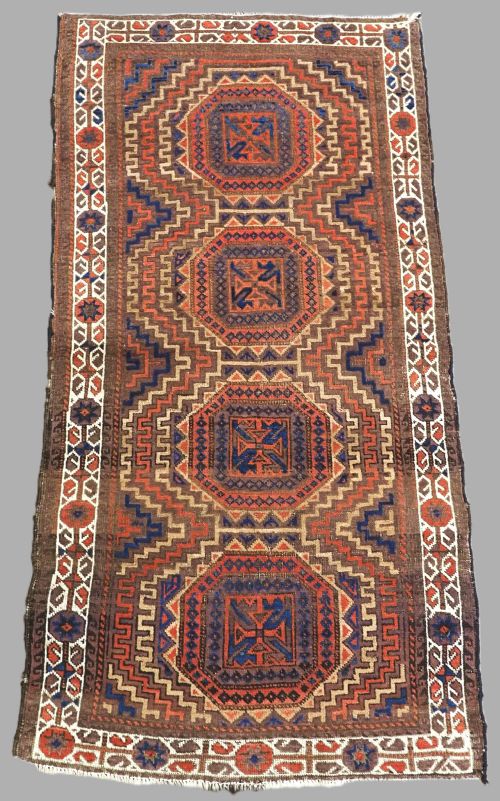


Salar Khani Rug
A salar khani rug brings rich tribal character into a room through deep Khorasan weaving traditions.
Salar Khani Rug
A salar khani rug is a tribal weaving originating from the borderlands of eastern Persia and western Afghanistan, particularly the Khorasan region. These pieces typically date from the late nineteenth and early twentieth centuries, around 1880 to 1900.
Buyers encounter various forms ranging from small rugs and carpets to vanity bags and pushti faces. The designs frequently feature large guls, turreted guls, or intricate Herati motifs tied to Baluch tribal traditions.
The aesthetic leans heavily into nomadic expression, rooted in the heritage of the Salar Khani sub-tribe. They function well as decorative floor coverings or smaller textile accents in traditional interiors.
How they were made
Weavers constructed these textiles using traditional hand-knotted techniques on resilient foundations. The primary materials recorded in the evidence are wool and cotton.
Natural dye traditions and regional wool supplies gave these tribal pieces their distinct coloration and tactile density. The structure relies on sturdy warps and wefts designed for practical nomadic use.
Salar Khani Rug Retail Price Guide 2026
Typical asking prices for salar khani rug among the pieces listed under this phrase on Sellingantiques today, from the lower quarter to the upper quarter. They describe what is for sale here now, not the wider market.
Some tribal weavers tucked small vanity bags into their daily saddle loads for personal belongings.
What varies in quality
The refinement of the knotting and the crispness of motifs such as the Herati design or large guls define the upper tiers. Finer execution in regional Khorasan pieces demonstrates superior control over complex tribal geometry.
Structural integrity and the preservation of original edges and pile depth distinguish master weaver output from more utilitarian examples. The balance of proportion within smaller formats like pushti faces also indicates finer craftsmanship.
The Salar Khani Rug Glossary
- Gul
- A medallion motif commonly found in tribal weavings. These geometric shapes often repeat across the field of Khorasan and Baluch carpets.
- Herati
- A repeating floral pattern featuring a central rosette enclosed by leaves. This classic design appears frequently in Persian and tribal rugs.
- Pushti
- A small mat or rug often used for sitting or leaning against. In tribal contexts, these smaller formats served portable functions.
- Khorasan
- A historical region in north-east Persia known for prolific carpet production. It encompasses major centres of traditional weaving.
- Baluch
- A tribal designation for nomadic groups inhabiting the borderlands of Persia and Afghanistan. Their textiles share distinctive dark palettes and geometric structures.
Salar Khani Rug: Frequently Asked Questions
What is a salar khani rug?
A salar khani rug is a hand-knotted tribal textile produced by the Salar Khani sub-tribe within the Khorasan region and the Persian-Afghan borderlands.
These pieces date predominantly to the late nineteenth and early twentieth centuries, featuring distinct nomadic motifs like large guls and Herati patterns.
How do you date these rugs?
Dating relies on structural analysis, material composition, and stylistic markers typical of late nineteenth-century and turn-of-the-century tribal output.
Evidence from surviving pieces points consistently toward the period around 1880 to 1900, identified through specific wool types and traditional dyeing methods.
Where were they made?
They originated in the borderlands between eastern Persia and western Afghanistan, specifically within the Khorasan province.
Nomadic and semi-nomadic weavers of the Baluch and Salar Khani tribes produced these textiles for both daily use and cultural expression.
How should I live with one?
These rugs suit areas with moderate foot traffic where their durable wool construction can be appreciated safely.
Placing them on underlays helps protect the historical foundation while displaying their tribal designs effectively in modern interiors.