

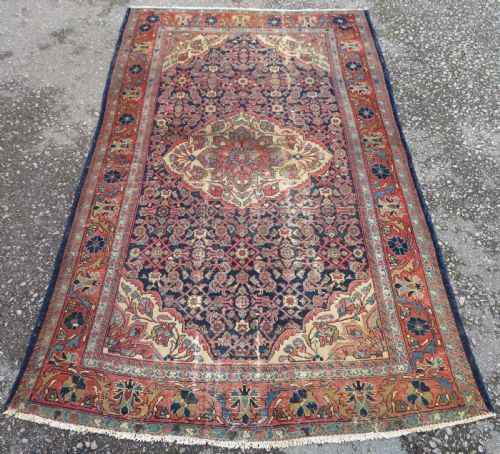
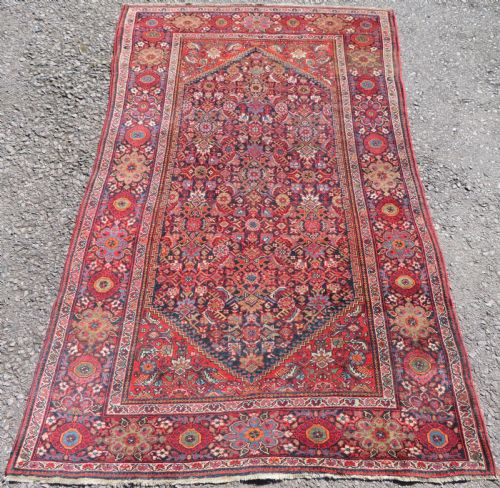


Vintage Malayer Carpet
A vintage malayer carpet brings traditional Persian village craftsmanship into a room, offering rich cultural history and distinct motifs.
Vintage Malayer Carpet
When you search for a vintage malayer carpet, you are looking at woven floor coverings originating from West Persia. These pieces include standard rugs, large carpets, medium formats like the Kelleh, and very long hallway runners.
The pieces listed here date from the late nineteenth century through to the early decades of the twentieth century. They encompass traditional Persian village and tribal styles, showcasing varied regional aesthetics.
Buyers encounter formats ranging from compact area rugs to substantial runners exceeding twelve metres in length. Common examples feature traditional Persian design schemes created in West Persian weaving communities.
What varies in quality
Quality in these textiles rests upon the fineness of the knotting and the complexity of the rendered design. Pieces featuring pictorial elements such as birds, lions, or butterflies often demonstrate superior artistic ambition.
The handling of the colour palette and the preservation of the original format significantly influence the standing of an individual rug. Finer examples maintain crisp geometric motifs and balanced proportions across the field and border.
Vintage Malayer Carpet Retail Price Guide 2026
Typical asking prices for vintage malayer carpet among the pieces listed under this phrase on Sellingantiques today, from the lower quarter to the upper quarter. They describe what is for sale here now, not the wider market.
Keep an eye out for woven lions and butterflies hiding among the traditional floral motifs.
The Vintage Malayer Carpet Glossary
- Kelleh
- A rectangular carpet format that is longer than it is wide, traditionally suited for specific room proportions. This format offers a balanced middle ground between standard rugs and long runners.
- Boteh
- A traditional almond-shaped or paisley motif representing a floral spray or cypress tree. It appears frequently across Persian village weaving.
- Herati
- A repeating decorative pattern composed of a central rosette enclosed by leaves and flanked by fish-like motifs. This classic design forms the backbone of many traditional Persian layouts.
- Runner
- A long, narrow carpet format specifically woven for corridors, hallways, and staircases. These pieces accommodate linear spaces while displaying continuous border and field patterns.
Vintage Malayer Carpet: Frequently Asked Questions
Where were vintage malayer carpets made?
These textiles were produced in villages and workshops located in the Malayer region of West Persia.
The local weavers combined tribal traditions with established Persian design elements to create distinct regional rugs.
How do I clean a wool rug?
Regular gentle vacuuming without a rotating brush helps remove surface dust and loose particles.
Professional specialist cleaning is recommended for deeper maintenance to protect the wool pile and cotton foundation.
What is a Kelleh format?
A Kelleh is a specific rectangular rug proportion that is longer than a standard area carpet.
This format historically filled the space along the edge of a larger room or filled narrower reception areas.
How do I identify a Herati design?
The Herati pattern consists of a central floral motif framed by curved leaves and flanked by delicate serrated forms.
It creates an all-over repeating texture across the field of the carpet.
Can these carpets handle hallway traffic?
The sturdy wool pile and cotton construction make long runners suitable for corridors and passageways.
Using an appropriate underlay helps secure the runner and reduces friction against the floor.