



Antique Letter Casket
An antique letter casket organises correspondence with the weight of nineteenth-century craftsmanship.

Antique Letter Casket
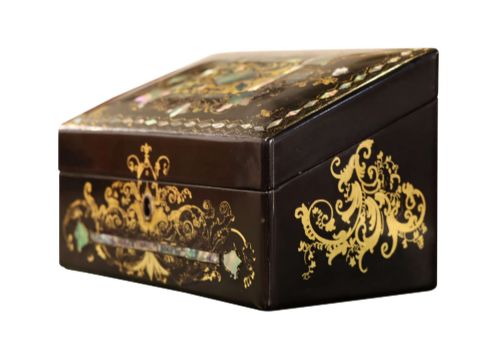
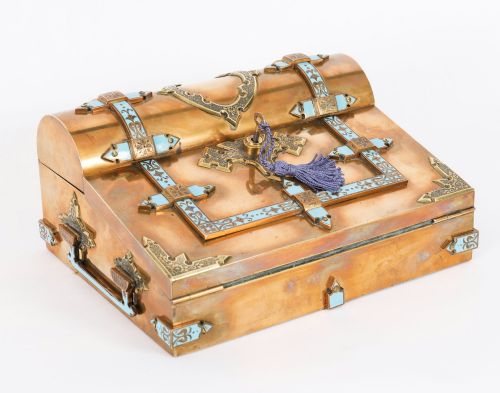
An antique letter casket functions primarily as a desktop repository for stationery and mail, emerging frequently in Victorian iterations alongside nineteenth-century forms. These items appear across various styles, including Gothic Revival, Anglo-Indian, and French Napoleon III.
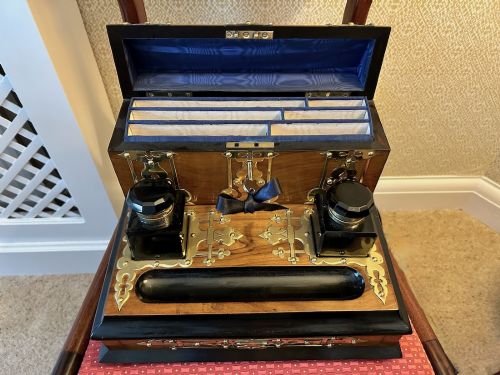
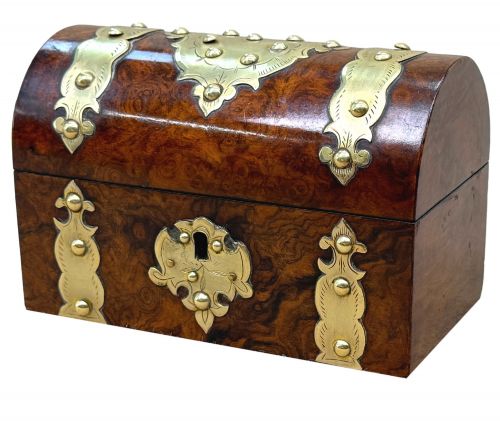
The standard version met on this page is the Victorian walnut or coromandel stationery box, often reinforced with brass mounts or configured with a dome top. Walnut, oak, and exotic woods dominate the forms, supplemented by glass and brass desk accessories.
Assessing quality in letter caskets
The selection of timber grain defines the visual merit of the piece, with heavily figured burr walnut or richly patterned coromandel commanding greater regard than plain domestic woods. Cabinet work that integrates precise mitre joints and secure brass mounts indicates superior workshop standards.
Intricacy of subsidiary decoration separates standard items from finer examples, evident in the precision of pietra dura panels, bone inlays, or ormolu castings. Complete interiors featuring fitted compartments for correspondence enhance the utility and refinement of the casket.
Antique Letter Casket Retail Price Guide 2026
Typical asking prices for letter casket among the pieces listed under this phrase on Sellingantiques today, from the lower quarter to the upper quarter. They describe what is for sale here now, not the wider market.
Listings feature nineteenth-century walnut and coromandel stationery boxes alongside rarer examples in satinwood, papier mache, and pollard oak.
C.G. Hope Hastings
The Antique Letter Casket Glossary
- Coromandel
- A dense, heavily figured Southeast Asian timber prized for dark brown colouring and contrasting black streaks. It frequently appears as a veneer on high-status Victorian boxes.
- Pietra dura
- An artistic technique using cut and fitted polished coloured stones to create geometric or pictorial images. These plaques ornament the lids of select nineteenth-century stationery boxes.
- Tunbridge ware
- Woodworking originating in Kent featuring mosaic patterns assembled from thousands of tiny tinted wood blocks. Boxes bearing this work display geometric or floral motifs.
- Ormolu
- Gilded bronze used for decorative mounts, handles, and feet on French and English boxes. The technique imparts a bright metallic accent to wood surfaces.
- Papier mache
- A composite material formed from paper pulp mixed with glue and oil, then pressed and lacquered. It provides a smooth dark surface for Victorian painted desk wares.
Antique Letter Casket: Frequently Asked Questions
What is an antique letter casket?
An antique letter casket is a desktop box designed to hold stationery, envelopes, and incoming correspondence in nineteenth-century studies and drawing rooms.
These pieces typically feature hinged lids, often dome-shaped, and internal partitions to organise letters by category or urgency.
How do I date a stationery box?
Dating relies on identifying the prevailing style, timber choices, and hardware characteristic of periods such as the Victorian era, Regency, or Edwardian years.
Secondary clues include construction methods inside the box, the presence of specific brass mounts, and material combinations like coromandel with ormolu.
Where were letter caskets used?
Letter caskets sat upon writing desks, Davenport tables, or credenzas in country houses and town residences during the nineteenth century.
They served the practical need to keep private correspondence secure and orderly before the widespread use of modern filing systems.
What woods are common on these boxes?
Makers frequently selected decorative hardwoods including burr walnut, coromandel, oak, satinwood, and pollard oak for their distinct grain patterns.
Exotic timbers were often applied as veneers over solid secondary woods, sometimes accented with brass inlay or contrasting borders.