


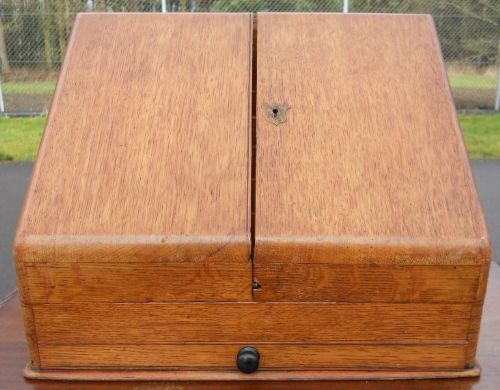
Slant Front Stationery Box
These slant front stationery box examples organise your desk with period craftsmanship, offering classic hinged storage for letters and papers.
Slant Front Stationery Box
A slant front stationery box brings traditional desk organisation into your study through sloping lids that conceal fitted compartments for paper and correspondence. When you search for a slant front stationery box, you encounter pieces primarily from the Georgian and Victorian eras, alongside specimens dating around eighteen hundred and eighteen sixty.
The form adapts traditional knife box shapes and cabinet formats to house writing materials neatly on a desktop. Most variants emerge in rich timbers such as mahogany and oak, occasionally featuring walnut or satinwood surfaces.
Materials and construction
Cabinetmakers utilised solid timbers like mahogany and oak to build the carcasses, sometimes incorporating burr walnut or satinwood veneers for decorative effect. Boxwood inlay adds crisp geometric contrast to the primary wood grains across selected examples.
Fittings incorporate brass for hinges, handles and escutcheons, whilst internal partitions occasionally utilise bone for writing implements or paper dividers. Paper linings finish the interior compartments where letters and envelopes rest.
Several Victorian examples include adjustable date mechanisms, proving that nineteenth century desk owners were just as prone to forgetting what day it was.
Judging quality and craftsmanship
Quality reveals itself in the selection of timber figures, such as the rich grain of mahogany or the distinct patterns found in burr walnut. Superior examples demonstrate precise joinery where the sloping lid meets the box body seamlessly.
Hardware selection separates standard production from finer output, with heavy brass mounts and integrated locking mechanisms indicating higher workshops standards. The finesse of boxwood inlay and internal configuration further distinguishes better items.
The Slant Front Stationery Box Glossary
- Stationery box
- A desk accessory designed specifically to hold writing paper, envelopes and correspondence. These containers keep desktop clutter contained within compartmentalised interiors.
- Sloping lid
- An angled hinged cover that opens to grant access to paper slots and writing requisites. This architectural feature descends towards the front of the box.
- Escutcheon
- A protective brass plate surrounding a keyhole. It prevents the surrounding wood from splintering when inserting a key into the lock.
- Inlay
- A decorative technique where contrasting materials like boxwood are inserted into recesses cut into the primary wood surface. This creates crisp geometric patterns or borders.
Slant Front Stationery Box: Frequently Asked Questions
What fits inside a slant front stationery box?
These boxes accommodate standard letters, writing paper and envelopes within their compartmentalised wooden interiors. Many specimens also provide space for pens, stamps and date markers.
Larger cabinets offer deeper slots for ledgers and larger correspondence files, keeping desks tidy and organised.
How do I date a wooden stationery box?
Dating relies on examining the timber species, construction techniques and hardware styles present on the piece. Georgian and Victorian examples exhibit distinct characteristics in their mouldings and dovetail joints.
Secondary materials like paper linings and bone fittings provide further clues to the decade of manufacture.
Where should I place it on my desk?
Position the box where the sloping lid opens freely without obstruction from surrounding desk items or shelving. Placing it near the back of a writing table leaves ample space for daily paperwork.
Keep wooden surfaces away from direct sunlight and heat sources to preserve the polish and prevent timber movement.
Are these boxes secure?
Many period examples feature functioning brass locks intended to secure private correspondence and valuable papers. A matching key allows the sloping lid to be securely fastened.
Over the centuries, some locks have lost their keys, functioning primarily as decorative enclosures rather than secure vaults.