
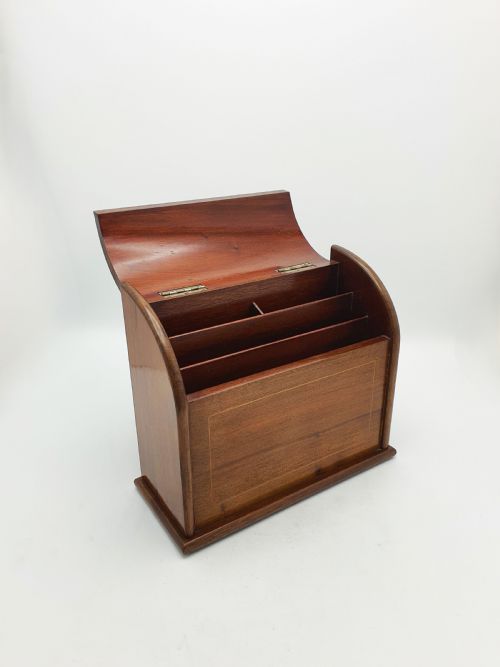


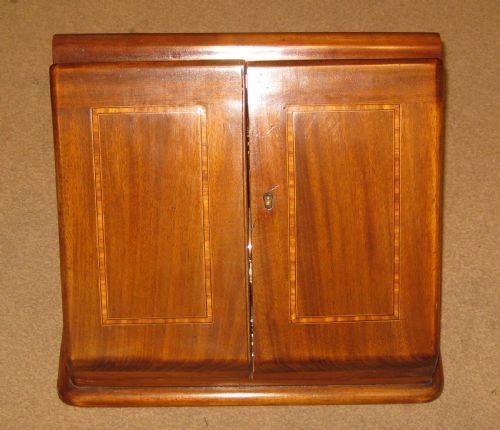


Brown Wood Letter Cabinet
These brown wood letter cabinet pieces are practical organisers built to sort post and papers, offering timeless desk storage for the study.
Brown Wood Letter Cabinet
A brown wood letter cabinet serves as a dedicated desktop or wall-mounted organiser for correspondence, holding stationery, letters, and documents within structured compartments. When searching for a brown wood letter cabinet, collectors encounter a variety of forms including hinged-lid desk tidies, stationery boxes, and institutional cupboards spanning the Victorian, Edwardian, and later periods.
The pieces appearing on this page range from compact nineteenth-century mahogany stationery boxes to larger institutional school cupboards and patent letter files. Such items reflect the administrative needs of past offices and country houses, combining utilitarian pigeonholes with decorative timberwork.
Makers and manufacturers of these cabinets utilised durable timbers to withstand daily handling in school libraries, workshops, and private studies. Surviving examples demonstrate how Victorian and Edwardian craftsmanship adapted standard office storage into handsome furniture for the home.
Materials and construction
Cabinet makers relied predominantly on dense hardwoods such as mahogany, oak, and walnut to construct the primary carcasses and panelled doors of these filing chests. These timbers were selected for their stability and durability, ensuring the internal dividers and shelving remained rigid under the weight of heavy paper records.
Decorative touches frequently involved inlaid details utilising contrasting materials like boxwood alongside brass hardware for handles, hinges, and label holders. Glass panels appear on library and display variants, while paint and paper linings finish the internal compartments of stationery boxes.
Watch and clock repairers once kept their tiny gears and delicate springs safe inside these very chests.
Assessing quality in desk storage
Quality in these pieces is dictated by the selection of timber grain, the precision of joinery in the internal pigeonholes, and the retention of original brass fittings. Superior examples display carefully matched veneer patterns or crisp inlay work that elevates a simple utility box into a polished desk accessory.
The complexity of the internal mechanism also distinguishes standard models from superior pieces, particularly in patent filing cabinets and chests with adjustable dates or specialised storage slots. Well-preserved internal dividers and original locking hardware indicate higher grade manufacture intended for professional or elite domestic use.
Amberg’s Patent Cabinet
The Brown Wood Letter Cabinet Glossary
- Stationery box
- A tabletop container designed to hold writing paper and envelopes, typically featuring a sloping or hinged lid that opens to reveal fitted internal dividers.
- Desk tidy
- A compact desktop organiser incorporating shallow trays, pen grooves, and small compartments for daily writing paraphernalia.
- Patent letter file
- A specialised mechanical storage unit designed to index and secure correspondence alphabetically or chronologically using internal metal or wooden clamping systems.
- Inlay
- A decorative technique where contrasting woods or materials such as boxwood are fitted into recesses flush with the surrounding surface of the cabinet.
Brown Wood Letter Cabinet: Frequently Asked Questions
What is a brown wood letter cabinet used for?
These cabinets were designed to sort, store, and protect correspondence, writing paper, and administrative documents in homes and offices.
Today, they function well on desks or sideboards for organising modern mail and stationery supplies.
How do I date a stationery cabinet?
Dating relies on observing construction methods, timber choices, and stylistic cues such as Victorian or Edwardian inlay work.
Patent marks and specific institutional labels also help narrow the decade of manufacture.
Are these cabinets suitable for modern desks?
Their compact footprints make them ideal for placing on modern desks or tables to provide concealed storage for paperwork.
They bring period character and practical compartmentalization to contemporary workspaces.
What woods were commonly used?
Cabinet makers predominantly used mahogany, oak, and walnut for their strength and rich grain patterns.
Secondary woods like pine often appear on internal partitions and drawer bases.