
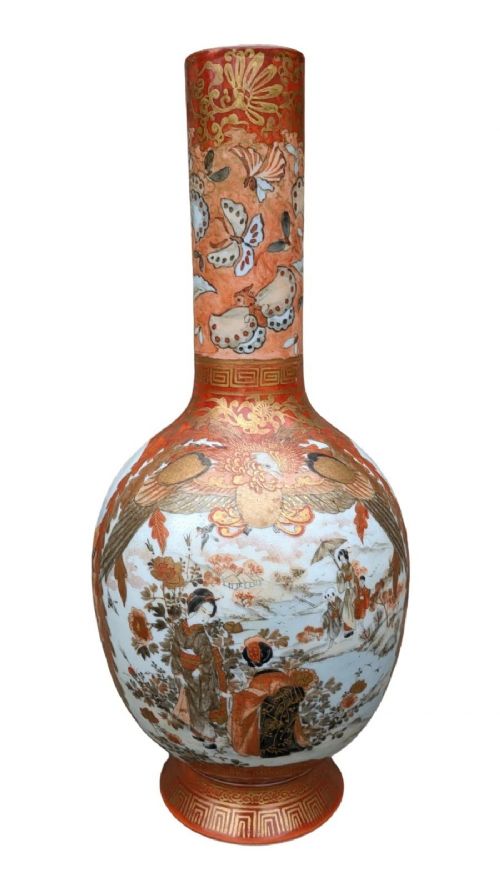


Antique Kutani Urns
Antique kutani urns are heavy Japanese porcelain vessels from the Meiji and Taisho periods, prized for rich hand-painted enamels and gold leaf.
Antique Kutani Urns
Antique kutani urns represent Japanese ceramic production largely spanning the nineteenth and early twentieth centuries, encompassing the Meiji and Taisho periods. These vessels appear most frequently as large vases, ginger jars, and flare neck forms.
The objects arriving for selection on this page span single display pieces and matched pairs, occasionally mounted as table lamps or accompanied by carved wood stands. Buyers encounter robust floor vases alongside smaller hand-painted table vessels.
Originating from the Kaga province in Japan, these items reflect both domestic aesthetic traditions and pieces produced for export markets. The forms range from stout ginger jars to tall, imposing presentation vases.
How they were made
The makers formed these vessels from white porcelain, applying mineral-based glazes and dense enamel pigments by hand. Iron-red and green pigments dominate the palette, often enriched with detailed gold leaf detailing.
Techniques such as moriage were utilised to build up raised enamel surfaces, creating tactile decoration that stands proud of the porcelain body. Gilding adds metallic lustre, framing complex figural and floral scenes.
Some nineteenth-century makers applied glazed porcelain handles modelled as fierce lions to keep watching over the ginger jars.
What varies in quality
Quality rests in the precision and density of the hand-painted brushwork across the porcelain surface. Finer examples display meticulous control in the layering of enamels and the application of gold leaf.
The architectural scale of the vessel and the crispness of moulded details, such as lion handles or flared necks, distinguish finer production. Matched pairs showing consistent glaze firing and pigment saturation command particular attention.
Kinrin Workshop
The Antique Kutani Urns Glossary
- Kutani
- A style of Japanese porcelain originating from Kaga province, known for vibrant multi-coloured enamels. The tradition evolved through distinct historical revivals.
- Moriage
- A ceramic technique where slip or enamel is piped onto the surface to create raised, three-dimensional decorative relief. This adds texture to the painted scenes.
- Meiji Period
- The era in Japanese history lasting from 1868 to 1912, marked by industrialisation and a surge in decorative export arts. Much of the surviving porcelain dates to these decades.
- Taisho Period
- The period following the Meiji era, spanning from 1912 to 1926. Pieces from this time maintain traditional enamel methods while reflecting changing twentieth-century tastes.
- Ginger Jar
- A globular ceramic vessel originally used for storing spices and preserves, featuring a wide mouth and flat base. In decorative contexts, these jars often come with matching lids.
Antique Kutani Urns: Frequently Asked Questions
How do I date an antique kutani vase?
Dating relies on stylistic markers, historical periods such as the Meiji or Taisho eras, and manufacturing characteristics. Examination of the enamel pigments and porcelain body also provides clues.
Many pieces carry specific decade attributions based on form, such as flare necks or heavy moriage decoration, aligning with late nineteenth-century export standards.
How should I display a large kutani vase?
Large presentation vases and floor vessels require stable placement on firm surfaces or designated carved wood stands. Their substantial porcelain weight demands secure positioning away from foot traffic.
Allowing adequate space around the vessel highlights the detailed hand-painted panels and gold leaf highlights without visual clutter.
Were kutani vases made for export?
A significant portion of these nineteenth-century ceramics was produced specifically for international export markets following the opening of Japan. Workshops tailored sizes and decorative schemes for Western interiors.
At the same time, traditional domestic aesthetic standards were maintained in the painting of naturalistic scenes and mythological figures.