
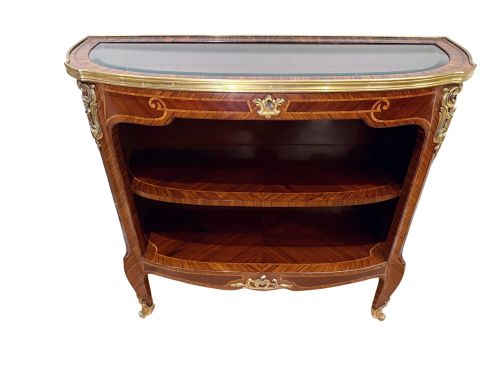


Antique Demilune Cabinet
An antique demilune cabinet brings the elegance of the half-round form into a room, offering practical storage with a distinctive curved front that suits tight spaces.
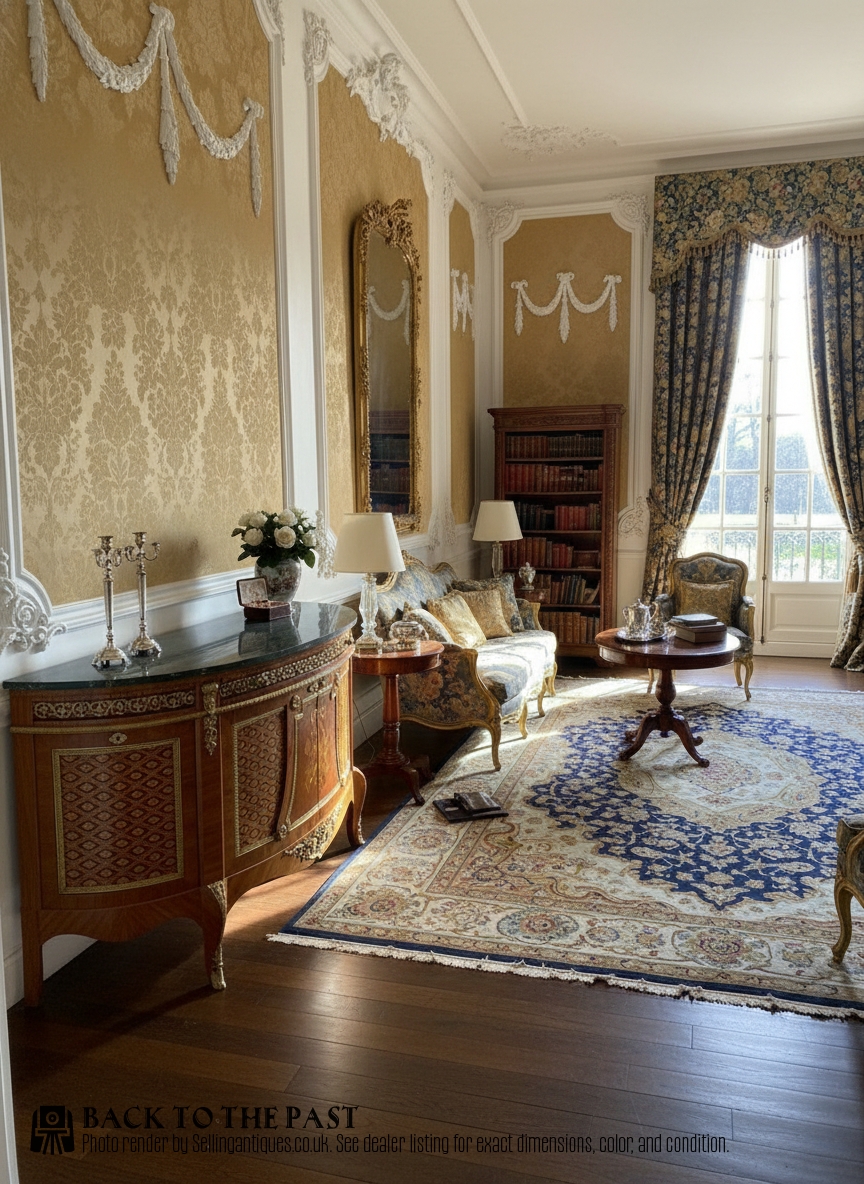
Antique Demilune Cabinet
An antique demilune cabinet is defined by its semicircular shape, standing flush against a wall whilst softening the corners of a room. These pieces appear across several eras, with English Georgian and Sheraton periods sitting alongside French Louis XVI and later revival styles.
You will encounter various iterations on this page, ranging from marble-topped commodes to satinwood side cabinets and glass-fronted vitrines. The selection draws on 18th-century roots through to 20th-century revivals, reflecting both English cabinet-making traditions and French decorative arts.
Materials and Construction
Cabinet makers utilised dense hardwoods such as mahogany and burr elm as the foundational structure, often applying veneers of satinwood, kingwood and rosewood to the curved surfaces. Marquetry and parquetry inlays create intricate geometric or floral patterns across the front drawers and doors.
Many examples feature imported marble tops, secured neatly to the curved timber frame, whilst others incorporate cast brass and ormolu mounts, handles and gallery rails. Painted finishes, including Vernis Martin techniques, appear on French pieces from later decades.
Antique Demilune Cabinet Retail Price Guide 2026
Typical asking prices for demilune cabinet among the pieces listed under this phrase on Sellingantiques today, from the lower quarter to the upper quarter. They describe what is for sale here now, not the wider market.
Listings feature mahogany, satinwood and burr elm alongside marble tops and ormolu mounts, spanning 18th-century Georgian designs to 1920s French commodes.
Assessing Craftsmanship and Detail
The distinction between standard production and exceptional work lies in the precision of the curved veneer matching and the complexity of the marquetry. Finer pieces demonstrate seamless integration of timber grains across the sweeping semicircular radius without buckling or lifting.
Hardware quality also separates the tiers, with heavy, finely chased ormolu mounts and original brass drawer furniture indicating a superior commission. The weight and choice of the marble slab, along with the crispness of hand-painted decorative panels, further define the upper tier of these pieces.
James Hicks·Paul Somani·Kaufman
The Antique Demilune Cabinet Glossary
- Demilune
- Half-moon shape, describing furniture designed with a flat back to sit against a wall and a semicircular front. This silhouette became particularly popular in late 18th-century commodes and side tables.
- Marquetry
- The art of applying decorative pieces of veneer to a structure to form intricate patterns or pictures. Craftsmen used contrasting timbers such as satinwood and rosewood to achieve tonal depth.
- Ormolu
- Gilded bronze ornamentation applied to furniture mounts, feet and galleries. This technique was heavily favoured in French cabinet making during the 18th and 19th centuries.
- Commode
- A low chest of drawers or cabinet, originating in France. The term frequently applies to grander decorative pieces featuring marble tops.
- Vernis Martin
- A type of simulated Japanese lacquer developed in France during the 18th century. It involved multiple layers of varnish applied to painted wooden panels to achieve a glossy, durable finish.
Antique Demilune Cabinet: Frequently Asked Questions
Where do I put a demilune cabinet?
These pieces excel in entrance halls, narrow landings or dining rooms where a standard rectangular cabinet protrudes too far into the walkway. Their curved profile softens rigid architectural lines in a hallway.
They also function effectively beneath a mirror in a drawing room, providing a surface for lamps or decorative objects without dominating the floor space.
How do I care for antique veneer?
Keep these cabinets away from direct sunlight and strong heat sources such as radiators, which dry out the timber and cause the delicate veneer to lift. Dust gently with a dry, soft cloth rather than using silicone sprays.
Applying a traditional beeswax polish occasionally will nourish the wood and maintain the natural lustre of mahogany, satinwood or rosewood surfaces.
Are marble tops original to these cabinets?
Many French commodes and English side cabinets were designed specifically to carry heavy marble slabs, which provided a durable, cooling surface. You can usually determine originality by examining the rebate in the timber frame where the stone rests.
Replacement marble is common due to historic breakages, though a correct period slab will match the exact semicircular radius and edge profile of the cabinet base.
How do I distinguish Georgian from revival pieces?
Georgian originals from the 18th century rely on structural integrity, native timber selection like mahogany or burr elm, and restrained, hand-cut inlay work. The interior construction utilises hand-cut dovetails and secondary woods specific to the period.
Revival pieces from the late 19th and early 20th centuries often feature more exuberant marquetry, machine-influenced precision in the framing, and brighter exotic veneers like kingwood.