
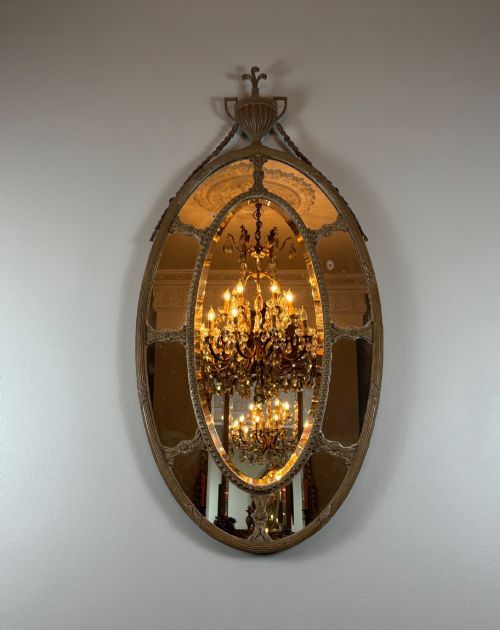
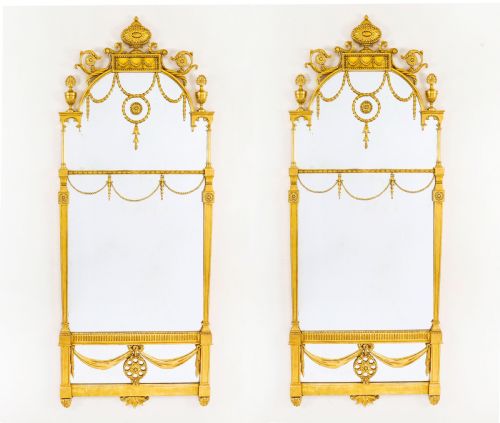


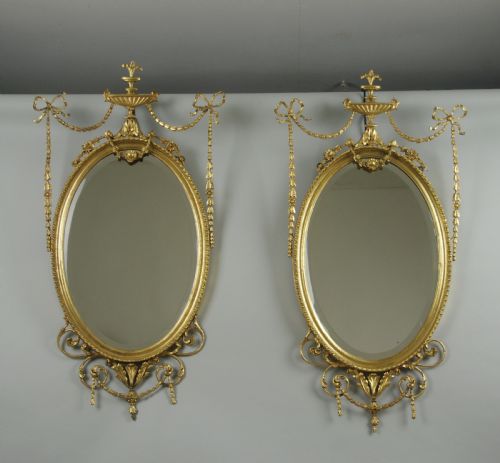


Adam Style Wall Mirror
An adam style wall mirror brings neoclassical symmetry and classical urn and swag motifs to a room, offering lightness and reflection.
Adam Style Wall Mirror
An adam style wall mirror draws upon eighteenth-century neoclassical design principles, featuring symmetrical geometries, delicate urns, swags, and classical ribbon ties. Buyers searching for this phrase encounter pieces ranging from eighteenth-century originals to nineteenth-century revivals and early twentieth-century interpretations.
The version most commonly met on this page is the nineteenth-century revival piece, particularly Victorian and Edwardian interpretations in giltwood and gesso, alongside occasional Georgian originals. These mirrors take oval, rectangular, and overmantel forms designed to hang above mantelpieces or serve as principal wall focal points.
How they were made
The construction of these mirrors relies on a wooden base frame overlaid with gesso and composition ornaments moulded into classical motifs such as swags, husks, and urns. Artisans then applied gold leaf or gilding to the prepared surfaces, creating a bright reflective finish characteristic of neoclassical frames.
Mirrors from the Georgian period through to the Edwardian era utilise traditional joinery and silvered mirror plate, sometimes supplied in segmented or border glass configurations. The combination of carved or moulded composition details on timber forms the structural foundation seen across the archive and current listings.
Some oval mirrors come with built-in candle sconces, ready for the moment the National Grid decides to take an unexpected evening nap.
What varies in quality
Quality in an adam style wall mirror rests on the crispness of the moulded or carved ornament and the depth of the gilding. Finer examples display sharply defined swags, urns, and paterae that retain their original definition beneath successive layers of gold leaf or period surface patination.
The handling of the frame structure and the quality of the glass plate further differentiate standard production from superior work. Original mirror plates often exhibit gentle foxing and distortion that speak to their age, while the underlying gesso work demonstrates the maker's precision in executing classical revival detail.
The Adam Style Wall Mirror Glossary
- Giltwood
- Timber carved and coated with gold leaf. This material forms the primary lustrous surface for formal neoclassical mirrors.
- Gesso
- A plaster-like mixture applied to wood frames to create a smooth surface for gilding. It also receives moulded decorative reliefs.
- Composition
- A moulded paste of whiting, resin, and oil pressed into ornament. It allows intricate neoclassical swags and urns to be applied to the wooden frame.
- Pier glass
- A tall mirror designed to hang on the wall between windows. These pieces reflect ambient light into the centre of a room.
- Overmantel mirror
- A wide mirror made to sit directly above a fireplace. They frequently incorporate extended horizontal proportions and elaborate crestings.
Adam Style Wall Mirror: Frequently Asked Questions
Where should I hang an adam style wall mirror?
These mirrors suit principal reception rooms, hallways, and above mantelpieces where their symmetrical neoclassical framing can anchor the wall space.
Their reflective properties also help to distribute natural light across darker corners of a room.
How do I identify a revival piece from an original?
Examination of the timber backing, the construction of the gesso, and the ageing of the mirror plate helps to distinguish eighteenth-century originals from nineteenth- and twentieth-century revival pieces.
Revival pieces often reflect Victorian or Edwardian manufacturing techniques beneath their neoclassical styling.
What materials make up the frame?
Frames typically combine a wooden carcass with gesso and composition ornamentation finished in gold leaf or parcel gilt.
Some examples also utilise mahogany as the primary visible timber rather than gilded finishes.
What is a girandole mirror?
A girandole is a wall mirror fitted with integrated candle sconces attached to the frame. These allowed candlelight to multiply within the room.
They appear in oval and circular formats within neoclassical designs.