


19th Century Stationery Casket
These 19th century stationery caskets are solid wood and brass-bound writing accessories designed to keep desks tidy, offering practical desktop organisation with period elegance.
19th Century Stationery Casket
A 19th century stationery casket is a desktop box designed to hold writing paper, envelopes, and correspondence. The pieces found here span Victorian, Regency, and French Napoleon III periods, taking forms such as dome tops, sloping fronts, and table cabinets.
Most examples on this page are fashioned from figured timbers like walnut, burr walnut, and coromandel, frequently reinforced with brass binding, mounts, or inlays. They sit upon library tables and writing desks, keeping everyday desk accessories orderly and secure.
Materials and construction
Cabinet makers utilised dense hardwoods such as oak, mahogany, rosewood, and ebony as foundations, often applying decorative veneers like burr walnut or coromandel to visible surfaces. These wooden carcasses were joined with precision and shaped into sloping desk fronts or curved dome tops.
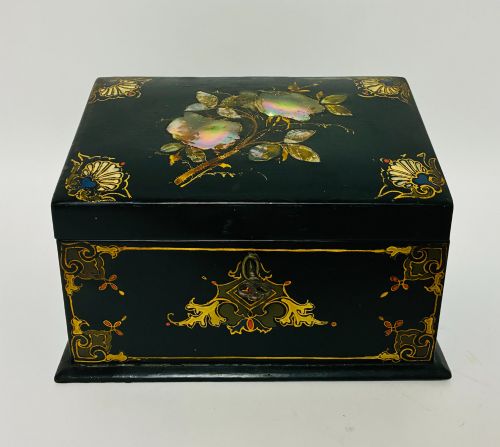
Metalwork played a structural and decorative role, with brass straps, inlaid corners, and gilt-brass mounts strengthening the corners and hinges. Details like mother-of-pearl, porcelain plaques, or agate cabochons were then inset into the wood to elevate the finish.
Listings feature Victorian, Regency, and 19th century periods, utilising materials including coromandel, burr walnut, mother-of-pearl, and brass.
Judging quality and execution
Quality rests in the selection of the timber veneers and the precision of the brass or ormolu mounts. Finer pieces display continuous grain matching across dome tops and harmonious placement of inlays without gaps.
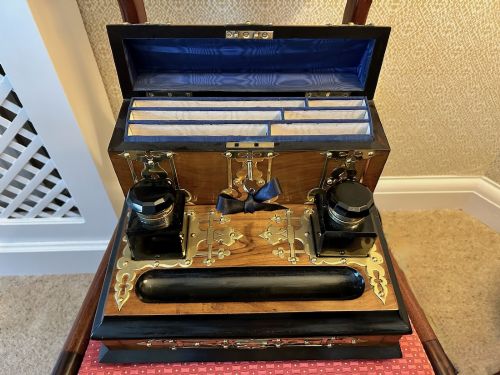
Internal arrangement and hardware also separate standard boxes from superior examples. Well-made caskets retain original fitted compartments, working locks with keys, and uncompromised hinges that support heavy lids smoothly.
The 19th Century Stationery Casket Glossary
- Stationery casket
- A desk box designed specifically for holding writing paper and envelopes. They often feature tiered internal dividers for organised filing.
- Coromandel
- A dense, heavily grained timber from South Asia and Southeast Asia, prized for its dark brown colour and dramatic contrasting stripes. It appears frequently on high-status Victorian boxes.
- Ormolu
- Cast bronze that has been gilded with a finely ground gold mercury amalgam. It provides bright metallic mounts and feet on French and English desk pieces.
- Dome top
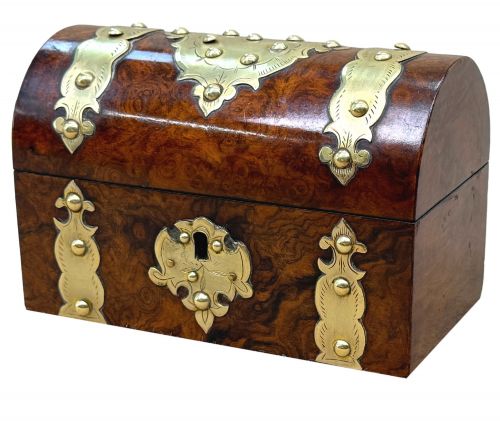
- A curved lid construction providing extra interior height for papers and ledgers. This shape is characteristic of many Victorian walnut and oak caskets.
- Brass bound
- Furniture or boxes edged or strapped with brass banding for reinforcement and decoration. This technique protects corners from knocks while adding a linear metallic contrast to the timber.
19th Century Stationery Casket: Frequently Asked Questions
What is a 19th century stationery casket?
A 19th century stationery casket is a specialised box built to store writing paper, envelopes, and small writing tools on a desk. They emerged in various woods like walnut, rosewood, and coromandel to keep correspondence neatly filed.
Most examples feature hinged lids, sometimes with domed shapes or sloping fronts, and internal dividers sized for standard letters of the period.
How do I tell a Regency box from a Victorian one?
Regency boxes, dating from the early decades of the century, often lean towards clean geometric lines with rosewood veneers and precise brass stringing. They reflect classical proportions popular during that era.
Victorian boxes, appearing from the middle of the century onwards, frequently showcase heavier timber choices like burr walnut and oak, sometimes incorporating Gothic Revival brass mounts or dome-shaped lids.
How were these boxes used on a desk?
Owners placed them on library tables, Davenport desks, or Davenport writing cabinets to keep stationery close at hand. The internal partitions held folded letters, cards, and stamps ready for daily correspondence.
Many included locks to keep private letters secure from household staff or visitors, functioning as personal archives before the era of mass-produced envelopes.
What woods should I look for?
Walnut and burr walnut are common on this page, offering rich swirls of grain under a polished finish. Coromandel and rosewood also appear, providing darker tones with striking natural patterns.
Hardwoods like oak and mahogany serve as the structural core for many brass-bound campaign and desk pieces, ensuring durability through generations of use.
Can I use a stationery casket today?
These boxes function well on modern desks for holding modern stationery, notebooks, or small keepsakes. Their internal dividers accommodate tablets, letters, and modern correspondence cards with ease.
Placing one on a work surface introduces period timber tones and practical lidded storage without altering the room's layout.