


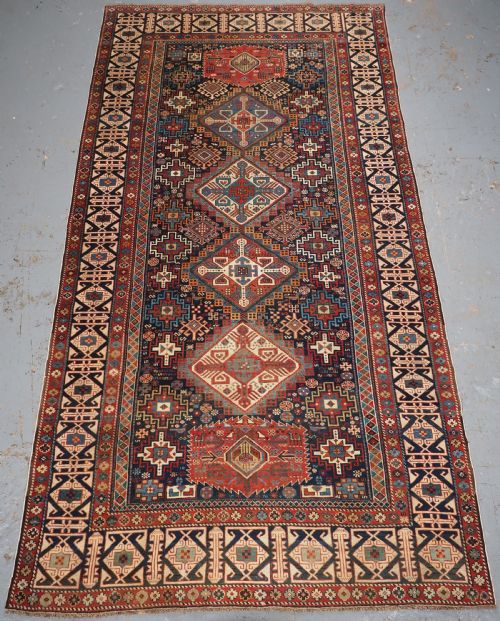

19th Century Shirvan Rug
A 19th century shirvan rug delivers geometric mastery and rich regional colour, prized by collectors for striking tribal symbolism and enduring artisanal structure.
19th Century Shirvan Rug
A 19th century shirvan rug originates from the eastern Caucasus, spanning various weaving traditions from small area sizes to elongated runners and prayer formats. Collectors seek these textiles for their crisp geometric medallions, floral lattices, and distinct regional motifs.
The most common examples encountered on this page date from the decades surrounding 1880, often displaying traditional Caucasian styles with structured borders and field designs such as prayer arches, stars, or garden compartments.
Materials and construction methods
These floor coverings utilise hand-spun wool for both the pile and the foundational structure, creating a dense and resilient textile. Weavers employed traditional techniques suited to the Caucasian tribal workshops of the period.
Colour comes from natural dyes applied to the wool, yielding deep tones and occasional variations that develop rich patinas over time. The handle of each piece reflects the tight knotting characteristic of regional weaving centres.
Look closely within the geometric borders to spot wandering stylized birds sharing space with traditional floral shrubs.
Evaluating quality and execution
The distinction between standard examples and superior pieces rests upon the precision of the drawing and the clarity of the design motifs. Finer density in the weave allows intricate elements like Kufic borders or bird details to remain sharp and legible.
Palette saturation and the complexity of the internal geometry also elevate certain specimens, particularly those featuring uncommon ground colours or scarce pictorial layouts.
The 19th Century Shirvan Rug Glossary
- Prayer rug
- A textile featuring a distinct architectural mihrab or arch design at one end, traditionally used for personal devotion. These rugs often contain specific symbolic motifs within the central field.
- Boteh
- A stylised almond or pear-shaped motif representing a floral shoot or cypress tree, frequently repeated across the field. This ancient symbol appears extensively in Caucasian weaving.
- Kufic border
- A border design imitating angular Kufic Arabic script, composed of geometric interlocking shapes. It provides a structured frame for the central field.
- Kilim
- A flat-woven textile produced without a pile, utilising slit-weave techniques to create sharp geometric patterns. Banded examples show distinct horizontal bands of colour.
- Mihrab
- The arched niche found at the top of prayer rugs, orienting the textile during use. Its shape varies significantly between different Caucasian weaving regions.
19th Century Shirvan Rug: Frequently Asked Questions
How are prayer rugs identified?
Prayer rugs are distinguished by the presence of a pointed arch or mihrab at one end of the field. This architectural feature directs the visual focus of the design.
Such formats often incorporate specific motifs like flowering plants or hanging lamps beneath the arch, separating them from standard medallion or all-over lattice field layouts.
What materials make up the pile?
The pile consists entirely of hand-spun wool gathered from regional sheep. This material provides a durable surface suited to daily floor use.
Natural dyes interact with the wool fibres to produce varied hues that mature gradually across decades of light exposure and handling.
Where were these textiles woven?
Production took place in the Shirvan region of the eastern Caucasus, encompassing towns and tribal workshops near the Caspian Sea. Weavers passed down specific border patterns and structural techniques through generations.
Local variations in design vocabulary help differentiate Shirvan output from neighbouring Caucasian weaving districts like Kuba or Dagestan.
How should a woven runner be displayed?
Runners suit long hallways, staircases, or gallery spaces where their linear format can be fully appreciated. Proper rug underlays help secure the flat-woven or piled structure against slipping on hard floors.
Rotating the textile periodically ensures even exposure to foot traffic and ambient light across the length of the piece.