

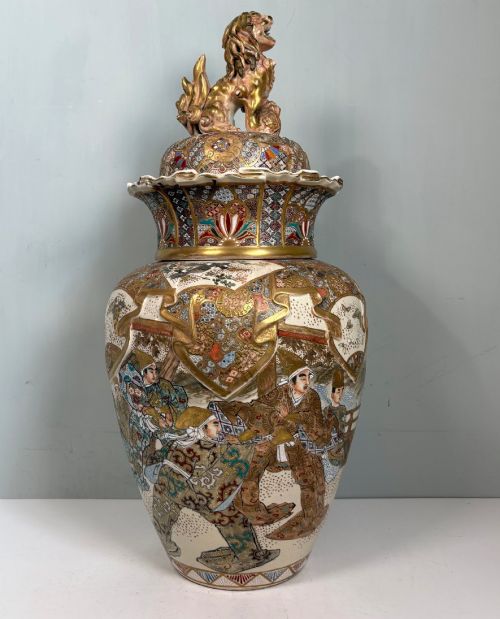


19th Century Satsuma Urn
A 19th century satsuma urn brings earthenware ceramic craft, intricate enamel work and gold leaf detail directly into a room.
19th Century Satsuma Urn
When you search for a 19th century satsuma urn, you encounter earthenware and porcelain vessels originating from Japan during the Meiji period. The items on this page span the nineteenth century, including pieces dated around 1880, 1890, 1900, and the Victorian era.
The forms vary from large lidded vases and garlic head shapes to miniature vessels, pairs, and even pieces adapted as table lamps. Many incorporate figural processions, samurai scenes, or depictions of Mount Fuji alongside the Shimazu crest.
Originating from Kyoto and associated makers such as Hayakawa, these ceramics represent a distinct intersection of Japanese Meiji period aesthetics and European export tastes. Buyers find both monumental display pieces and smaller cabinet items among the selections.
Materials and Techniques
Maker workshops built these vessels using earthenware or porcelain bodies, shaped into large urns, garlic head vases, and polygonal forms. Artisans then applied detailed enamel decoration across the ceramic surface.
Gold leaf and gilt accents highlight figural scenes, processions, and heraldic crests such as the Shimazu mark. Some large lidded examples are accompanied by fitted wooden elements or display fabric components.
19th Century Satsuma Urn Retail Price Guide 2026
Typical asking prices for 19th century satsuma urn among the pieces listed under this phrase on Sellingantiques today, from the lower quarter to the upper quarter. They describe what is for sale here now, not the wider market.
Elephants stand guard on handles while samurais march across miniature vases, proving that nineteenth-century artisans loved a grand battle scene.
Distinctions in Quality
Quality rests upon the precision of the enamel work and the finesse of the gilt figural scenes painted across the earthenware. Denser, cleaner brushwork and crisper rendering of samurai processions or landscape details distinguish finer examples from simpler production.
The complexity of the vessel shape also marks a difference, with finely modelled handles like elephant motifs or intricate polygonal forms requiring greater skill from the potter than standard cylindrical vases.
Hayakawa
The 19th Century Satsuma Urn Glossary
- Satsuma
- Earthenware pottery originating from the Satsuma Province in Japan, characterised by a fine crackle glaze and detailed polychrome enamel painting. It became widely exported during the Meiji period.
- Meiji Period
- The era in Japanese history spanning from 1868 to 1912, corresponding with the reign of Emperor Meiji. Pieces from this time often combine traditional motifs with styles suited for Western markets.
- Shimazu Crest
- The heraldic symbol of the Shimazu clan, featuring a cross within a circle. It frequently appears on Satsuma ceramics as a mark of patronage or origin.
- Garlic Head Vase
- A ceramic vessel featuring a bulbous constriction near the top of the neck that resembles a bulb of garlic. This distinct form appears in several nineteenth-century Japanese pieces.
- Enamel
- Vitrified glass paste applied to the ceramic surface and fired to create colourful decorative scenes. It provides the vibrant red, blue, and green hues found on these wares.
19th Century Satsuma Urn: Frequently Asked Questions
What distinguishes satsuma ware from other Japanese ceramics?
Satsuma ware is defined by its characteristic earthenware body, ivory-coloured crackle glaze, and intricate hand-painted enamel designs enhanced with gold leaf. It relies on decorative figural or landscape scenes rather than simple studio pottery glazes.
These pieces were heavily produced for export during the Meiji period, satisfying Western demand for ornate Japanese craftsmanship.
How were these large urns originally used?
Large lidded urns and tall vases served primarily as decorative display pieces in nineteenth-century drawing rooms and parlours. Their grand scale allowed them to act as focal points in domestic interiors.
Some examples were later adapted into table lamps to suit changing interior uses while retaining their traditional ceramic bases.
How can I identify a Meiji period piece?
Meiji period pieces align with the late nineteenth century, spanning from 1868 to 1912. The items often feature detailed depictions of samurai, figural processions, or Mount Fuji.
Craftsmen during this time refined enamel and gilding techniques to appeal to international buyers following the reopening of Japanese trade.
Where were these ceramics made?
While the style originated in the Satsuma Province, many refined export pieces were produced in Kyoto workshops. Makers in these urban centres catered specifically to the Victorian appetite for Japanese art.
Specific workshops and artists, such as Hayakawa, signed or marked their creations to denote their origin.
How do I care for antique earthenware urns?
Keep these delicate earthenware and enamel pieces out of direct sunlight to protect the vibrant colours and gold leaf details. Dust them gently with a dry, soft cloth without using water or cleaning solutions.
Handle lidded urns with care, lifting the lid separately from the main body to prevent accidental drops.