

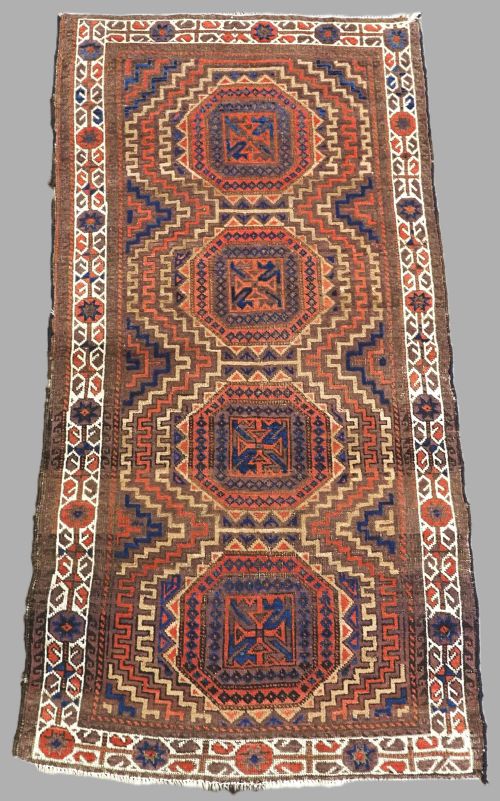


19th Century Baluch Rug
When you search for a 19th century baluch rug, you encounter hand-knotted tribal textiles woven by nomadic and village groups across the borders of Persia and Afghanistan.
19th Century Baluch Rug
A 19th century baluch rug encompasses tribal floor coverings and small formats woven across regions spanning western Afghanistan and eastern Persia. The pieces listed here frequently carry tribal attributions such as Timuri, Bahluli, and Mahdad Khani, reflecting specific regional weaving traditions.
The format varies from small prayer rugs featuring mihrab arches to larger main carpets and compact birdbag containers. Designs incorporate traditional motifs including guls, shrub patterns, tree of life compositions, and the distinctive Dokhtar-e-Qazi design.
Most examples originate from the latter decades of the nineteenth century, typically dated between the eighteen-seventies and nineteen-hundreds. They serve as functional portable furnishings created by tribal weavers using traditional geometric and stylized botanical layouts.
Materials and construction
Weavers constructed these textiles using hand-spun wool for the pile, combined with foundations of wool, cotton, or goat hair. Certain examples incorporate camel hair into the foundation or pile to introduce natural warm brown tones.
The coloration relies upon natural dyes that produce deep, rich hues across blue grounds, camel fields, and multi-coloured borders. Artisans knotted the wool by hand onto flexible foundations suited to nomadic transportation and daily use.
19th Century Baluch Rug Retail Price Guide 2026
Typical asking prices for 19th century baluch rug among the pieces listed under this phrase on Sellingantiques today, from the lower quarter to the upper quarter. They describe what is for sale here now, not the wider market.
The listings demonstrate production spanning from eighteen-seventy through to nineteen-hundred, utilising hand-spun wool, cotton, goat hair, and camel hair.
Evaluating quality and merit
Quality in these tribal pieces rests upon the precision of the knotting, the handling of the wool, and the depth of the natural dyes. Finer examples display tightly packed piles that preserve intricate geometric details like calyx lattices and repeating star motifs.
Design execution and format scarcity elevate individual pieces above standard production. Well-drawn motifs, balanced proportions, and unusual structural formats demonstrate superior craftsmanship within regional tribal traditions.
The 19th Century Baluch Rug Glossary
- Gul
- A medallion motif repeated across the field of a carpet. These octagonal or polygonal designs often identify specific tribal origins.
- Prayer rug
- A small format textile featuring a mihrab or arched niche at one end. Weavers designed these pieces to indicate the direction of prayer.
- Dokhtar-e-Qazi
- A specific prayer rug design associated with Timuri and Baluch weavers. The name translates from local terminology relating to the judge's daughter pattern.
- Camel hair
- Animal fibre utilised in its undyed natural state to form soft brown backgrounds. It appears frequently in the field designs of desert-woven textiles.
- Natural dye
- Colouring matter derived from plants, insects, or minerals prior to the introduction of synthetic alternatives. These dyes age with harmonious patination.
19th Century Baluch Rug: Frequently Asked Questions
How do I identify a Timuri baluch rug?
Timuri rugs share technical characteristics and design vocabulary with broader Baluch production, originating from the borderlands between Persia and Afghanistan. Look for finely knotted structures and specific motifs such as small shrubs or repeating leaf patterns.
Many pieces combine attributes of both groups due to overlapping tribal territories and shared nomadic heritage. Examining the wool quality and secondary foundation materials helps clarify the specific regional attribution.
What is a birdbag textile?
A birdbag, or torba, is a small utilitarian container woven by tribal groups for storage and domestic transport. These compact pieces feature specialised dimensions suited to hanging inside tents or carrying personal belongings.
Despite their small size, they share the dense hand-spun wool construction and natural dyes found in larger floor carpets. Collectors value them as intact examples of functional nomadic craftsmanship.
Where were these tribal rugs made?
The pieces originate from regions spanning western Afghanistan, eastern Persia, and the Khorasan and Ferdows districts. Nomadic and village tribes inhabiting these arid borderlands produced the textiles for domestic utility and local trade.
Geographic attributions often reference specific tribal subgroups such as the Mahdad Khani or Bahluli. Local environmental conditions influenced the availability of materials like camel hair and sheep's wool.
How should I care for an old wool rug?
Maintain the textile by using a smooth suction vacuum without beater bars to remove embedded dust gently. Protect the hand-spun wool and natural dyes by keeping the piece away from direct, harsh sunlight.
Rotating the rug periodically ensures even exposure to foot traffic and light. Professional conservation cleaning should be undertaken sparingly by specialists experienced in antique textiles.