




19th Century Arita Porcelain
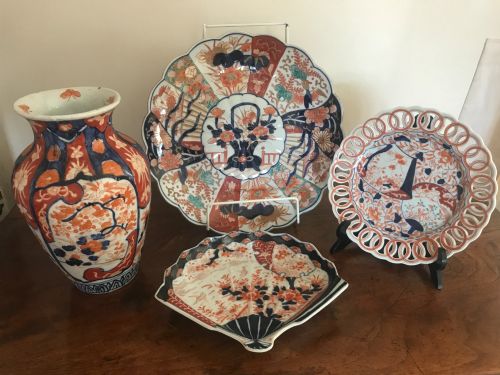
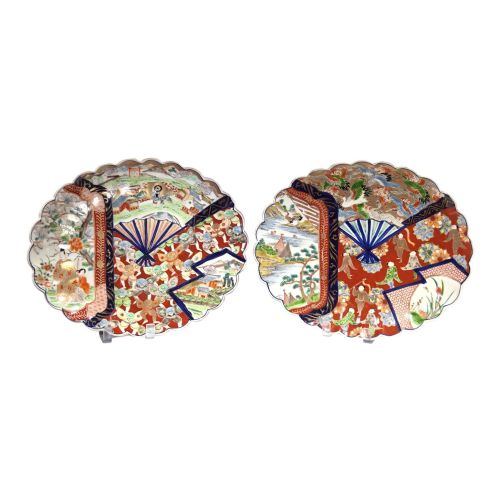
These 19th century arita porcelain pieces bring vibrant Japanese Imari palette work and blue and white glaze decoration into any room.
19th Century Arita Porcelain
When you search for 19th century arita porcelain, you encounter ceramic vessels and wall plates created in Japan during the Edo and Meiji periods. The forms range from large chargers and ginger jars to pairs of spill vases and bowls.
The most common examples on this page are Japanese Imari chargers and plates featuring scalloped rims and traditional decoration. Alongside these, blue and white porcelain and Kakiemon style pieces appear frequently.
How they were made
Potters shaped porcelain bodies and applied cobalt underglaze before firing, creating deep blue tones beneath the clear ceramic glaze. Artisans then added enamel paint and gold leaf details over the glaze in subsequent low temperature firings.
Specialised workshops produced items utilising rich enamel glaze and gilt highlights to accentuate intricate patterns. The physical weight and substantial dimensions of chargers and large vases reflect the scale of production in this era.
Some nineteenth-century plates carry the mark of maritime trade, decorated with black ship motifs recording foreign vessels in Japanese waters.
What varies in quality
The precision and depth of the cobalt underglaze painting separate standard output from finer artistic achievements. Crisp brushwork across complex floral and geometric motifs indicates greater skill in the kiln.
The richness of the gilding and the crispness of the enamel work dictate the visual impact of each vessel or charger. Pieces bearing specific kiln or maker attribution, such as Fukagawa, demonstrate higher tier manufacturing.
Fukagawa
The 19th Century Arita Porcelain Glossary
- Imari
- A style of Japanese porcelain decorated in underglaze blue, iron red, and gold, originating from the port of Arita. These pieces gained immense popularity in Europe during the nineteenth century.
- Charger
- A large decorative plate intended for display on a wall or dresser rather than for dining use. Nineteenth-century examples often feature scalloped rims and dense panel designs.
- Kakiemon
- A refined style of Japanese enamel decoration characterised by asymmetrical designs on a milky white porcelain body. The palette typically employs soft red, yellow, green, and blue.
- Underglaze blue
- A decorative technique where cobalt oxide is applied to the raw ceramic body before glazing and firing. This method protects the blue pigment beneath a glassy surface layer.
- Ginger jar
- A ceramic storage vessel with a rounded body and a matching cover, originally used for spices. Nineteenth-century variants served largely as decorative garniture elements.
19th Century Arita Porcelain: Frequently Asked Questions
How do I hang a heavy charger?
Large chargers require specialised spring clip hangers that distribute the weight evenly across the rim. Ensure the wall fixing is secure before mounting any ceramic piece.
Avoid wire attachments that grip only a small section of the porcelain edge. Check the stability of the mount periodically.
Were these pieces made for export?
Many nineteenth-century Arita items were produced specifically for Western markets following the opening of Japanese trade ports. The large scale of chargers and vases catered to Victorian interior display tastes.
Export pieces often combined traditional Japanese motifs with forms familiar to European collectors. This cross-cultural exchange defined much of the Meiji period ceramic output.
How do I clean antique porcelain?
Dust surfaces gently with a soft, dry brush to prevent the accumulation of particles in recessed glaze details. Avoid harsh chemical cleaners that might damage delicate enamel and gold leaf accents.
Immerse ceramics in water only when strictly necessary, and support the base with both hands. Pat dry immediately with a lint-free cloth.
What is the difference between Arita and Imari?
Arita refers to the Japanese town and surrounding region where the porcelain clay and kilns originated. Imari is the port town from which these ceramics were shipped.
Over time, the name Imari became synonymous with the specific blue, red, and gold decorative style produced in Arita kilns. Collectors use both terms to describe this heritage.