


A 2026 Guide by Sellingantiques
Thomas Chippendale popularised the form in mid-18th century Britain. His designs quickly set the standard for formal seating.
Look at pattern books from the period. They often show antique camelback sofas with carved mahogany legs replacing the earlier cabriole style.
Production continued well into the nineteenth century. Later variations frequently adopted the heavier proportions favoured by Victorian tastes.
Regional cabinetmakers copied London styles. You often find country variations executed in local timbers rather than imported mahogany.
Thomas Chippendale produced many during his working period from the 1750s to 1779. His workshop supplied complete suites of seating furniture.
George Hepplewhite is another documented name. The 1788 Cabinet-Maker and Upholsterer's Guide includes designs with the characteristic serpentine back.
Remember that most surviving examples carry no maker marks. The London trade operated through complex networks of anonymous frame makers and specialist upholsterers.
The 2026 retail price guide for Antique Camelback Sofas is drawn from a proprietary archive of over 1.1 million retail prices indexed by Sellingantiques since 2003. This guide relies exclusively on their own internal data; no external sources or auction records are used.
Analysing nearly 25 years of UK antique market history alongside current retail values, the data indicates that typical UK retail prices for Antique Camelback Sofas range between £1,900 and £6,500. Entry-level prices generally fall under £1,900 and premium examples upwards of £6,500.
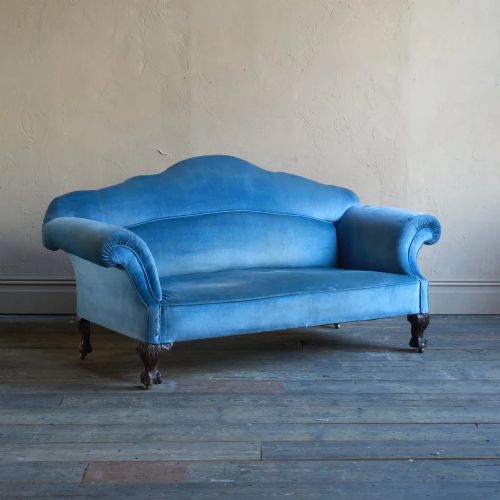
The central hump is the defining characteristic. Some versions feature a triple serpentine curve along the top rail rather than a single arch.
Outward scrolling arms wrap the sitter. Tightly upholstered sides give the profile a tailored outline.
Legs vary by period. Straight Marlborough legs with block feet dominate the later Georgian era.
Frame makers used hand-sawn beech for the complex curved sections. You often find these curved elements joined with simple dowels.
Horsehair stuffing builds the distinct humped profile. Upholsterers stitched and moulded this dense material over coarse linen to hold the rigid shape.
Early seating relies on webbing and stuffing alone. Coil springs only appear in the seat construction of nineteenth-century versions.
"The undulating back profile creates a natural division of space. It visually separates the wall behind from the seated area."
"Many feature eight-way hand-tied stitching in the seat base. This traditional method distributes weight evenly across the frame."
"Open space beneath the seat remains clear. You won't find solid timber bases under the traditional horsehair stuffing."
Based on almost 25 years of Sellingantiques UK antique market data, Antique Camelback Sofas appeared 46 times (out of 1,100,000 antiques) which gives it a rarity score of 99/100.
This score measures scarcity within the Sellingantiques archive only and is not a survey of the entire antiques market, so these statistics may not be indicative of the general availability of Antique Camelback Sofas elsewhere.
They tend to command space. The sweeping rolled arms extend outwards, making the overall footprint wider than the seating area.
Positioning one requires leaving breathing room at the sides. They don't usually fit well wedged tightly between other large pieces.
Exposed wooden legs actually create a sense of lightness. Because you can see the floor beneath the seat, the piece feels less grounded than modern block sofas.
The humped back draws the eye upwards. This vertical movement often works well to balance contemporary rooms with lower ceilings.
They offer a firm sit. The shallow seat depth is meant for formal posture rather than lounging.
They work best in hallways where people sit for shorter periods.
Stripping the old fabric reveals the bare carcase. A skilled upholsterer can remove the degraded stuffing and assess the internal beech framing.
Old frames often survive well despite surface damage to the covers. Loose joints can be re-glued and wedged before new webbing goes on.
Re-covering them is standard practice. The timber frame was built to outlast multiple generations of upholstery fabric.
Please note: This Antique Camelback Sofas guide and its associated pricing data are provided for general informational purposes only. It does not constitute formal financial, investment, or appraisal advice and should not be relied upon as the sole basis for any commercial activity, purchasing, or sales decisions. Sellingantiques.co.uk accepts no liability for any actions taken in reliance on this information. Always consult with a qualified professional or independent appraiser.
