





A 2026 Guide by Sellingantiques
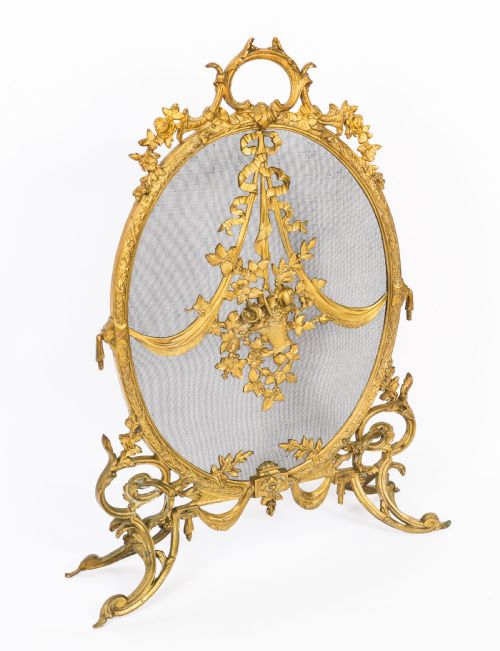
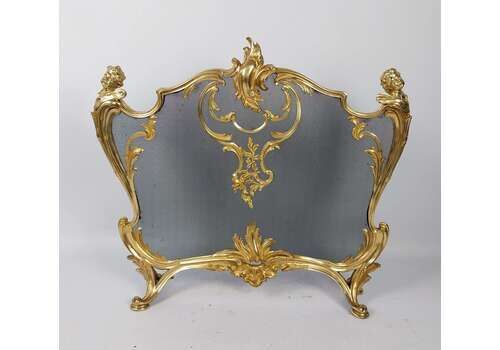
Antique French Gilt Bronze Fire Screen, 1910
Priced at £650 from Andrew Lovatt Antiques
Early examples from the seventeenth century often stood on heavy trestle bases to block draughts from large, open chimneys.
Georgian society demanded something lighter. Small, movable tripod stands became the rule for drawing rooms.
Check the scale. You'll notice nineteenth-century versions often sit much lower to the ground, matching the shift towards coal-burning grates.
Victorian households sometimes treated them as seasonal furniture. They filled the empty hearth space during the summer months with brightly painted papier-mâché panels.
Thomas Chippendale supplied several pole screens to grand houses in the 1770s, using elaborate carved mahogany tripods.
Gillows of Lancaster made solid mahogany cheval screens. Their trade catalogues from the late eighteenth century show neat frames with reeded borders.
Regional carvers produced the vast majority of these frames without leaving a stamp. The needlework itself was usually done by women of the household.
Needlework Sampler Firescreen, Regency
Priced at £275 from Midwinter Antiques
The 2026 retail price guide for Antique Fire Screens is drawn from a proprietary archive of over 1.1 million retail prices indexed by Sellingantiques since 2003. This guide relies exclusively on their own internal data; no external sources or auction records are used.
Analysing nearly 25 years of UK antique market history alongside current retail values, the data indicates that typical UK retail prices for Antique Fire Screens range between £300 and £1,400. Entry-level prices generally fall under £300 and premium examples upwards of £1,400.
Most early tripod designs use a slender central pole. The panel slides up and down to match the height of whoever is sitting nearby.
Cheval screens feature two upright posts instead of one. These rest on four splayed legs and hold wider, fixed panels.
Inspect the back. A well-made antique fire screen has neat silk or backing cloth covering the reverse side, keeping the raw threads hidden.
Gothic Iron Fire Screen, Spark Guard, 1920
Priced at £350 from Elmgarden
Tripod bases rely on a solid block at the bottom of the central column. The three legs join using sliding dovetails glued firmly into place.
Frames around the fabric panels rely on mortise and tenon joints at the corners. They've got to be strong enough to hold canvas tight.
Metal springs often hide inside the sliding block of a pole screen. This provides enough friction against the wooden shaft to stop the panel dropping.
"Some Georgian panels fold out into small tables. The flat screen hinges downwards and locks horizontally to hold a teacup."
"The needlework in the central panels often preserves colours better than wall tapestries. Because they faced away from the sun, the dyes stayed bright."
"Many tall tripod examples dismantle into three distinct pieces. The base, upright pole and framed panel separate easily for flat storage during the summer."
Based on almost 25 years of Sellingantiques UK antique market data, Antique Fire Screens appeared 1096 times (out of 1,100,000 antiques) which gives it a rarity score of 80/100.
This score measures scarcity within the Sellingantiques archive only and is not a survey of the entire antiques market, so these statistics may not be indicative of the general availability of Antique Fire Screens elsewhere.
Gentle vacuuming works best for loose dust. Tie a piece of nylon stocking over the vacuum nozzle and hover it just above the fabric surface without pressing down.
Wet cleaning is risky for old dyes. If the needlework has heavy soot staining, it needs an expert textile conservator rather than a domestic carpet cleaner.
On most pole screens, yes. The top finial unscrews and the sliding block lifts straight off the central pillar.
Taking the fabric out is harder. They're usually tacked in from behind under a pasted backing cloth.
A leaning pole screen usually points to a problem in the base rather than a bent upright. The sliding dovetails joining the legs to the central block loosen over time.
Check where the legs meet the pillar. If the joints are loose, a restorer can clean out the old glue and re-seat the legs to make the piece plumb again.
Putty isn't needed and can damage the wood. Originally, these glass panels were held tight by thin wooden sprigs or glazing beads tacked onto the inside edge of the frame.
If the glass is loose, those beads have likely shrunk or lost their pins. Tapping a few tiny veneer pins back into the existing wooden beads will secure the glass firmly.
Please note: This Antique Fire Screens guide and its associated pricing data are provided for general informational purposes only. It does not constitute formal financial, investment, or appraisal advice and should not be relied upon as the sole basis for any commercial activity, purchasing, or sales decisions. Sellingantiques.co.uk accepts no liability for any actions taken in reliance on this information. Always consult with a qualified professional or independent appraiser.
