



Antique Queen Anne Dressing Tables
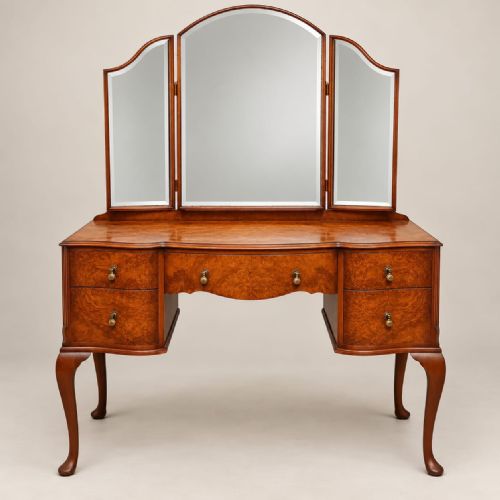
A bedroom table with a mirror above and drawers below, made in the Queen Anne taste with cabriole legs and figured walnut veneer.
Antique Queen Anne Dressing Tables
The name in the title is a style label, not a date. Queen Anne here means a set of early eighteenth-century features - cabriole legs, pad feet, shaped aprons, figured walnut veneer - that came back into favour for bedroom furniture in the early twentieth century. Dealers write "Queen Anne" and "Queen Anne style" almost interchangeably.
The dominant piece is a burr walnut dressing table of the 1920s. Of 52 dated listings on Sellingantiques, 40 fall in that one decade, walnut is named in 52 of 58 titles and burr walnut in 40. So the table you meet is veneered, well figured, with a mirror above a drawered base on cabriole legs.
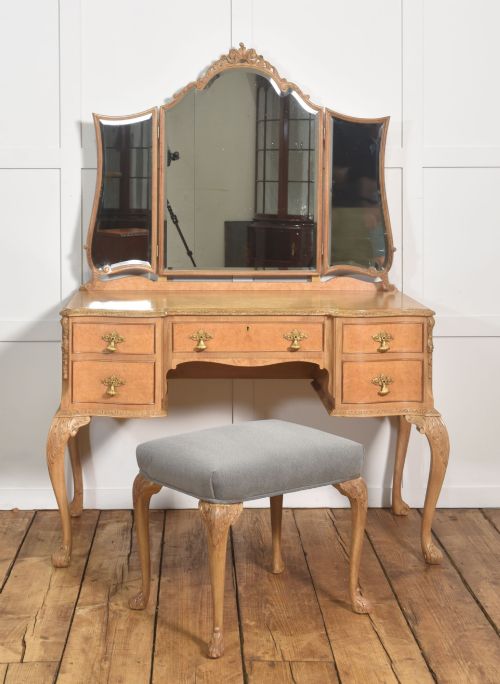
Behind that run there are variations. Roughly a fifth are plain walnut rather than burr, and one sampled title is mahogany. Shaped fronts get singled out when they occur: serpentine twice in the sample, kidney-shaped once. A small recurring group is sold with a stool, a chair or a matching mirror, and triple mirrors appear twice.
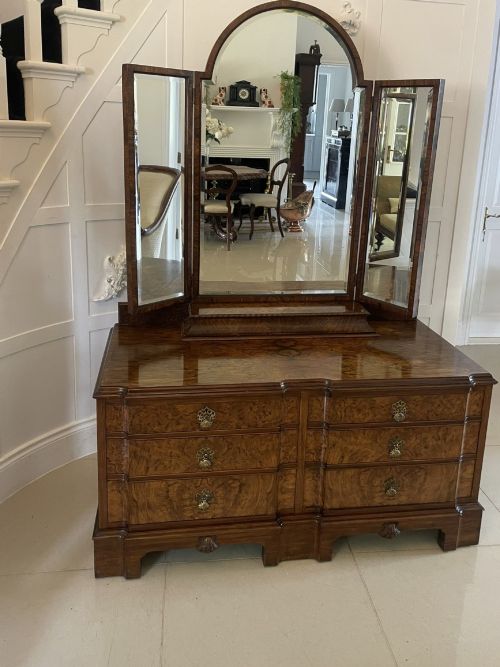
Genuine period pieces are a handful. Only two listings in the whole archive carry an eighteenth-century date, and they take different forms: a featherbanded walnut lowboy with a quarter-veneered top, and a bachelors dressing chest. Two chinoiserie lacquered examples turn up, plus single listings dated 1850 and 1890.
Where The Range Splits
Timber and figure do most of the work. Burr walnut clusters through the upper half of the sampled range, plain walnut sits below it, and the single mahogany table falls at the very bottom. In a category this single-minded about one wood, the grade of veneer is the main thing separating one table from the next.
After figure comes shape and completeness. A serpentine or kidney front gets named in the title because it is uncommon, and those shaped profiles sit high. So do the tables that arrive with their stool, chair or matching mirror rather than on their own. Chinoiserie lacquer, which appears twice, also sits above the walnut middle.
Then there is period against revival. The two eighteenth-century listings occupy the highest ground in the sample, the bachelors dressing chest at the very top. Everything else is interwar work in an older taste, and valued as such.
Antique Queen Anne Dressing Tables Retail Price Guide 2026
Typical UK retail prices for queen anne dressing tables, calculated from the Sellingantiques database of over a million retail prices indexed since 2003. This retail price guide relies exclusively on Sellingantiques data; no external sources or auction records are used, so the figures do not describe the wider market.
Only two listings in the whole Sellingantiques archive are dated to the eighteenth century: a featherbanded walnut lowboy and a bachelors dressing chest.
The Antique Queen Anne Dressing Tables Glossary
- Queen Anne style
- In these titles, a description of cabriole-legged walnut form rather than a date. It runs alongside plain "Queen Anne" with no consistent distinction between the two.
- Burr walnut
- Veneer cut from a burr or knotty growth, giving a dense swirled figure. Named in 40 of 58 titles, which makes it the default surface of the category.
- Cabriole leg
- The S-curved leg that, more than any other feature, earns a table the Queen Anne label in these listings.
- Serpentine fronted
- A front with an outward-then-inward waved profile. It appears in a pair of sampled titles, and dealers treat it as worth naming.
- Triple mirror
- A central plate with two hinged side wings, so the sitter sees three angles at once. Two sampled titles carry one.
- Lowboy
- A low side table with drawers on legs, the eighteenth-century ancestor of the dressing table. One appears in the archive, featherbanded with a quarter-veneered top.
Antique Queen Anne Dressing Tables: Frequently Asked Questions
Are these actually from Queen Anne's reign?
Almost never. The dated listings on Sellingantiques run from 1850 to 1930, and 40 of the 52 clean years fall in the 1920s.
Only two listings in the whole archive are given an eighteenth-century date, and one of those is a lowboy rather than a dressing table proper. Queen Anne in the title describes the styling.
What wood are they made from?
Walnut, and little else. It is named in 52 of 58 titles, usually as veneer, with burr walnut in 40 of them.
That leaves about a dozen plain-walnut listings and a single mahogany table. It is one of the most single-minded timber categories a buyer will meet on Sellingantiques.
Do they come with a stool?
Sometimes. Sampled titles add "and Stool" four times, "and Chair" once and "and Mirror" once, so the accompanied table is a recurring minority rather than the norm.
Those listings tend to sit above the middle of the range.
How many turn up for sale?
Not many. Twenty-three dealers have listed in this category, and only about four pieces reach the market in a year.
That means most dealers here have handled one and moved on.
Why do so many say c1920?
Because dealers use the term loosely as shorthand for the interwar period rather than a precise year.
Read a 1920 date in this category as "interwar". The decade breakdown backs it up: 1920s 40 listings, 1930s six, 1910s two, 1900s two.
Which shapes appear in the titles?
Straight fronts are the default and go unmentioned. When the front is shaped, dealers say so.
Serpentine appears twice in the sampled titles and kidney-shaped once. Both sit toward the upper half of the range.